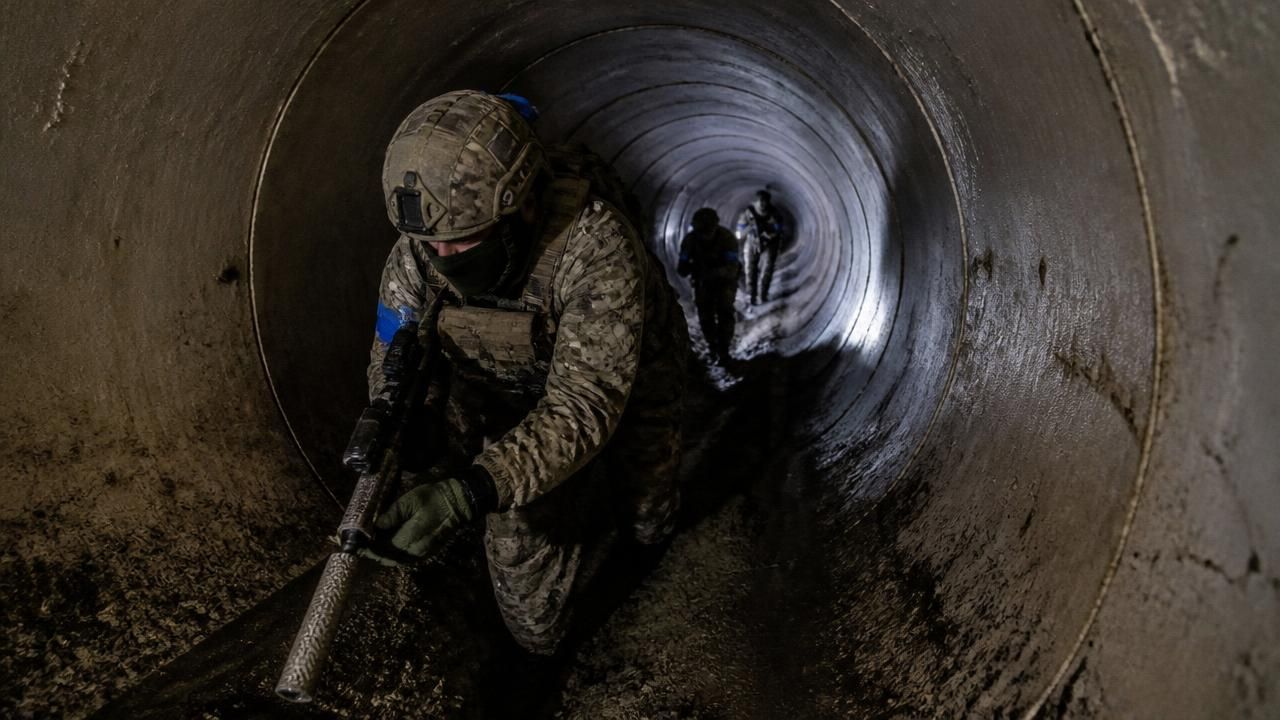
KUPIANSK, Ukraine — The war along Ukraine's northeastern front has moved into a claustrophobic new arena: abandoned gas pipelines beneath the kill zone. Ukrainian soldiers are using the disused pipes to move unseen toward positions near the front, according to The New York Times, whose correspondent Maria Varenikova traveled with troops through the underground route and into positions where soldiers can spend weeks at a time. The journey, the Times reported, takes troops through a landscape watched by drones and exposed to artillery, where above-ground movement can be fatal.
The outlet's account was echoed across Ukrainian and international coverage this week. MSN framed the shift simply: Ukraine's war is going underground as troops battle inside gas pipelines. Yahoo, citing the Khartiia formation, reported that Ukrainian troops had infiltrated the Russian rear through pipelines near Kupiansk. Ukrainian outlet NV said Khartiia had launched an underground counteroffensive and advanced more than 15 kilometers near Kupyansk, while separately quoting a Khartiia colonel who described the operation as “fighting in a new dimension.”
A new phase: from Vivaldi to VELES
The pipeline operations appear to be part of a broader tactical turn. MSN reported that Operation Vivaldi is over and that Ukraine is now moving the war underground with Operation VELES. Yahoo, in a separate report, said Ukraine outmaneuvered Russian troops in Operation Vivaldi. The operational details remain tightly guarded, and the naming of phases may reflect both battlefield reality and information strategy. But the direction is clear: after months of drone-dominated combat, Ukrainian units are looking for ways to bypass the exposed ground that separates them from Russian positions.
The Wall Street Journal, as summarized by UA.NEWS, reported that Russia is preparing for an underground war and that fighting continues near Kupiansk along gas pipelines. That framing suggests the pipeline tactic is not merely a Ukrainian innovation but a potential new front in the war, one that could force both sides to adapt doctrine, equipment and training.
How the pipeline route works
The pipelines offer cover from the reconnaissance drones and first-person-view attack drones that now dominate the battlefield. Above ground, troops crossing open fields can be spotted and struck within minutes. Below ground, the pipes provide a concealed route — but also a dangerous one. Soldiers must navigate confined spaces, poor visibility, uncertain structural integrity and the risk of discovery or ambush. The Times described troops moving through the kill zone and into positions where they can remain for weeks, a sign that the underground route is being used not just for a raid but for sustained positioning.
“Fighting in a new dimension,” a Khartiia colonel said, according to NV, describing how the underground operation near Kupiansk unfolded.
The most sensational claim came from The Sun, which reported that Ukrainian troops sneaked into Russian lines through underground gas pipes in a brazen operation that left 100 Russian soldiers dead. That casualty figure has not been independently verified, and the tabloid's framing should be treated with caution. Still, even the more sober accounts point to a significant tactical event: Ukrainian forces using subterranean routes to appear where Russian troops did not expect them.
Drones overhead, troops underground
South Carolina Public Radio captured the atmosphere of the front with a report describing drones buzzing overhead while troops hunker underground in Ukraine's hellish kill zone. That image helps explain why pipelines have become attractive. The skies are saturated with surveillance and strike drones, making camouflage and concealment more important than ever. Underground movement is a low-tech answer to a high-tech problem — a way to reduce exposure to the sensors and munitions that make open ground so lethal.
The tactic also carries echoes of earlier sieges and tunnel warfare, from the trenches of World War I to the steelworks of Mariupol. But the Kupiansk pipeline operations are distinctive because they use existing industrial infrastructure as a military corridor. They show how the war is being shaped by the physical landscape as much as by weapons: pipes, forests, ruins and minefields all become part of the battlefield.
Differing frames and a wider signal
The coverage diverges in emphasis. The New York Times focuses on the human experience of soldiers moving through the kill zone and living underground for weeks. Ukrainian outlets such as NV emphasize operational success and the Khartiia colonel's account of a new dimension of fighting. The Wall Street Journal, via UA.NEWS, stresses Russian preparations for underground war. Yahoo highlights the outmaneuvering of Russian troops in Operation Vivaldi, while MSN links the shift to the transition from Vivaldi to VELES. The Sun accentuates casualties and drama. Each frame captures part of the story: a tactical innovation, an information campaign, and a battlefield adaptation forced by drones.
The underground operations are not the only sign of how Ukraine's front-line experience is traveling. Stars and Stripes reported that Ukrainian soldiers are tapping their front-line experience to scout for US armor in a Bavaria exercise. That training event is separate from the Kupiansk pipeline operations, but it points to the same reality: Ukrainian troops are now exporters of hard-won battlefield knowledge, helping NATO forces understand how drones, armor and concealment interact in modern war.
What it means for the war
Kupiansk remains a critical sector. If Ukrainian units can use pipelines to infiltrate Russian rear areas, they can disrupt supply lines, force redeployments and create uncertainty. If Russia adapts — as the Wall Street Journal report suggests it is trying to do — the underground route could become another contested zone, with ambushes, traps and counter-tunneling. The immediate gains claimed by Khartiia, including the 15-kilometer advance, should be read as military claims in an active war, but they align with the broader pattern of small, innovative operations aimed at breaking static front lines.
For now, the image that lingers is of soldiers disappearing into abandoned pipes beneath a drone-filled sky. It is a reminder that even in an age of satellites and precision weapons, the battlefield can still be shaped by darkness, confined space and surprise. The war in Ukraine is not only underground; it is being fought in a new dimension.