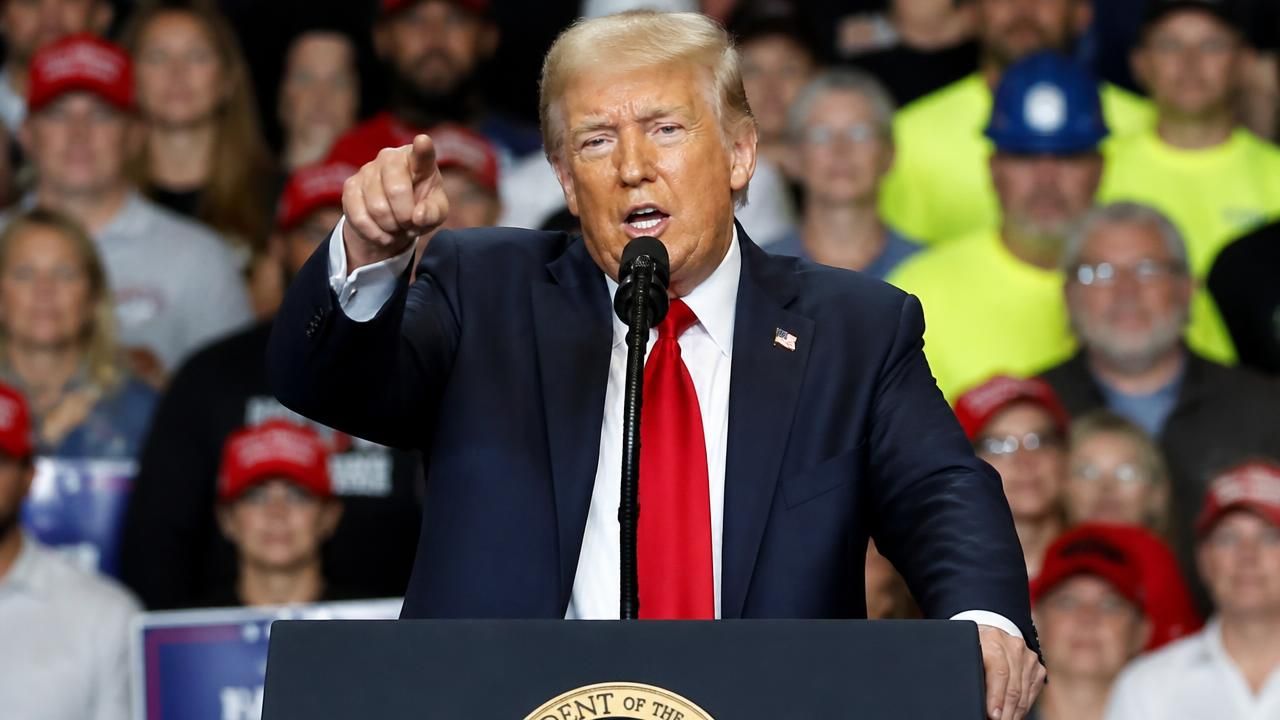
President Donald Trump escalated his anti-Muslim attacks against Michigan Senate candidate Abdul El-Sayed on Sunday, using a rally in Port Huron to portray the Democrat as a national-security threat and to question his loyalty to the United States. The remarks, delivered eight days before the midterm elections, drew immediate rebuke from Arab American leaders and thrust Michigan’s Senate race into the center of a broader fight over religion, identity and political rhetoric.
According to NPR, Al Jazeera, Bloomberg and other outlets, Trump intensified his rhetoric against El-Sayed, a physician and former Detroit health director, at a campaign event meant to boost Michigan Republicans, including GOP candidates James and Rogers. MSN reported that Trump said he was “here to keep a jihadist out,” invoked the Sept. 11 attacks and described El-Sayed as a threat. Bloomberg framed the attack as aimed at El-Sayed’s Muslim faith; Al Jazeera called it a “fierce attack”; the New Arab described it as an escalation of Islamophobic attacks.
“I’m here to keep a jihadist out,” Trump said, according to MSN, in a remark that drew cheers at the rally and condemnation elsewhere.
A Rally Focused on Faith and Fear
The event in Port Huron was officially about turnout for Michigan Republicans, but Trump’s remarks about El-Sayed dominated coverage. Fox News framed the president’s speech as an intensification of attacks “as election disputes mount,” noting that the Justice Department was simultaneously defending an Alaska lawsuit. That framing placed the Michigan rally inside a larger Republican strategy: rally the base with culture-war appeals while contesting election rules and litigation in the background.
Trump also claimed that Barack Obama’s recent Michigan rally was empty, a familiar attempt to diminish a Democratic rival’s crowd size. News photos circulated by outlets showed otherwise, turning the claim into another side story in a rally that had already generated headlines over El-Sayed.
Arab American Rebuke
Michigan is home to one of the nation’s largest Arab American communities, and the Chicago Tribune reported that Trump’s remarks drew Arab American rebuke. Local leaders and civil-rights groups have long warned that labeling a Muslim candidate a “jihadist” can incite harassment and violence. The phrase is especially charged because it fuses religious identity with terrorism, leaving little room for policy debate.
El-Sayed, who has built a progressive following, did not appear to back down. The attack gave his campaign an opening to contrast Trump’s rhetoric with his own biography as a physician and public-health official. One conservative pollster found El-Sayed with an improved standing after the exchange, according to MSN, a result that suggested the president’s attack may have energized rather than damaged his candidacy.
Polling and Political Calculus
The Michigan Senate race is a key midterm battleground. Trump’s decision to focus on El-Sayed’s religion, rather than local issues, reflects the president’s preference for nationalizing races around cultural grievance. MSN also reported that Trump campaigned with Michigan GOP candidates James and Rogers, and that the event featured Nicki Minaj, blending celebrity spectacle with hard-edged rhetoric.
Not all Republicans welcomed the turn. One MSN analysis described Republicans taking “an ominous turn” in their midterm campaign, suggesting that appeals to religious and ethnic identity could alienate swing voters, particularly in suburban districts. Democrats, meanwhile, seized on the remarks to argue that Trump was running a campaign of division.
A Nationalized Midterm
The rally came as early voting began in several states. In Texas, the first day of early voting drew long lines, according to MSN, a sign of intense engagement on both sides. With eight days left, the political environment is shaped by litigation, turnout battles and presidential provocation. Fox News noted that the president’s attacks on El-Sayed were unfolding alongside election disputes, including a DOJ defense of an Alaska lawsuit.
The episode also illustrates how different outlets frame the same event. NPR emphasized the escalation of anti-Muslim attacks; Al Jazeera highlighted the ferocity of the rhetoric; Bloomberg focused on the attack over faith; Fox News placed it in the context of election disputes; MSN foregrounded the “jihadist” quote and the 9/11 invocation. The cumulative effect is a story that is at once local—Michigan’s Senate race—and national—a referendum on how far political rhetoric can go.
What Comes Next
With voting underway, the question is whether Trump’s attack will mobilize his base, persuade undecided voters or backfire. Arab American and Muslim voters in Michigan could be pivotal, and civil-rights groups are likely to keep pressure on candidates to condemn the language. El-Sayed’s response, and the broader Democratic strategy, will determine whether the rally becomes a turning point or another data point in a polarized midterm.
For now, the Port Huron rally has done what Trump’s rallies often do: turn a local race into a national spectacle, sharpen divisions and force opponents to respond on his terms. The coming week will show whether Michigan voters reward that approach—or reject it.