NASA on Friday offered its most detailed public blueprint yet for returning astronauts to the lunar surface, saying it is still aiming for a landing as soon as 2028 under the Artemis program. The plan, outlined at a lengthy news conference, confirms substantial changes to the architecture that will carry astronauts from Orion to the Moon—and it puts unusual pressure on SpaceX and Blue Origin to mature their landers on a compressed schedule.
The agency had previously discussed pieces of the revised approach, but Ars Technica reported that Friday marked the first time NASA laid out the full plan in detail and acknowledged the scope of the changes. Ars Technica also characterized the update as finally resolving a long-festering Orion issue. The announcement was framed by some outlets as a major turn in Artemis; others emphasized the race against time.
A changed docking architecture
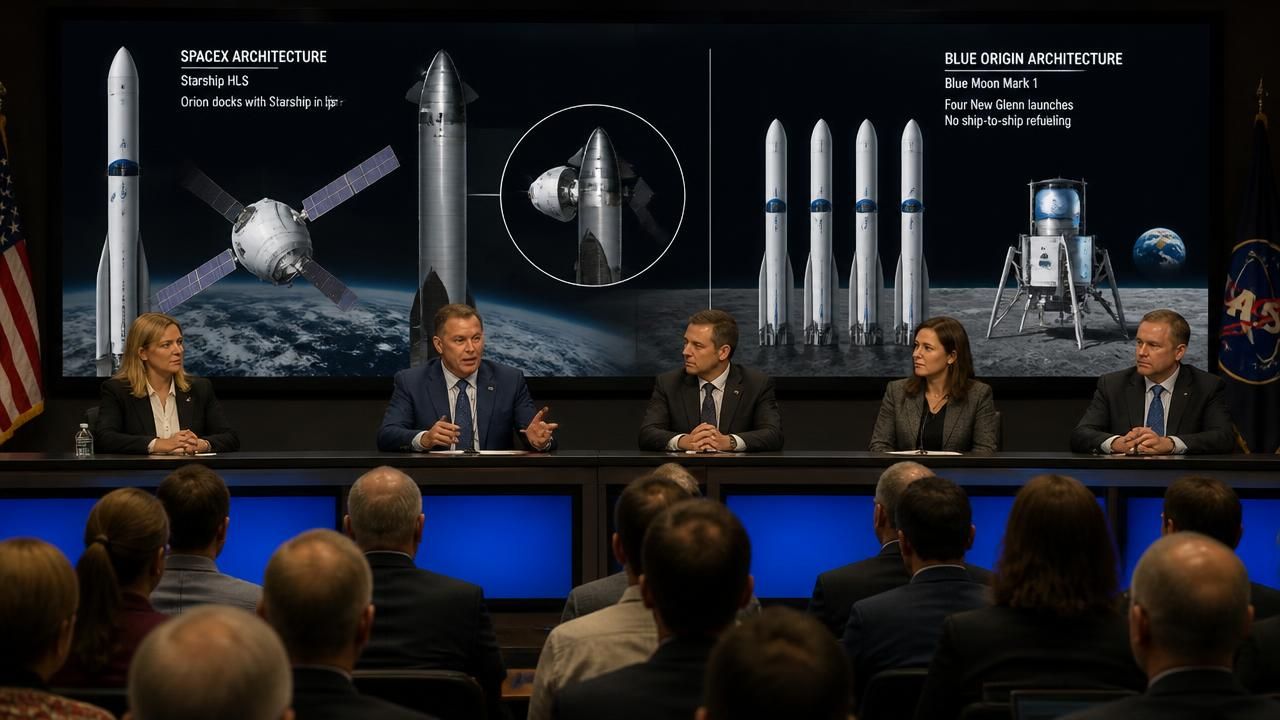
For SpaceX, NASA's revised plan calls for the Orion spacecraft to dock with the Starship lunar lander in high-Earth orbit before transiting to the Moon. That is a significant shift from concepts in which Orion and a lander would meet in lunar orbit. The high-Earth-orbit rendezvous creates a different sequence of launches, docking and crew transfer—one that NASA believes can be made to work, but one that also depends on Starship being ready for complex operations far from the lunar surface.
For Blue Origin, the architecture is different. NASA said the Blue Origin mission plan includes four launches of the New Glenn rocket, but no spacecraft-to-spacecraft refuelings. The plan also allows for the possibility that Blue Origin's Blue Moon lander will rendezvous with Orion in low lunar orbit. That flexibility could reduce some operational risk, though four New Glenn launches still represent a demanding cadence for a rocket that is still building flight experience.
Test flights before a landing
Before any astronaut steps onto the Moon, NASA will test both companies' landers. ScienceDaily reported that NASA will test SpaceX and Blue Origin Moon landers before the next lunar landing, a step intended to retire risk while the agency holds to its 2028 target. CNN described the effort as “the most complicated launch campaign ever,” capturing the scale of the undertaking: multiple rockets, multiple spacecraft, docking maneuvers and surface operations all have to come together.
“The most complicated launch campaign ever.” — CNN’s description of NASA’s lunar lander test effort.
The testing requirement is central to the revised plan. It means the 2028 date is not simply a single mission but the culmination of a sequence of demonstrations. NASA has revealed lander timelines and an Artemis III update, according to MSN, suggesting the agency is trying to synchronize hardware milestones across two commercial partners and its own Orion and Space Launch System elements.
Beyond one landing: a moon base
NASA's ambitions extend past a single return. ScienceDaily reported that the agency's moon base is taking shape with more than 20 lunar landings planned. That figure, if realized, would transform Artemis from a flags-and-footprints program into a sustained campaign of lunar delivery and surface operations. It also explains why NASA is willing to accept a complex architecture: the agency is trying to build a repeatable transportation system, not just a one-off stunt.
The New York Times reported that NASA is still aiming for the next Moon landing in 2028, a reminder that “aiming” is the operative word. Ars Technica used the same cautionary phrase—“as soon as 2028”—and noted that the plans have been reported before but are now official. The difference matters: NASA is publicly committing to a schedule that depends on SpaceX's Starship and Blue Origin's Blue Moon reaching maturity faster than either company has demonstrated so far.
A race against time
MSN framed the announcement as NASA's moon landing plans taking a major turn, with SpaceX and Blue Origin facing a race against time. That framing captures the central tension. NASA has selected commercial partners to do what government-run programs once did, but the agency remains accountable for astronaut safety and for a schedule that has already slipped repeatedly. Every test failure, launch delay or redesign at SpaceX or Blue Origin now ripples directly into Artemis.
The revised architecture also shows how NASA is adapting to the realities of its partners. For SpaceX, the high-Earth-orbit docking plan changes the choreography of the mission. For Blue Origin, the four-launch, no-spacecraft-refueling approach aims to simplify the mission profile while preserving the option of a low-lunar-orbit rendezvous with Orion. Both paths are ambitious. Both require NASA to prove that Orion can serve as a reliable crew taxi and that commercial landers can operate safely in the lunar environment.
For now, NASA has answered the “how” more clearly than it has answered the “when.” The agency says 2028 is possible. Its partners have to prove it.