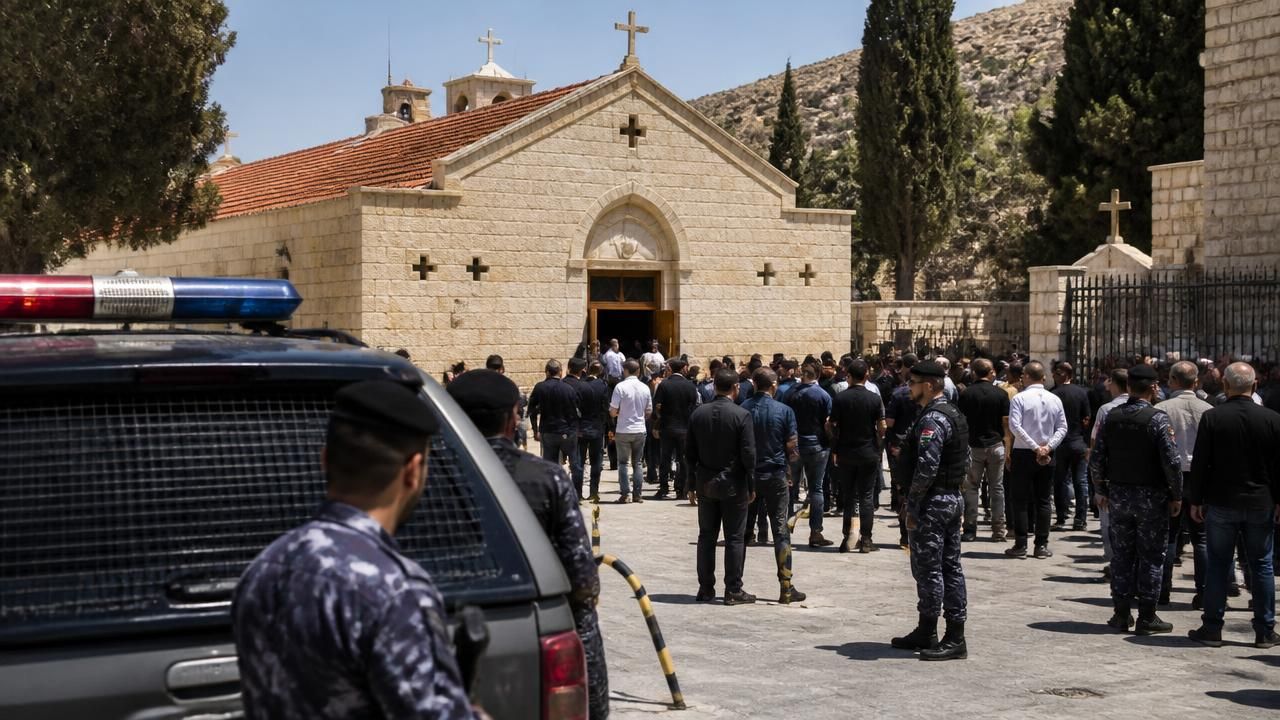
Gunmen opened fire on mourners gathered for a funeral at a church in southern Jordan on Sunday, killing at least seven people and wounding others before fleeing, according to the kingdom's public security agency and state-run broadcasters. The attack took place in the province of Karak, a rugged region south of Amman that is home to one of Jordan's most established Christian communities.
Jordan's Public Security Directorate confirmed the deaths, and the state broadcaster reported that security forces had launched a manhunt for the perpetrators. The New York Times, citing the national police force, reported that the shooting erupted "during a funeral in the southern province of Karak." Other outlets, including the Times of Israel, Ynet and India's Times of India, described the assailants opening fire "inside" a Greek Orthodox church. Still others — among them Azerbaijan's Azernews — placed the attack on a funeral procession near the church, a discrepancy that reflects how quickly early wire copy diverges in the first hours of a breaking story.
As is common in fast-moving incidents, casualty figures and the precise sequence of events could not be independently verified late Sunday, and the identities and motives of the gunmen remained unknown. No group had claimed responsibility as of the initial round of reporting.
What we know — and what we don't
- Location: Karak governorate in southern Jordan, at or near a Greek Orthodox church where a funeral was under way.
- Casualties: At least seven dead, with additional injuries reported by multiple outlets, including Anadolu-linked and Chinese state media.
- Perpetrators: Described in every account as "gunmen" or "unknown gunmen"; no claim of responsibility and no official identification released.
- Response: Security forces were actively pursuing the attackers, per the state broadcaster.
"Security forces are pursuing the gunmen," Jordan's state broadcaster reported, according to a New York Times account citing the national police force.
A minority community at the heart of the story
The New York Times framed the location pointedly, noting that Karak is "home to a longstanding Christian community." That detail matters. Christians make up a small minority in Jordan — commonly estimated at roughly 2 to 3 percent of a population of about 11 million — but they are deeply woven into the kingdom's civic and commercial life, with historic communities in Amman, Madaba, Fuheis, Salt and Karak. Greek Orthodox, Catholic and Protestant denominations all maintain churches and schools across the country, and Christian tribes in the south, particularly around Karak and Madaba, have maintained ties with the Hashemite monarchy for generations.
That makes an attack on a funeral gathering at a church a particularly sensitive event for the Jordanian state, whose legitimacy is bound up in a narrative of interfaith harmony and protection of religious minorities — a contrast the monarchy frequently draws with neighbors riven by sectarian conflict.
How different outlets told the story
The coverage divided less over facts than over emphasis. Western outlets such as The New York Times foregrounded the communal context — a Christian funeral in a historically Christian southern province — and the official response. Regional and Israeli outlets, including Ynet and the Times of Israel, led with the death toll and the funeral setting, drawing particular public attention given Jordan's role as a custodian of Jerusalem's holy sites and a key party to regional security arrangements.
Turkish and other wire aggregators emphasized the unknown identity of the attackers and the "several killed, injured" framing. Chinese state media outlet Xinhua, in its typically terse formulation, reported that "gunmen open fire inside church in S. Jordan, causing multiple casualties" — a headline stripped of communal detail. MSN and Yahoo syndicated the wire version of the story, ensuring the seven-death figure propagated widely, while several outlets — including msn.com, azernews, timesofisrael and others — were accessible only in fragments because of paywalls and bot-blocking pages.
Karak's troubled security history
Karak is best known internationally for the Crusader-era castle that dominates its skyline and for the King's Highway that draws tourists through the region. But it has also been a flashpoint. In December 2016, gunmen attacked police and tourists around the Karak Castle, killing at least 10 people, including a Canadian tourist, in an assault later linked to supporters of the Islamic State. That episode underscored a persistent security challenge for Jordan: a small but resilient Salafi-jihadist current that has targeted the kingdom despite its intelligence services' aggressive counterterrorism posture.
Jordan has experienced significant attacks before — most notoriously the 2005 triple hotel bombings in Amman, which killed more than 50 people — and its security apparatus has foiled numerous alleged plots since. Sunday's attack, if confirmed as a deliberate strike on a religious gathering, would mark an escalation in targeting.
Why it matters
Jordan is a linchpin of regional stability: a Western-allied monarchy hosting a large Palestinian refugee population, a U.S. security partner, and, since the war in Gaza, a central intermediary in hostage and ceasefire negotiations. A deadly attack on a church in the country's south is likely to be felt well beyond Karak — raising questions about internal security, sectarian friction, and the potential for copycat violence.
The immediate priority for authorities will be establishing the identity and affiliation of the gunmen and whether they had local or external support. The second will be managing public messaging: in a country where Christian and Muslim communities live closely intertwined, how the government characterizes the motive will shape whether the attack is read as a sectarian assault or a criminal or terrorist act of another kind.
For now, official confirmation remains thin, and the story is still moving. What is clear is that at least seven people died while mourning someone else — a funeral interrupted by gunfire in one of the Middle East's most carefully maintained oases of calm.