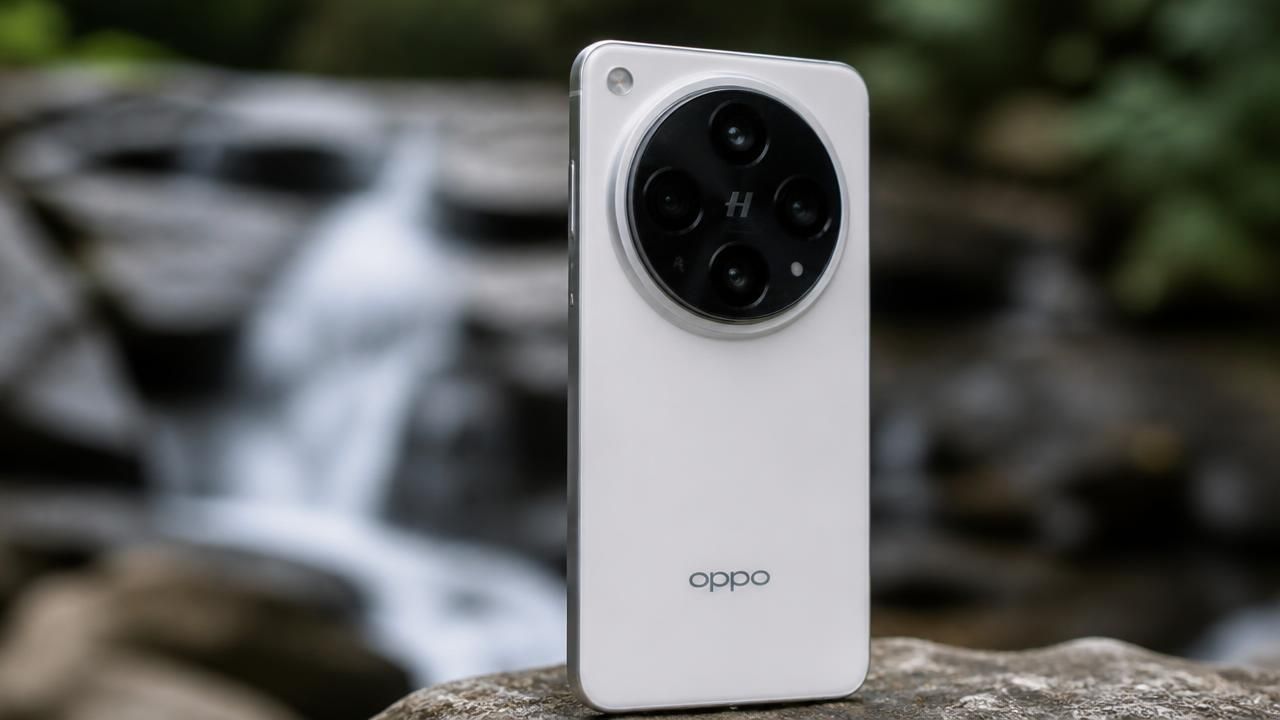
Oppo has officially unveiled the Find X10 Pro Max, the first smartphone in the world to ship with three separate 200-megapixel rear cameras — a main shooter, a telephoto, and, for the first time on any phone, a 200-megapixel ultrawide. The device launched in India this week alongside the standard Find X10, powered by MediaTek's Dimensity 9600 Pro chipset, and is being marketed under a Hasselblad-branded "600MP camera system" banner.
It is a specification that lands somewhere between genuine engineering achievement and carefully calibrated marketing, and the early coverage reflects exactly that split.
A camera system, not just a camera
Oppo's pitch is straightforward arithmetic: three sensors at 200 megapixels each equals 600 megapixels of total imaging hardware, developed in partnership with Hasselblad, the Swedish optics house whose branding has appeared on Oppo flagships for several generations. Supply-chain reporting from Notebookcheck indicates the sensor package — built around Samsung's new HPC imaging sensor, according to Gizmochina — is moving closer to mass production, suggesting Oppo intends to keep the triple-200MP configuration in its lineup rather than treat it as a one-off halo product.
The Verge's hands-on notes that the phone remains "camera-centric" in its industrial design but is "less extreme than most Ultra phones," a subtle shift away from the chunky, grip-heavy bodies that have defined the ultra-premium camera segment. The only sensor that doesn't hit 200 megapixels is the selfie camera, which runs at a lower resolution — a reminder that the headline number applies strictly to the rear array.
The resolution race, explained
High-megapixel sensors have been a fixture of the Android ecosystem since 2022's Moto X30 Pro, which introduced a 200-megapixel main camera. This year's Vivo X300 Ultra went further with two such sensors — main and telephoto — and remains, in The Verge's assessment, the best camera phone currently on sale. Oppo's contribution is the third pillar: a 200-megapixel ultrawide, a component that historically has been the weakest link in flagship camera stacks.
The technical rationale is more nuanced than the marketing suggests. On a phone, 200-megapixel sensors almost never output 200-megapixel files by default. Instead they use pixel binning — combining clusters of adjacent pixels into larger, light-gathering superpixels — to produce 12- or 50-megapixel images with better dynamic range and lower noise. The full resolution is typically reserved for bright-light shooting or for cropping aggressively into a scene.
That is why Android Authority's review concluded that resolution "isn't the best part" of the Find X10 Pro Max. The real improvements, reviewers suggest, come from the processing pipeline: Hasselblad-tuned color science, improved computational photography, and the video and software features that Oppo detailed at launch.
"You're likely to see it as either a masterful feat of engineering or a load of hyped-up marketing nonsense. The truth is somewhere in the middle."
Skeptics and enthusiasts
Not every outlet was won over by the spec sheet. PhoneArena described the Find X10 Pro Max as having "the most ridiculous camera setup I've seen yet," capturing the skepticism of reviewers who argue that sensor count and pixel density have become a proxy war detached from real-world image quality. Digital Trends framed its coverage around a blunter question: do you actually need three 200-megapixel cameras on your phone?
The counterargument is that versatility, not resolution, is the point. A high-resolution ultrawide allows for cropping and perspective correction that a 12-megapixel ultrawide cannot match, and pairing it with equally dense telephoto and main sensors gives photographers consistent detail across all three focal lengths — a genuine engineering challenge given the size constraints of each module.
The competitive context matters here. Apple and Samsung have largely pivoted their flagship marketing toward computational photography, larger individual pixels, and video capability rather than megapixel counts. Chinese manufacturers — Oppo, Vivo, Xiaomi, Honor — have taken the opposite approach, using aggressive hardware specifications as a differentiator in a crowded domestic market and, increasingly, in India and Europe.
What it means for buyers
The Find X10 Pro Max's India launch, with the cheaper Find X10 tagging along, signals where Oppo sees growth. India is now one of the most contested premium smartphone markets in the world, and camera capability is the single most-cited reason consumers upgrade in the segment. Whether they can be persuaded by a 600-megapixel badge is another question.
History offers a cautionary note: past megapixel leaders have often been overtaken by phones with humbler specifications and superior processing. The Find X10 Pro Max may well be the best camera phone Oppo has ever built — but the decisive factor is likely to be what the software does with those pixels, not how many of them there are.