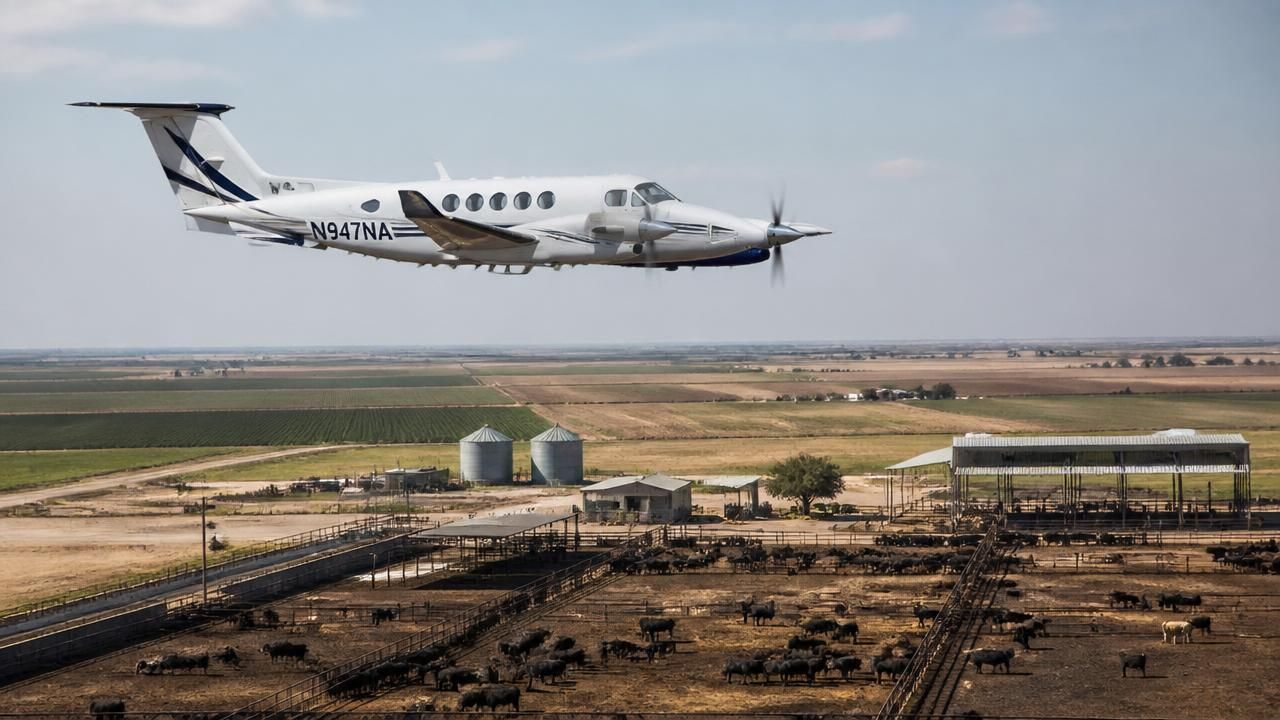
Starting Thursday, Oct. 22, and running through Monday, Nov. 9, a NASA Dynamic Aviation A200 aircraft will fly unusually low over farmland near Amarillo, Texas, in the Texas Panhandle. Its job is not photography or mapping but chemistry: sampling the gaseous and particulate emissions that rise from animal feeding operations and surrounding cropland.
The campaign is part of FarmFlux, a NASA Earth-venture mission jointly led by NASA's Goddard Space Flight Center in Greenbelt, Maryland, Colorado State University and Boston University. The agency describes the effort as an attempt to close a stubborn gap in climate and air-quality science: agricultural emissions are an important but poorly quantified component of Earth's land-atmosphere system.
What the aircraft will measure
The A200 will carry more than a dozen instruments, according to NASA, sampling ozone, methane, ammonia, particulates and other pollutants as they lift off livestock operations and crop lands and interact with the atmosphere above them. The flights are deliberately low-altitude — close enough to the source to capture emission plumes before they disperse and mix.
That design reflects a broader shift in atmospheric science. Satellites can see broad regional patterns of methane and ammonia, and ground towers can measure point sources with precision, but the space between — the near-field plume where emissions are still concentrated and chemically reactive — is where much of the uncertainty lives.
Agricultural emissions represent an important and understudied part of Earth's land and atmosphere systems, NASA said in announcing the flights.
Why ammonia and methane matter
Ammonia is a particular concern around concentrated livestock operations. It reacts in the atmosphere to form fine particulate matter — PM2.5 — which is linked to respiratory and cardiovascular illness in downwind communities. Methane, meanwhile, is a potent short-lived greenhouse gas, and agriculture is among the largest human-driven sources globally, chiefly through enteric fermentation in ruminants and manure management.
Getting better numbers on both has practical consequences. Emissions inventories used by regulators, researchers and industry are typically built from models and periodic sampling rather than direct measurement of real farms in real weather. FarmFlux is designed to test and refine those estimates — measuring how emissions vary with temperature, wind, soil conditions and farm management practices.
The bigger campaign
The Texas flights are only the opening act. NASA says additional low-altitude research flights using a P-3 Orion aircraft are scheduled for the March-to-July 2027 growing season, focused on cropland in the Midwest and California's Central Valley.
The two phases split the problem in useful ways: the Texas leg targets livestock-dominated landscapes where methane and ammonia dominate, while the later flights will examine crop systems and the interplay of fertilizer, ozone and particulates.
How the story was reported
Coverage of the campaign has varied widely in depth. NASA's own release, by Sharon Teitelbaum of the agency's Ames Research Center in California's Silicon Valley, carried the technical detail — sensor lists, mission partners, follow-on flights — and was updated to correct the flight location. Aggregators moved the story quickly: MSN's headline summarized it bluntly, noting that a low-flying NASA plane will "sniff farm emissions over Texas" from Oct. 22. Regional outlets also picked up NASA's broader low-altitude research activity, with at least one item framing flights around Colorado, though those versions carried little substantive detail.
The difference in framing is telling. Where the agency emphasizes science objectives and instrument payloads, syndicated versions emphasize the striking image — a NASA research plane buzzing at low level over cattle country — which is likely to raise questions from residents unaccustomed to aircraft noise over rural land. NASA has not, in its public materials, detailed specific flight paths or altitudes beyond describing them as low-altitude.
What to watch
- Resident impact: Expect local attention in the Amarillo area to aircraft noise and visible low passes during the roughly three-week window.
- Data legacy: FarmFlux results will feed emissions models used well beyond Texas, particularly for ammonia and methane inventories.
- The 2027 expansion: The Midwest and Central Valley flights will broaden the mission from livestock to cropland — and could prove more politically sensitive, given agriculture's role in those regional economies.
For now, the mission's immediate significance is methodological. Agriculture is one of the few major emission sectors where direct, plume-level measurement remains rare. If FarmFlux succeeds, it will provide something researchers have long lacked: a calibrated, real-world check on how much farms actually send into the sky — and how the atmosphere transforms it downwind.
More information on the mission is available through NASA's FarmFlux page at science.nasa.gov/mission/evs-4/farm-flux/.