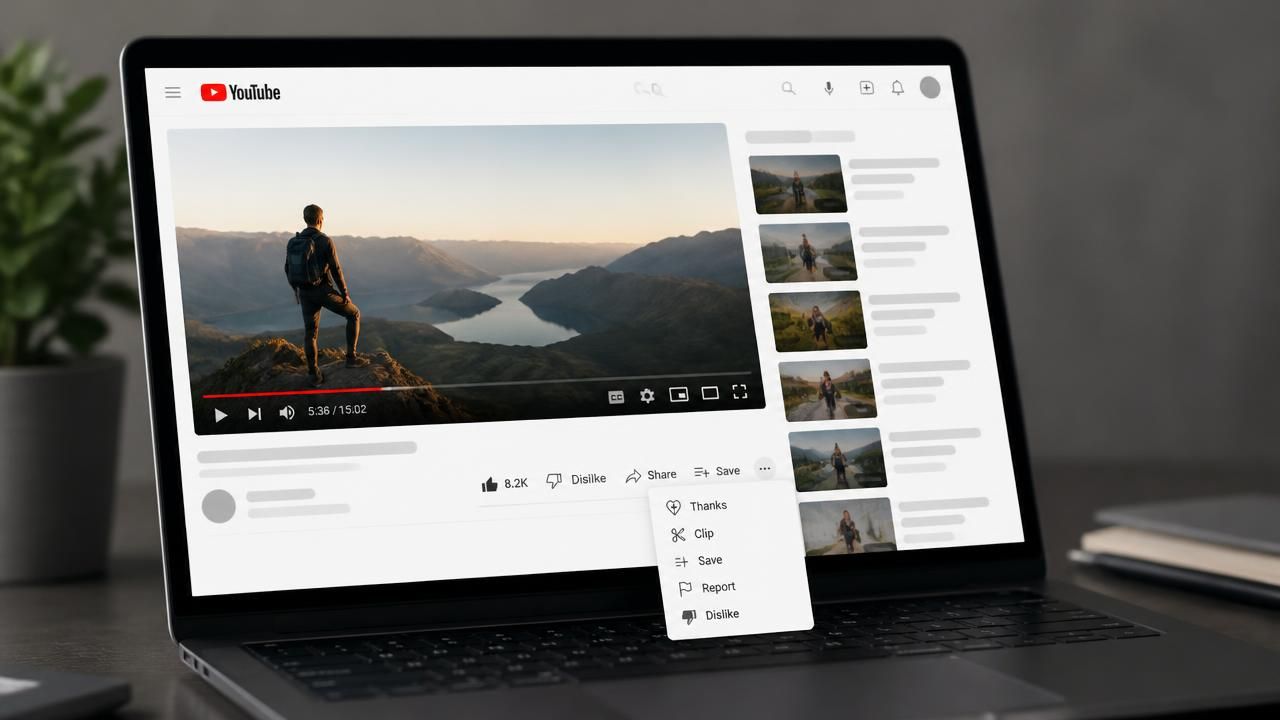
YouTube appears to be experimenting with one of the last remaining pieces of visible negative feedback on its platform: the dislike button itself. According to reporting from The Verge, citing an earlier discovery by 9to5Google, some users have recently found the thumbs-down icon no longer sitting beside the thumbs-up beneath a video, but instead buried inside the three-dots overflow menu — a change that would make registering disapproval a deliberate, multi-step act rather than a reflex.
The evidence, for now, is anecdotal. At least two users on X posted screenshots of the relocated dislike option, and a Reddit user shared an image of a player where the button appeared to be missing entirely. YouTube has not issued a public statement confirming a test, its scope, or whether it is limited to the desktop web interface. The company has a long-standing practice of running small, unannounced experiments on segments of its user base, which is why changes often surface first as scattered screenshots rather than announcements.
What the change actually looks like
On the standard desktop layout, the like and dislike buttons have lived side by side beneath the title and channel information since the site's early days. Moving the dislike into the overflow menu — the same submenu that houses "Save," "Share," and "Report" — would not remove the feature outright. Users could still dislike a video; they would simply have to hunt for it.
That distinction matters to critics, who argue the friction is the point. Android Authority framed the development bluntly as "YouTube's war on the Dislike button" being "far from over," while Neowin characterized it as Google "making it harder to dislike all YouTube videos" after previously reworking the control on Shorts. Android Headlines and Newsbytes both described the test as one that keeps the like button prominent while demoting its counterpart.
A five-year retreat from the thumbs-down
The apparent test is the latest chapter in a slow, contested withdrawal. In November 2021, YouTube made the public dislike count private across the platform, removing the visible tally while keeping the button itself. At the time, the company argued the number was being weaponized.
"We want to create an inclusive and respectful environment where creators have the opportunity to succeed and feel safe to express themselves," YouTube said in its 2021 announcement, explaining that the visible count had become a tool for coordinated harassment campaigns against smaller channels.
The backlash was immediate and enduring. Creators argued the count was a genuine quality signal — a way for viewers to spot tutorial videos with dangerous or wrong instructions, scam content, or misleading clickbait. The removal also spawned a cottage industry of workarounds: browser extensions such as Return YouTube Dislike, which reconstruct an estimate of the tally from archived data and extension users' own votes, have been downloaded millions of times and remain among the most-installed add-ons for the site.
Since then, the thumbs-down has retreated further. YouTube removed the dislike button from Shorts, its TikTok-style vertical feed, at one point — a change users periodically rediscover when the icon vanishes from their app, prompting explainers from outlets like Android Authority. Videos in the Shorts player have also historically leaned on swipe-based, low-consequence feedback rather than explicit ratings, a design philosophy borrowed from short-form rivals where engagement metrics are hidden from public view entirely.
Why platforms keep demoting the dislike
The business logic is not mysterious. Public dislike counts create visible reputational damage on a platform that sells advertising against video; a video with 40,000 dislikes is harder to monetize and harder to recommend. Internally, engineering teams have long wrestled with how to weigh negative signals — they are useful for ranking and trust-and-safety work, but corrosive when surfaced publicly and amplified by brigading.
Critics counter that the company is solving a harassment problem by removing a tool viewers use for self-defense. The tension between those two framings runs through nearly every product decision YouTube has made since 2021, and it is the reason each incremental change draws outsized attention.
- The user view: Losing quick access to the dislike makes it harder to warn others about low-quality or misleading content.
- The creator view: Opinions split sharply, with large channels generally less dependent on the signal and smaller ones often valuing it as evidence of audience engagement.
- The platform view: Reduce harassment vectors and keep the recommendation surface free of visibly negative social proof.
What happens next
A/B tests frequently die quietly. YouTube has tested interface variants before and abandoned them after muted response or measurable drops in engagement. If this experiment expands — and history suggests it could — the practical outcome will be a site where approval is one tap away and disapproval requires intent, a subtle but consequential shift in how hundreds of millions of viewers register judgment.
For now, the company's silence is the story. Until YouTube comments publicly, the scope of the test remains unknown: whether it touches only desktop, whether mobile is next, and whether the button will survive at all. What is clear is that the thumbs-down, once as automatic as pressing play, has spent five years moving further from the viewer's thumb.