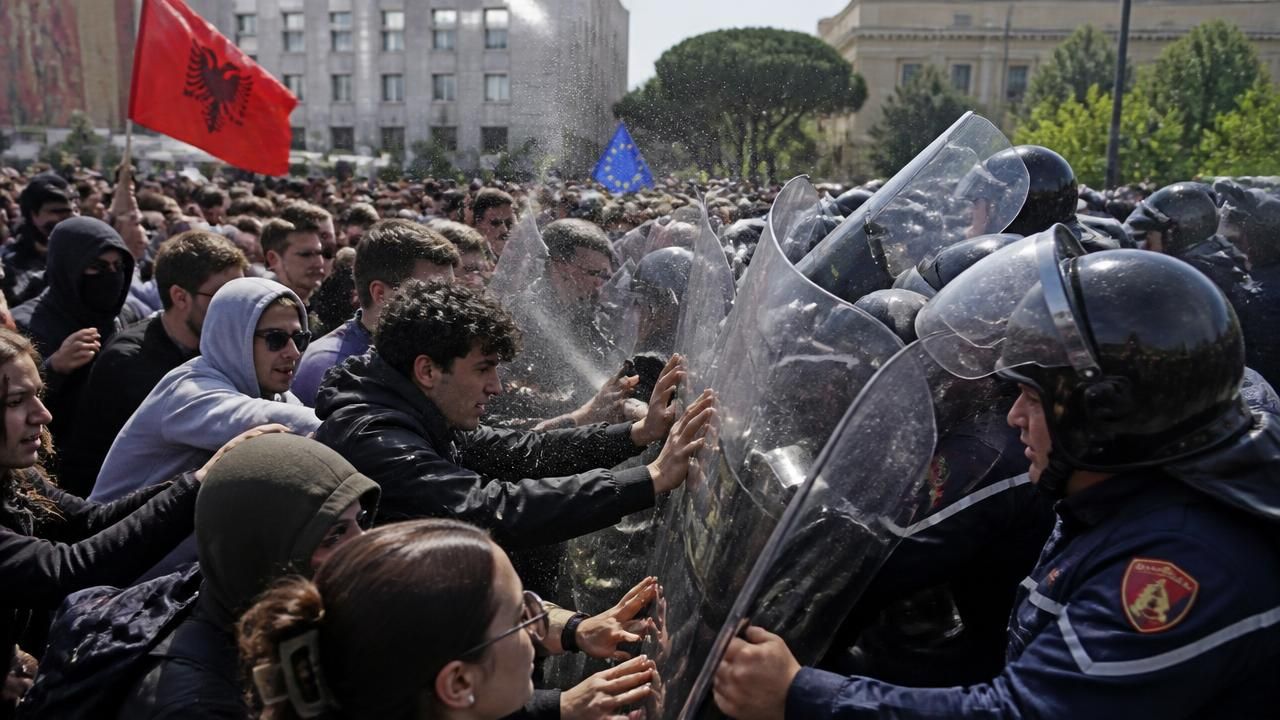
Albanian police clashed with anti-government demonstrators for an eighth consecutive day as protests against a luxury coastal development tied to Jared Kushner, Donald Trump's son-in-law, entered their 100th day — a milestone that has turned a localized environmental dispute into the most serious challenge to Prime Minister Edi Rama's decade in power.
The unrest, which has spread from the capital, Tirana, to other cities, pits a largely young, leaderless movement against a government that has alternately denounced the demonstrators as violent and accused foreign powers of orchestrating them. The convergence of a controversial real-estate deal, rising living costs and a frustrated young population has given the story resonance far beyond the Balkans — drawing in Washington, European capitals and the global investor community watching Albania's tourism boom.
How a Coastal Resort Became a Flashpoint
At the center of the dispute is a planned luxury resort on the Zvërnec peninsula near the southern city of Vlorë, a stretch of coastline adjacent to the Narta Lagoon, a protected wetland famous for its flamingos. The project is backed by Affinity Partners, the investment firm founded by Kushner after leaving the White House, and has been granted "strategic investor" status by the Albanian government — a designation that fast-tracks approvals and grants expedited legal protections.
For Rama's government, the deal is a signature piece of an economic strategy designed to capitalize on Albania's emergence as a Mediterranean tourism destination. For critics, it symbolizes a deeper problem: public land, environmental protections and planning rules being reshaped for the benefit of well-connected foreign investors.
Bloomberg Markets framed the story squarely around the political fallout, noting that the violent anti-government protests follow months of demonstrations against the Kushner-linked development and are now "piling pressure" on Rama. Al Jazeera emphasized the Trump connection in its coverage, describing demonstrators and police clashing "over [a] Trump-linked project."
The 'Horizontal Revolt'
The protests have been defined by their shape as much as their cause. Demonstrators describe the movement as a "horizontal revolt" — without formal leaders, parties or hierarchies — organized largely online and animated by a generation that came of age after Albania's post-communist transition. Protesters have adopted flamingo imagery, a nod to the lagoon's wildlife, and the movement has been dubbed the "Flamingo" protests.
Their demands have broadened well beyond the resort. Demonstrators are calling for Rama's resignation, for transparency in major development deals and for action on the cost of living — grievances that echo movements across Europe. Firstpost situated the Albanian unrest within a wider continental wave of protests over living costs that has swept from France to Belgium, Italy and Portugal, arguing that Albania is the latest front in a European season of discontent.
Rama's Counter-Framing: 'Hybrid War' and 'Red Lines'
The prime minister's response has shifted the terms of the debate. According to MSN, Rama blamed a "hybrid war" for fueling unrest across the country, and in separate remarks accused anti-government protesters of crossing a "red line" amid the violent demonstrations. Albanian Daily News reported that Rama claimed "foreign hands" were behind the mass student protests.
The government's message has been consistent: that a legitimate environmental and social grievance has been hijacked by organized, externally backed actors intent on destabilizing a NATO member state.
The New York Times reported that Rama denounced violence as protesters demanded his resignation — a framing that places responsibility for escalation on demonstrators rather than on police conduct. Protest organizers and critics counter that describing peaceful mobilization as foreign-directed is a familiar tactic used to delegitimize dissent, and note that the movement's horizontal structure makes the claim difficult to sustain.
Digital Front: Deepfakes and Takedowns
The battle is also being fought online. Balkan Insight reported that Instagram takedowns and AI-generated deepfakes are being deployed against the "Flamingo" protesters, raising questions about who is manipulating the information environment. The reporting suggests the movement faces a two-front challenge — physical confrontation in the streets and a digital campaign aimed at discrediting it, with synthetic media and platform enforcement used to erode public sympathy.
That dimension has complicated the government's own narrative about foreign interference, as analysts point out that information operations of the kind described typically cut in multiple directions.
Washington Sounds the Alarm
The violence has prompted concern in the United States, where lawmakers have publicly raised alarms about instability in Albania, a NATO ally and a staunch partner in the Western Balkans, according to MSN. The intervention matters because the project at the heart of the controversy carries the Kushner name — placing a domestic Albanian dispute inside the broader political orbit of the Trump family and raising the diplomatic stakes of any escalation.
The affair has also become a test case for how the region handles high-profile foreign investment. Albania has aggressively courted Gulf and American capital as it seeks to upgrade infrastructure and tourism revenues, and the Kushner project has been cast by officials as a vote of confidence in the country's future. Critics warn that offering bespoke legal treatment to politically connected investors risks eroding the institutional credibility that such investment ultimately depends on.
What Comes Next
For Rama, whose Socialist Party has dominated Albanian politics since 2013, the protests represent an unfamiliar challenge: a mobilization not organized by a rival party, and therefore not easily defeated at the ballot box or neutralized through coalition politics. His government faces a choice between concession — pausing or revising the resort deal, opening planning documents to scrutiny — and escalation.
- For investors: the unrest raises questions about political risk and the durability of strategic-investor protections in a country selling itself as a stable gateway to the Balkans.
- For Washington: a NATO ally's domestic turmoil, entangled with a presidential family's business interests, complicates an already crowded diplomatic agenda.
- For the protesters: the movement's leaderless structure is both its strength and its vulnerability, offering no obvious counterpart for negotiations.
The hundred-day mark is symbolic, but the underlying arithmetic is not: a young electorate facing high housing costs and limited opportunity has found a symbol — a flamingo, a lagoon, a luxury resort — around which to organize. Whether that energy produces policy change or dissipates into sporadic clashes will depend less on the resort itself than on whether Albania's institutions can demonstrate they answer to more than the investors they court.