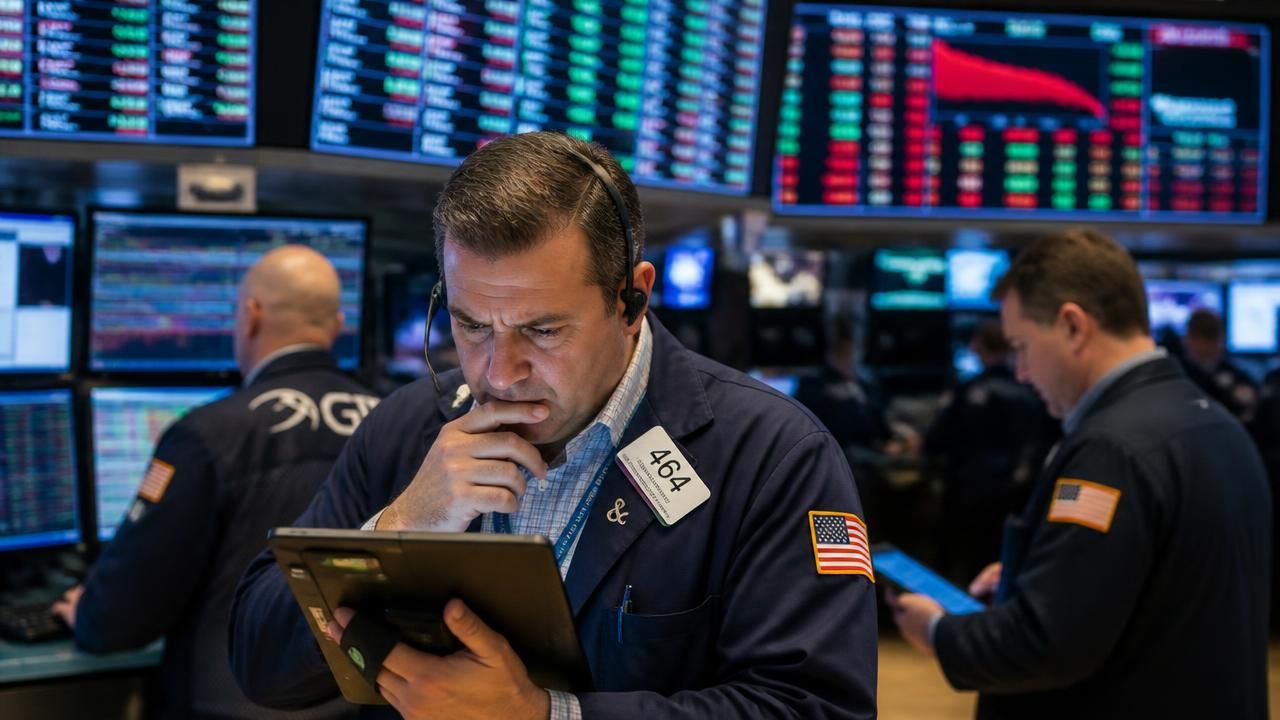
US equity futures slipped on Wednesday, pausing a fragile recovery in artificial-intelligence-linked stocks after a South Korean data-center company, Elice, plunged in its trading debut. The disappointment landed squarely on a market that has spent the past year pricing in an almost limitless buildout of AI infrastructure—and is now starting to ask harder questions about who actually gets paid.
The timing could hardly be worse. A crowded earnings slate featuring SpaceX, Netflix, General Motors, RTX and Northrop Grumman is set to test whether corporate results can justify valuations that have been stretched by AI enthusiasm. And hanging over all of it is a story that has become the purest expression of the AI boom's ambitions: the race to put data centers in orbit.
A Pause in the AI Recovery
For much of the past quarter, investors have treated data-center capacity as the surest proxy for AI demand—the physical plumbing beneath every model, every inference request, every chatbot reply. Elice's weak first session undercut that logic, at least momentarily, by reminding traders that not every company positioned on the AI supply chain converts enthusiasm into returns.
The broader question is whether the AI trade is entering a more discriminating phase. Jeanne Sun of Citigroup Global Markets, speaking on Bloomberg Brief, framed the coming weeks as a referendum on earnings quality rather than narrative, arguing that this season's results will matter more than headline optimism. For now, futures point to caution rather than capitulation—a pause, not a reversal.
“The market is no longer paying for the promise of compute. It wants to see the invoices.”
That shift in sentiment helps explain why SpaceX—famously one of the last great private companies—has suddenly become a fixture of financial-market conversation.
SpaceX's Pivot From Rockets to Compute
For years, the argument against a SpaceX IPO was simple: the company had access to private capital on favorable terms and no compelling reason to submit to quarterly scrutiny. Cathie Wood's view, as reported by Yahoo Finance, is that this calculus changed—not because of launch cadence or Starlink subscriber growth, but because data centers in space created a capital-intensive new business line that public markets may be better suited to fund.
The scale being discussed is extraordinary. FT's John Foley, in commentary carried by MSN, characterized SpaceX's roughly $500 billion AI data-center ambition as a gamble—but one with real revenue behind it, distinguishing it from the speculative paper promises that have defined parts of the AI trade. That distinction matters enormously to investors trying to separate genuine cash flow from narrative.
The operational record, however, is messier than the pitch deck. Reporting from Yahoo Finance indicates that SpaceX built AI data centers so quickly that some operated without backup power for months—an engineering shortcut with obvious consequences in a business where uptime is the product. The company now faces a $920 million deadline tied to that buildout, a figure that turns abstract ambition into a hard financing obligation.
Why Orbit?
The rationale is not as fanciful as it first sounds. Terrestrial data centers are increasingly constrained by grid interconnection queues, land acquisition, water for cooling, and local opposition. Orbital facilities sidestep many of those bottlenecks: continuous solar exposure, radiative cooling, and no zoning board. Nvidia's next data center, as MSN's coverage frames it, may not be on Earth at all—a notion that would have seemed absurd a decade ago and now appears on corporate roadmaps.
- Power: Orbital solar avoids grid queues that can stretch years.
- Cooling: Radiative heat rejection replaces water-intensive systems.
- Latency: A hard constraint—only viable for batch workloads and downlink-heavy processing.
- Launch cost: Falling per-kilogram prices are the single biggest variable in the economics.
Skepticism and Precedent
Veterans of the space industry are wary. The 1990s saw grand plans—Teledesic, Iridium's original constellation—collapse under the weight of capital costs that outran revenue. Orbital data centers face an additional hurdle: maintenance. Servicing hardware in space is expensive, and redundancy, not efficiency, becomes the dominant design principle.
There is also a circularity concern familiar to anyone who watched previous infrastructure booms: the same investors funding the buildout are often the largest customers of the resulting capacity. When a single company is simultaneously supplier, landlord, and tenant, the revenue can look robust while the underlying economics remain unproven.
“Scale is not the same as sustainability. Building fast is a strategy; keeping the lights on is a business.”
Macro Overlay
The AI narrative is unfolding against a volatile geopolitical backdrop. Ukrainian President Volodymyr Zelenskyy is traveling to Norway for fresh peace talks amid deepening tensions with Washington—a reminder that risk appetite in global markets remains hostage to events far from any balance sheet.
That combination—geopolitical uncertainty, a crowded earnings calendar, and a high-profile AI debut that failed to deliver—sets up a week in which sentiment could swing sharply in either direction.
What to Watch
SpaceX's results, however they are disclosed, will be scrutinized less for headline revenue than for disclosure quality: how much of the orbital data-center program is contracted, how the $920 million obligation is structured, and whether backup power—the mundane detail that separates a demo from a product—has been resolved. Netflix and the defense and auto names reporting alongside will provide a read on consumer and industrial demand that is largely independent of the AI cycle.
The deeper story is one of maturation. AI infrastructure has moved from the realm of concept to the realm of balance sheets, power purchase agreements, and deadlines. Elice's stumble and SpaceX's deadlines are two expressions of the same transition: the market has begun auditing the boom it spent two years celebrating.