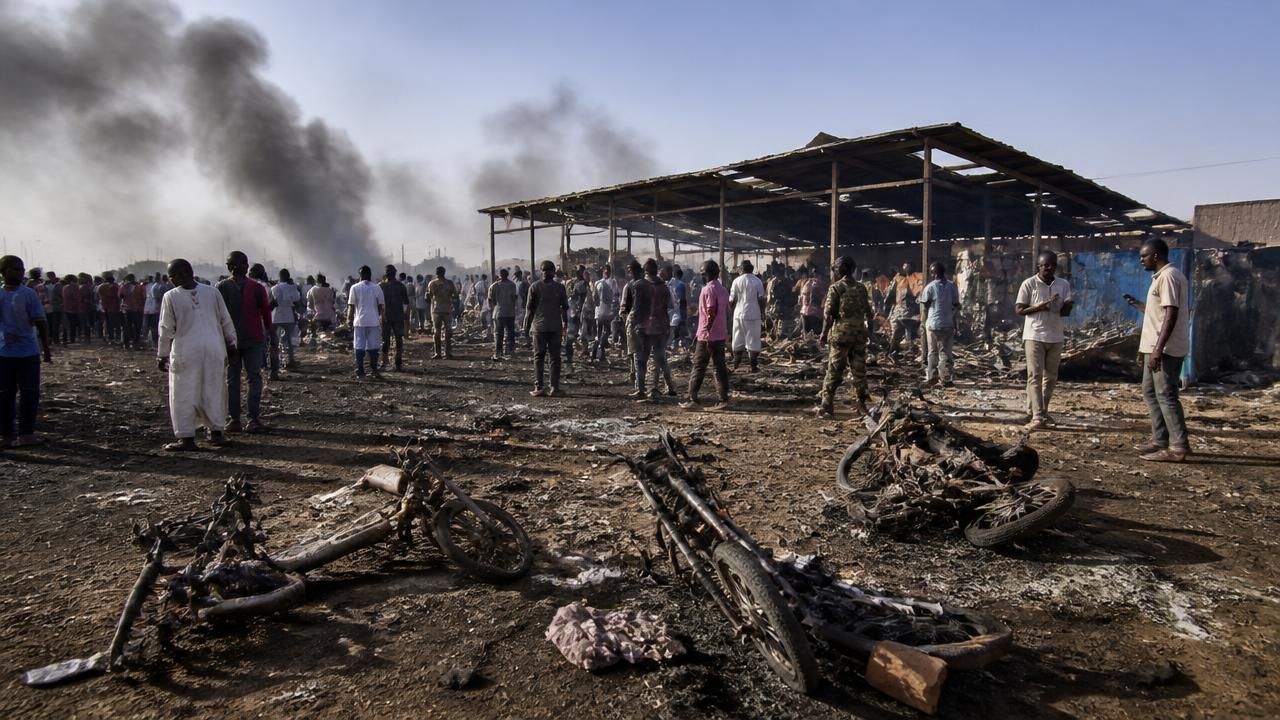
A drone attack on a busy transport hub beside a market in southern Sudan killed 80 people on Sunday evening, in what witnesses and monitors described as one of the deadliest single strikes of the country's two-year civil war. The attack in al-Dibab, a town in West Kordofan state, struck twice as commuters gathered to catch rides home, according to accounts relayed by local residents and reported by several international outlets.
Ahmed Wadi, a witness to the strike, said the scene quickly became a mass burial ground. "There were 50 bodies who I helped bury, one of them my own brother Mohamed," he told the Guardian. Other residents described crowds of travellers waiting at the transport point at dusk when the aircraft returned for a second pass — a pattern that has become grimly familiar in Sudan's drone war, where first responders and bystanders are often hit by follow-up strikes.
The death toll of 80, if confirmed, would place the al-Dibab attack among the single bloodiest incidents since fighting erupted between the Sudanese Armed Forces (SAF) and the Rapid Support Forces (RSF) in April 2023. Reports from the ground could not be independently verified, and no party immediately claimed responsibility for the attack.
Multiple front lines, one widening war
The al-Dibab strike was not an isolated incident. Reporting from France 24 described drone attacks killing scores of people in both West Kordofan and the capital, Khartoum, on the same day — evidence that aerial strikes now shape the conflict across widely separated theatres. Other coverage noted civilian casualties in Darfur and Kordofan, alongside reports of attacks targeting eastern Sudan, a region that for much of the war had been spared the worst of the fighting.
In parallel, Sudan's army claimed to have killed dozens of RSF fighters in an attack in Nyala, the capital of South Darfur and one of the war's most contested cities. The military's statement, carried by Sudanese media and aggregated by MSN, casts the army as striking back against paramilitary positions in Darfur's urban centres. It could not be independently confirmed.
Read together, the disparate reports sketch a conflict in which neither side holds a decisive advantage and both are relying increasingly on drone technology — a capability that has proliferated rapidly and cheaply across the Sahel and Horn of Africa.
How the story is being told
The way the attack has been framed differs markedly between outlets, reflecting both the difficulty of reporting from Sudan and the varying priorities of newsrooms:
- The human cost first: The Guardian led with witness testimony, naming victims and emphasising the market setting and commuter crowd — a deliberate choice that foregrounds civilian harm rather than military claims.
- A regional pattern: MSN's aggregation emphasised the breadth of drone strikes across Darfur and Kordofan and the expansion of attacks into eastern Sudan, casting al-Dibab as one data point in a wider aerial campaign.
- A battlefield contest: Coverage of the army's Nyala claim frames the same week's violence through the lens of military operations and RSF losses, offering a counterpoint to the narrative of pure civilian victimisation.
- Breaking-news brevity: Several outlets, including News24 and Modern Ghana, carried headline-only or truncated reports, underscoring how the information vacuum in Sudan shapes coverage — news arrives in fragments, often without verification.
"There were 50 bodies who I helped bury, one of them my own brother Mohamed." — Ahmed Wadi, witness to the al-Dibab strike
A war largely invisible to the world
The strike's scale highlights a conflict that, by most humanitarian measures, is the world's largest displacement crisis and one of its most severe. Tens of thousands of civilians have been killed, according to UN and monitoring estimates, and millions have been displaced internally or forced into neighbouring countries including Chad, South Sudan and Egypt. Aid access has repeatedly collapsed, and both the SAF and RSF have been accused by rights groups and UN investigators of war crimes and crimes against humanity.
West Kordofan has long been a strategic corridor linking Darfur to central Sudan, contested by both sides as supply lines have shifted. Its civilian population has repeatedly borne the consequences of that geography. The use of drones against markets, bus stations and other gathering points has drawn particular condemnation because it turns everyday infrastructure into killing zones with little warning.
What remains unclear is who launched the al-Dibab strike, how many of the dead were combatants as opposed to travellers, and whether the attack was a targeted operation against a military objective or an indiscriminate assault on a civilian crowd. Independent investigation is likely to be slow: Sudan's war has made access for journalists, human rights monitors and forensic teams extremely difficult.
What is not in dispute is the trajectory. Months of diplomacy — from Jeddah talks to US- and Saudi-brokered ceasefires to African Union mediation — have failed to halt the fighting, and heavy weapons now do what they have done elsewhere in Sudan's war: kill civilians in numbers large enough to be reported as headlines, and then fade into a longer, quieter tally.