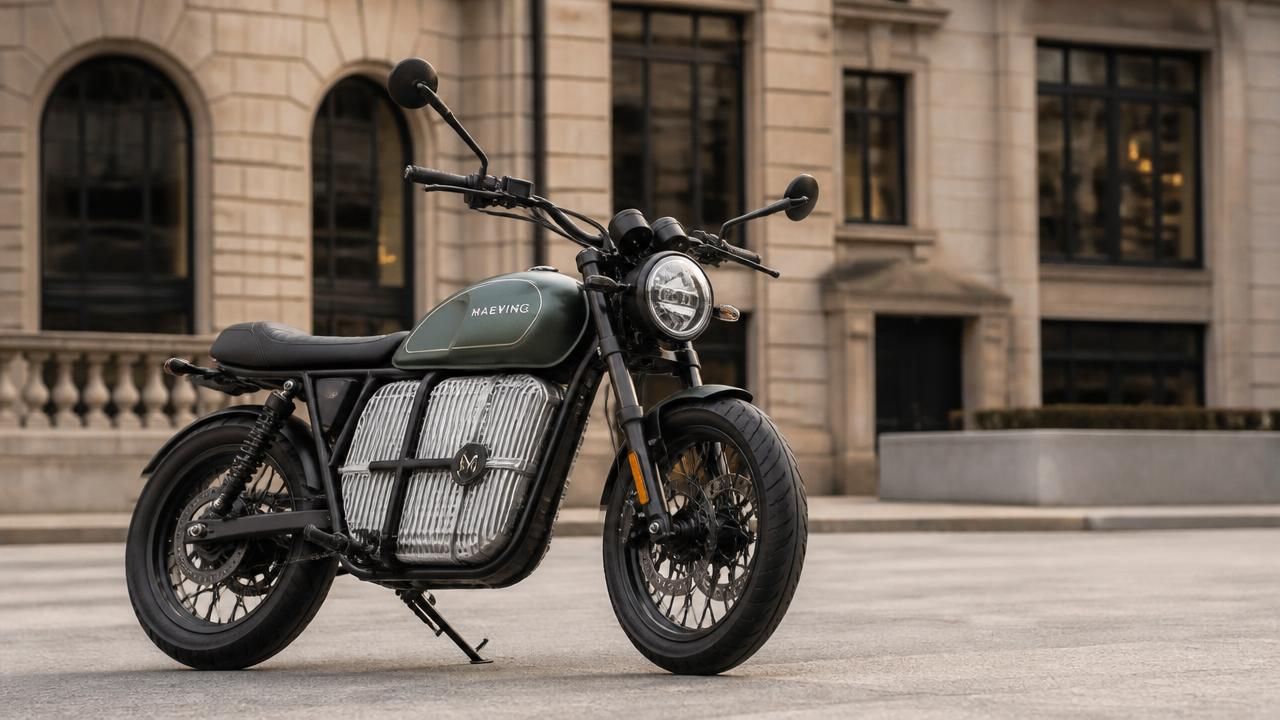
There is a fast-growing category of two-wheeled electric vehicles that splits the difference between high-end scooters and entry-level motorcycles — machines with avant-garde style but approachable performance. Offerings like the Infinite Machine P1 and BMW CE 02 compete in that space with wildly different attitudes, and now a British upstart is making its own case. The Maeving RM2, built in Coventry, has arrived to strong reviews for its design, alongside measured warnings about what riders give up to get it.
A retrofuturist take on the classic British motorcycle
The Verge's review frames the RM2 as a standout in its class, praising its “distinctly retrofuturistic flair” that evokes classic British motorcycles such as the Triumph Bonneville or the Royal Enfield Continental GT — without the exhaust fumes, vibration and noise that come with internal combustion.
That framing is echoed across coverage. Forbes describes the bike as “a deft blend of classic moto style and EV tech,” while Men's Journal goes further, calling it the machine with which “this British startup finally figured out electric motorcycles.” The consensus, in other words, is that Maeving has solved the aesthetic problem that has dogged electric two-wheelers: most look like either appliances or science projects, and very few look like something you would want to be seen on.
The RM2's silhouette — a low, naked frame, round headlamp, exposed tubes and a bench-style seat — reads as heritage design rather than gadgetry. It is a deliberate strategy: Maeving is selling nostalgia with a modern drivetrain underneath.
Two seats, removable batteries, urban intent
The most tangible upgrade in the RM2 over Maeving's original RM1 is practical rather than stylistic. As MSN's coverage puts it, riders who love the EV motorcycle's style “can finally have it and bring a friend” — the RM2 adds a pillion seat, turning a solo urban runabout into a genuine two-up machine.
The architecture remains the same idea that made Maeving notable in the first place: rather than relying on a fixed pack and public charging infrastructure, the bike uses removable battery modules that can be carried indoors and plugged into a standard wall socket. For city riders without off-street parking or access to a dedicated charger, that is a meaningful advantage over larger electric motorcycles.
That design also keeps the bike light and the price comparatively accessible for the category — a key differentiator against heavier, faster, far more expensive electric machines from established manufacturers.
The trade-offs
Reviewers are notably consistent about where the RM2 falls short. The Verge's headline verdict is “high-style electric riding with a few compromises,” and MSN's coverage similarly flags “some trade-offs” in an otherwise stylish package.
Those compromises are largely inherent to the bike's positioning. It is a city-focused machine rather than a highway tourer, with performance and range calibrated for urban distances rather than long-distance travel. Riders expecting motorcycle-grade acceleration or motorway capability will need to look elsewhere — and pay considerably more for it.
“High-style electric riding with a few compromises.” — The Verge's verdict on the Maeving RM2
There are also the usual caveats that come with buying from a young manufacturer: a smaller dealer and service footprint than legacy brands, and a feature set that prioritizes design cohesion over the gadget-heavy dashboards found on premium electric motorcycles.
Why the RM2 matters
The RM2 lands at a moment of real momentum for small electric two-wheelers. Electric bicycles have normalized battery-powered commuting; electric scooters have captured dense urban markets; and a new middle tier is forming between them. The Infinite Machine P1, with its angular, cyberpunk bodywork, and BMW's CE 02, with its deliberately playful proportions, are chasing the same buyer: someone who wants something expressive, not merely efficient.
Maeving's advantage is that its aesthetic references are older and more universally legible. A Bonneville-style stance travels better across generations and markets than a sci-fi wedge, and it gives the brand a story that is easy to tell.
- Who: Maeving, a British electric motorcycle startup based in Coventry.
- What: The RM2, a retro-styled electric motorcycle with a two-seat layout and removable batteries.
- Why it stands out: Heritage-inspired design that reviewers uniformly single out as its defining strength.
- The catch: Urban-focused performance and range, and the practical limits of buying from a young manufacturer.
- Competitive set: Infinite Machine P1, BMW CE 02, and premium electric scooters.
The business test ahead
For all the warm coverage, the harder question is scale. Men's Journal's framing — that a British startup has “figured out” electric motorcycles — is a design verdict, not yet a commercial one. Small manufacturers must convert favorable reviews into production volume, dealer networks, servicing capacity and financing options, and they must do it while legacy brands ramp up their own electric lineups.
What Maeving has clearly achieved is a coherent product identity. In a category where many vehicles read as compromises between scooter and motorcycle, the RM2 reads as a deliberate object. Reviewers across The Verge, Forbes, Men's Journal and MSN converge on the same conclusion: this is a beautiful, characterful electric bike for the city, provided you accept that it is not trying to be anything more.
For buyers weighing style against specification, that is the central question the RM2 poses — and it is one the young British company appears increasingly confident riders will answer in its favor.