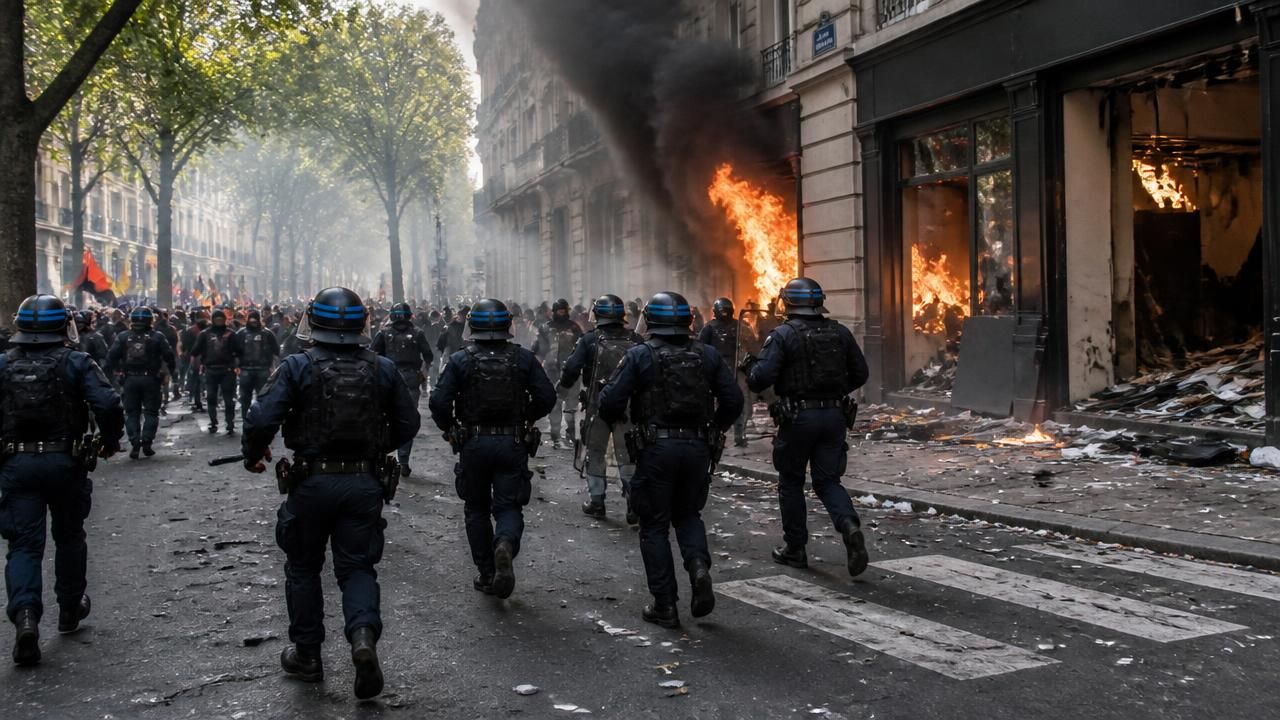
French police arrested at least 1,800 people across the country after violent groups clashed with officers and looted shops during nationwide demonstrations that drew hundreds of thousands of people, according to reporting carried by NPR and member stations including Boise State Public Radio. The figure, attributed to police counts, is the broadest tally to emerge from a day that saw scattered violence punctuate otherwise massive street protests.
But the headline number depends heavily on where you read it — and on how you define the geography of a protest movement that unfolded simultaneously in Paris and in cities and towns across France.
A day of demonstrations, and a day of disorder
The demonstrations drew crowds in the hundreds of thousands, making them among the largest mobilizations the country has seen in recent years. While the overwhelming majority of participants marched peacefully, smaller groups — described in the reporting as "violent groups" — broke away to confront riot police and target commercial storefronts.
Yahoo News framed the same events with an emphasis on the physical destruction, reporting "violent clashes, looting and buildings ablaze in France" alongside an arrest figure of more than 1,200. The imagery of burning buildings, smashed shop windows and running battles with officers has become a familiar visual signature of contemporary French protest coverage, and it travels faster across social platforms than any official tally.
"Violent clashes, looting and buildings ablaze in France as over 1,200 arrested after protests" — Yahoo News headline summarizing the day's unrest
The numbers problem: 1,800, 1,200, or 855?
The most striking feature of the aggregated coverage is the divergence in arrest figures. NPR and Boise State Public Radio both report at least 1,800 arrests nationally. Yahoo News cites more than 1,200. North Country Public Radio, meanwhile, reports that Paris police alone recorded 855 arrests.
These numbers are not necessarily contradictory — they measure different things. A national total compiled later in the day will exceed a count released by a single police prefecture earlier. Paris, as the focal point of both the largest crowds and the most intense clashes, would naturally account for a large share of any national figure. Read together, the three data points sketch a rough picture: hundreds of arrests in the capital, and well over a thousand across the country.
Still, the gap illustrates a persistent challenge in covering civil unrest. Arrest counts are released incrementally, by different agencies, at different times, and under different definitions — people taken into custody, people formally detained, people charged. Outlets publish the number available at the moment of writing, and those numbers harden into headlines that outlive the circumstances that produced them.
Why France keeps erupting
France has a long and well-documented tradition of mass protest, and its security forces are structured around it. Successive governments have maintained large standing contingents of riot police, and the doctrine of responding to urban disorder with rapid, large-scale arrests — including preventive detentions — has become a standard tool of French policing.
That approach produces dramatic headline numbers but also raises questions that rights groups have pressed for years: how many of those arrested are later released without charge, and whether mass detention functions as a deterrent or as an escalator. French authorities have generally argued that swift arrests prevent worse violence and protect businesses and public property. Critics counter that heavy-handed tactics can radicalize otherwise peaceful demonstrators and pull more people into confrontation.
The economic dimension is equally visible in the coverage. Looting and arson hit small businesses hardest — shopkeepers who are often uninsured for riot damage, or whose policies exclude civil disturbance. In the aftermath of previous rounds of unrest, French governments have faced pressure to expand compensation schemes for affected merchants, and the political cost of boarded-up high streets can outlast the protests themselves.
What the differing framings tell us
The four sources diverge in emphasis as much as in data. The NPR and Boise State versions lead with the national arrest total and the scale of the crowds, situating the violence within a mass democratic expression. The Yahoo headline foregrounds fire and looting. North Country Public Radio's Paris-specific figure localizes the story in the capital, where the images are most concentrated.
None of these framings is wrong, but each produces a different impression of the same day — one of a broadly supported movement marred by fringe violence, another of a city under siege. Readers who encounter only one version will come away with a materially different understanding of what happened.
What comes next
The immediate questions are logistical and legal. French prosecutors will now process those arrested, with many expected to face rapid hearings; the proportion released without charge will be a key indicator of how targeted the police operation actually was. Officials will also update the national tally, likely pushing the final figure above the 1,800 reported in the initial wave of coverage.
Politically, the unrest lands in a landscape already defined by disputes over policing, economic insecurity and the legitimacy of street protest as a tool of dissent. Whether the violence is remembered as a fringe aberration or as a defining feature of the movement will depend less on the arrest figures than on what happens in the coming days — and on whether the underlying grievances that brought hundreds of thousands into the streets are addressed at all.
- National arrests: at least 1,800, per NPR and Boise State Public Radio
- Alternative national figure: more than 1,200, per Yahoo News
- Paris arrests: 855, per Paris police as reported by North Country Public Radio
- Crowd size: hundreds of thousands nationwide
- Reported damage: looting, clashes with officers, buildings set ablaze