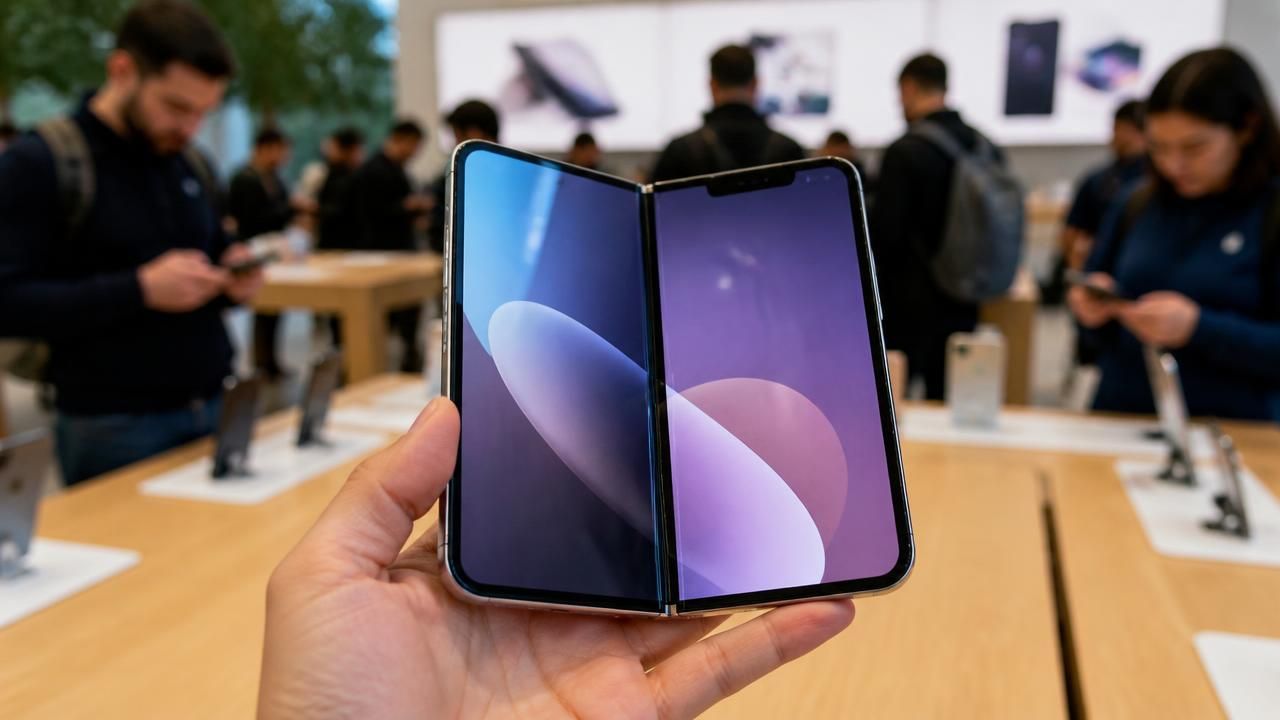
Apple's long-rumored foldable is finally real — and it is already gone. The iPhone Duo, the company's first entry into the folding-phone category, opened for preorders this week at a starting price of $1,999 for the 256GB model, and sold out within minutes. Delivery estimates almost immediately slipped past the holidays and into January 2027, with some configurations showing even longer waits.
Apple characterized the response in a single word: extraordinary.
"Apple says iPhone Duo preorder demand has been 'extraordinary.'"
The company has not disclosed unit figures, but the speed of the sellout — and the immediate collapse of shipping estimates — tells its own story. Reports from Forbes, MacRumors, Digital Trends and IGN converged on the same detail within hours of preorders going live: anyone who did not complete a purchase in the first few minutes is now looking at a 2027 delivery date. By later in the day, AppleInsider reported that delivery windows had begun to "stabilize" on late-January shipments across all models, suggesting Apple's supply chain has at least settled into a predictable queue rather than continuing to slip.
The Hardware: A Foldable Built Like an iPhone
The Duo pairs a 5.4-inch outer display with a 7.6-inch inner screen, the latter finished with a "nano-texture" coating designed to cut glare and feel more like paper than glass. Reviewers who handled the device at announcement — including The Verge, which published a hands-on under the headline "We unfolded the iPhone Duo" — came away impressed by how little crease is visible along the fold, historically the most visible compromise in the category.
Apple's design choices are notably conservative in places. There is no Face ID; the Duo instead uses Touch ID built into the power button, a decision that keeps the inner display free of the larger sensor array a TrueDepth camera would require. The camera system is a two-lens setup — a main wide camera and an ultra-wide — rather than the triple-lens stack found on Apple's Pro phones. Apple has leaned on software to close the gap, shipping features like Smart Take, Kid Cue and Duo Preview that use the folding form factor for hands-free shooting and framing.
The bigger story may be iOS 27. Apple reworked the operating system specifically for the foldable, moving the dock to the side of the device when unfolded and reflowing first-party apps around the squarer aspect ratio. There is even a bespoke unfolding animation — a small flourish that underscores how much of the Duo's identity is choreographed rather than purely functional.
The Price of Admission — and of Repair
At $1,999, the Duo sits at the top of Apple's iPhone lineup and squarely in the premium tier occupied by Samsung's Galaxy Z Fold series and Google's Pixel Fold. Carriers are already moving to soften the blow: Android Authority reported that Verizon is offering several trade-in and installment structures to bring the effective cost down, a familiar playbook for a device priced well above the psychological $1,000 threshold.
The long-term cost of ownership is less forgiving. TechRepublic flagged that repairing the Duo's folding display runs roughly $999 — about the price of an entirely new iPhone. That figure will invite direct comparison with Samsung's foldable repair pricing, and it lands at an awkward moment for a device whose hinge and panel are its entire selling proposition.
Accessories are drawing scrutiny too. MacRumors noted that Apple's $79 case for the Duo attaches with adhesive rather than clipping on, an unusual approach that raises questions about residue and reusability.
The Demand Story: Sellouts, Scalpers, and Samsung Searches
The sellout has produced the usual secondary-market distortions. Cult of Mac reported that Duo units are already commanding significant premiums on eBay, with resellers flipping unopened devices to buyers unwilling to wait five months. Meanwhile, the New York Post captured the flip side of the launch: a wave of frustrated customers who believed they had secured a launch-day device only to watch their delivery estimates jump to 2027 during checkout.
Perhaps the most telling data point came from Forbes, which reported a 300% spike in searches for Samsung's Galaxy Z Fold8 following the Duo's debut. That number cuts two ways. It suggests Apple's marketing machine has reignited broader consumer interest in foldables — a category that has consistently underwhelmed in unit volume outside Asia. But it also suggests a meaningful slice of would-be Duo buyers are shopping the competition, whether out of impatience with the backorder, price sensitivity, or simple curiosity about the more mature alternative.
Late, Expensive, and Possibly Unstoppable
Apple is arriving at the foldable party years after Samsung and Google established the form factor. The Verge framed the Duo as "a big new bet from Apple, though one that's a little late to the game." That framing captures the central tension of the launch: Apple is not leading here, and its first foldable is neither the thinnest, nor the cheapest, nor the most feature-dense on paper.
What Apple does have is pricing power rooted in status — the dynamic CNBC examined in its coverage of whether $1,999 is a bridge too far even for Apple's brand equity. The early evidence suggests the answer is no. A product that sells out in minutes at two thousand dollars, during a period of broader consumer caution in electronics, is a product whose appeal is not purely rational.
The open question is whether that initial wave is genuine sustained demand or a launch-window artifact amplified by scarcity, scalping, and FOMO. Apple's real test comes in January, when the backlog clears and the Duo has to compete on its merits — including against a Samsung ecosystem that just got a very public, very free advertisement.
For now, the company can point to the only metric that matters at launch: there are no phones left to sell.