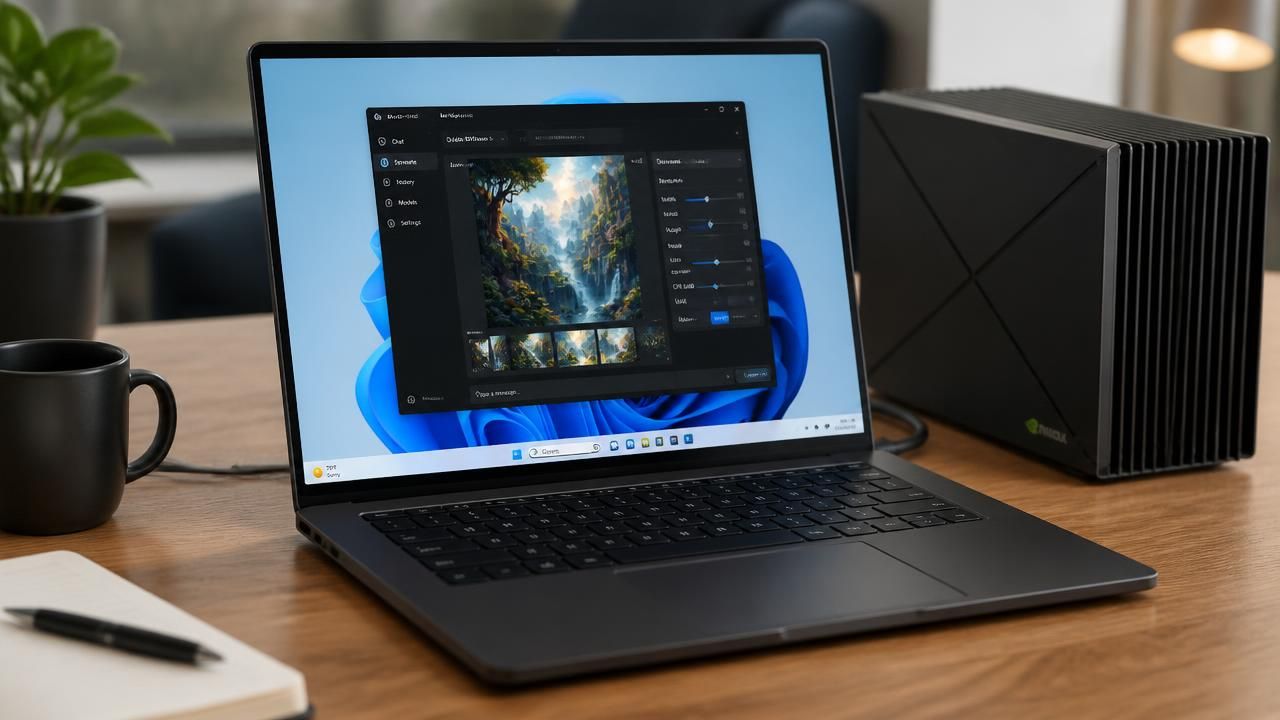
Nvidia's long-anticipated RTX Spark N1X processor has officially arrived in retail hardware, and the first wave of reviews paints a picture of a platform that is genuinely different from anything else on the Windows market. The chip, an Arm-based system-on-a-chip combining a high core-count CPU, RTX Blackwell graphics, and a large pool of unified memory, is now shipping in Windows laptops from six different manufacturers — four of which reviewers have already put through their paces.
The stakes are unusually high. Nvidia is staking a claim in a territory long dominated by Intel, AMD, Qualcomm, and, most importantly, Apple's M-series silicon. But unlike previous attempts to challenge Apple's laptop dominance, RTX Spark arrives with a specific thesis: that the next generation of personal computing will be defined not by frame rates alone, but by the ability to run large AI models locally, on-device, without a cloud connection.
What RTX Spark Actually Is
At its core, RTX Spark is a "superchip" — Nvidia's own framing — that marries an Arm CPU cluster with RTX Blackwell graphics and a unified memory architecture that lets the CPU, GPU, and AI accelerators draw from the same pool. That last detail matters enormously. Unified memory is what allows Apple's MacBooks to run sizable language models locally, and it is the architectural feature Nvidia is most directly targeting.
The flagship showcase is Microsoft's Surface Laptop Ultra, which pairs the chip with a staggering 128GB of unified memory. The Verge's Tom Warren published a full review of that machine, while colleague Sean Hollister has been living with a 64GB configuration of an Asus model. Across a week of collective testing, the outlet reported that RTX Spark delivers on its promise of high-performance Arm computing for laptops and small desktops — but with caveats that vary sharply by manufacturer.
The Benchmark Picture
Raw performance numbers have been the most closely watched data point, and the early results are favorable for Nvidia. In multi-core CPU benchmarks, RTX Spark outperformed AMD's "Strix Halo" Ryzen AI Max+ 395 — a chip that until now represented the high-water mark for integrated PC silicon. That result is significant because Strix Halo was itself positioned as AMD's answer to Apple Silicon, and it suggests Nvidia has leapfrogged the incumbent on CPU throughput alone, before accounting for its GPU and AI advantages.
Live benchmarking coverage has focused on four dimensions: CPU, GPU, AI inference, and gaming. WIRED framed the launch as "the first real look at AI PCs," a notable shift in language — the term "AI PC" has spent two years as a marketing slogan attached to modest neural processing units, and RTX Spark is the first hardware that arguably justifies it.
Windows Learns a New Architecture
None of this works without software, and here the story becomes as much about Microsoft as it is about Nvidia. Windows is being actively optimized for RTX Spark laptops, with a substantial portion of that work centered on Prism, Microsoft's emulation layer for running x86 applications on Arm hardware.
Microsoft has argued that Prism's role on RTX Spark extends well beyond raising frame rates in emulated games. The company's positioning suggests the translation layer is foundational infrastructure — the mechanism that lets an entirely new silicon architecture inherit four decades of Windows software without forcing users to think about compatibility at all.
Gaming support has been the most visible proof point. Nvidia has locked in major AAA game support ahead of the laptop launch, including the anti-cheat systems that have historically been the single biggest blocker for Arm-based gaming. In parallel, RTX Neural Texture Compression now runs on RTX Spark and Windows on Arm, bringing Nvidia's AI-driven asset compression to the new platform — a signal that the company intends to ship its full graphics feature stack rather than a stripped-down port.
Built for Local AI Agents
The most forward-looking framing comes from the AI angle. RTX Spark laptops are explicitly designed to run AI agents locally — autonomous software that plans, calls tools, and executes multi-step tasks without round-tripping to a data center. That use case is memory-hungry and latency-sensitive, which explains why Nvidia is pushing 64GB and 128GB configurations rather than the 16GB that has been standard on premium Windows laptops.
Creators are a secondary but deliberate target. At IFA 2026, Asus unveiled ProArt RTX Spark systems aimed squarely at creative AI workflows — rendering, generative image and video pipelines, and on-device model fine-tuning — positioning the platform as a workstation alternative rather than a gaming-first product.
The Case for Waiting
Not every outlet is ready to declare victory. PCWorld's assessment was notably measured, arguing that RTX Spark could be the future of laptops — and that this is precisely the reason to hold off.
“Nvidia's RTX Spark could be the future of laptops. That's exactly why I'd wait.” — PCWorld
The skepticism rests on familiar first-generation logic: six manufacturers shipping simultaneously means wildly inconsistent thermal designs, battery life, and memory configurations; driver maturity on a brand-new Arm platform is unproven; and the price of entry, particularly at 128GB, is likely to sit in workstation territory. For buyers whose current laptop handles their workload, the argument for patience is strong.
Why It Matters
Whatever the first-generation trade-offs, the strategic picture is clear. Nvidia has spent a decade dominating AI accelerators in the data center; RTX Spark is its attempt to extend that position to the device in your bag. Microsoft, meanwhile, gets a second serious Arm partner alongside Qualcomm — and one with considerably more graphics credibility.
- Performance: Multi-core CPU benchmarks top AMD's Ryzen AI Max+ 395.
- Memory: Configurations up to 128GB of unified memory enable large local models.
- Software: Prism emulation, AAA anti-cheat support, and Neural Texture Compression all arrive at launch.
- Ecosystem: Six OEMs at launch; four tested by reviewers in week one.
- Caveat: Early-adopter risk on drivers, thermals, and pricing remains unresolved.
For now, RTX Spark is best understood as the opening move in a multi-year contest rather than a settled verdict. The benchmarks are real, the software stack is deeper than expected, and the AI-agent use case gives the platform a reason to exist beyond spec-sheet bragging rights. Whether that translates into a laptop most people should buy in 2026 — or one they should watch from a distance until the second generation — is the question the next twelve months will answer.