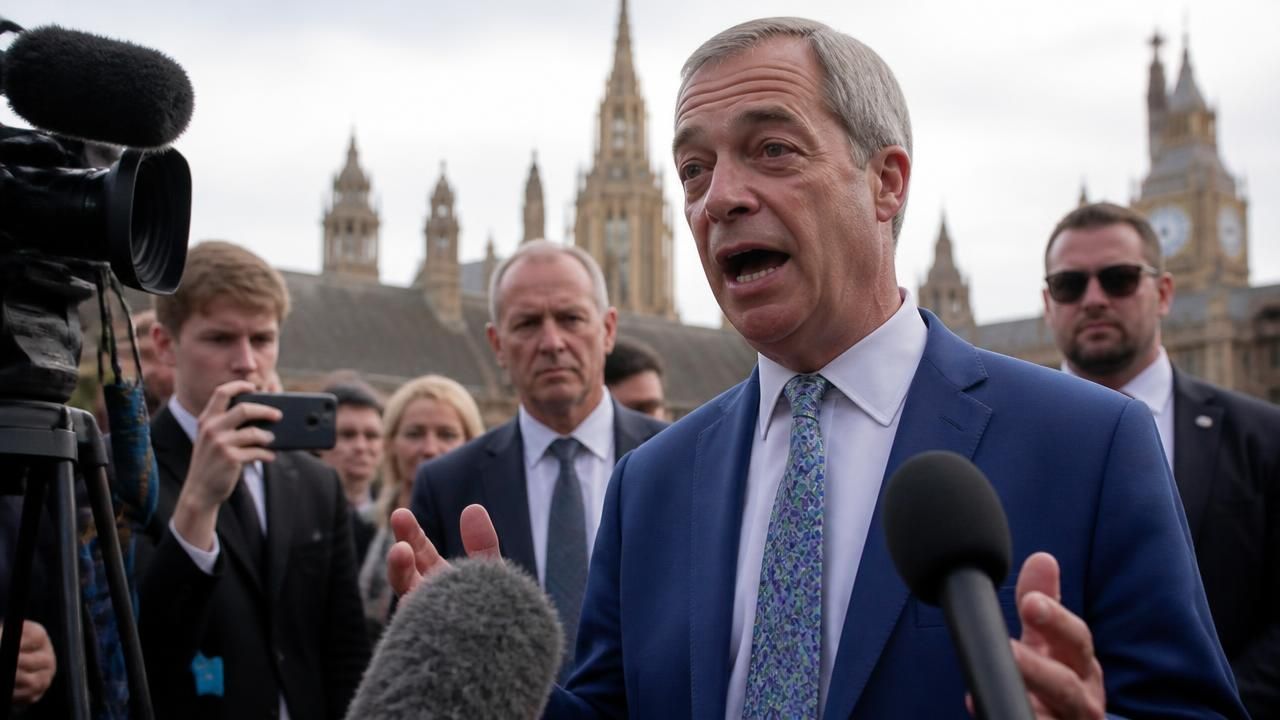
Reform UK has been forced onto the defensive after ITV News broadcast undercover footage showing a number of its councillors and parliamentary candidates using racist, violent and sexist language. The recordings, gathered over the course of more than a year, have triggered a fresh round of scrutiny over the party's candidate vetting procedures and its internal culture — and have handed its opponents a damaging line of attack just as Reform seeks to convert its polling strength into durable electoral gains.
The party responded swiftly but firmly in public, stating that "there is no room for racism" in Reform UK. Behind that formula, however, lies an uncomfortable question the leadership has so far struggled to answer: how did individuals holding public office under the Reform banner pass screening processes that the party has repeatedly described as rigorous?
What the footage showed
According to ITV News, the material was collected by an undercover reporter working inside the party over roughly a twelve-month period — a timescale that makes it difficult for Reform to characterise the remarks as isolated slips by a handful of new recruits. The clips reportedly capture serving councillors and prospective parliamentary candidates speaking in terms that the broadcaster described as extreme on race, and gratuitously violent and sexist in tone.
The documentary format is a familiar one in British broadcast journalism: long-duration infiltration followed by a single, high-impact transmission designed to maximise political reverberation. Reform, like UKIP before it, has often argued that such investigations are disproportionate and selectively edited. The party has not denied that the individuals featured were its members or office-holders.
Farage defends the party's vetting
Nigel Farage, Reform's leader and its most recognisable figure, moved quickly to defend the party's screening arrangements, arguing that vetting can only go so far when a party is expanding rapidly at local level. That argument cuts two ways. Reform has grown from a protest vehicle into a party with hundreds of councillors following successive local election breakthroughs, and its leadership has made the scale of that expansion central to its claim to be the real opposition to Labour.
"There is no room for racism" in Reform UK, the party said in response to the broadcast.
Critics counter that rapid growth is precisely why vetting must be resourced properly. Rival parties noted that Reform has itself made candidate quality and cultural standards a central part of its messaging, promising a break from what it calls the failures of the established parties.
Fallout: a suspension and a prison job
The consequences were not confined to Westminster. One councillor was suspended from a job in a prison following comments described as "despicable" — a development that pushed the story beyond party politics and into questions about public safety, employment and the conduct expected of those working in the criminal justice system. The suspension gives the affair a concrete institutional dimension: it is no longer only a story about what politicians said on camera, but about where those individuals work and what access they hold.
For Reform, the practical difficulty is that suspensions and expulsions, while demonstrating responsiveness, also amount to an admission that the party's filters failed. Every name added to that list reinforces the impression of a party that has grown faster than its internal machinery.
How the outlets framed it
The coverage has split along predictable lines. The BBC's political reporting led on the party's official response and the criticism it faces, framing the story around accountability and the "no room for racism" statement. Aggregators and mid-market outlets emphasised the confrontation between Farage and his critics, foregrounding the vetting defence. Yahoo's coverage, headlined around the "extreme and racist views" captured on camera, pushed the most direct framing of the content itself. The prison-job suspension was picked up as a separate, secondary strand — a reminder of how a single investigation can spawn multiple news cycles as new details surface.
The net effect is a story told in three registers: what was said, how the party answered, and what happened to the people involved. Each register reaches a different audience, and only the first is likely to travel widely on social platforms.
Context: a party built on insurgency
Reform UK's growth has followed a pattern familiar from UKIP's ascent — a charismatic leader, a clear anti-establishment pitch, and a membership and candidate base assembled quickly from a wide and loosely screened pool. Historically, insurgent parties on both left and right have struggled with the transition from movement to machine. The professionalisation that follows electoral success is expensive, unglamorous and often resented by activists who joined precisely because the party was not like the others.
That tension is now Reform's central organisational problem. The party needs candidates at scale to contest seats; it also needs a vetting operation capable of withstanding hostile scrutiny. The undercover footage suggests the second has not kept pace with the first.
What happens next
Expect Reform to announce disciplinary action against those featured, to restate its commitment to higher standards, and to accuse the broadcaster of pursuing a political agenda. Expect its opponents to keep the footage in circulation for as long as it remains useful, and expect the question of vetting to follow Farage into every subsequent broadcast interview.
The deeper issue is reputational rather than legal. The story does not, on its own, alter the electoral arithmetic that has made Reform a significant force. But it does test whether the party can persuade voters that it is a serious governing proposition rather than a vessel for grievance — and that is a question its leadership will have to answer again and again, not with a single press line, but with the slow, unglamorous work of building institutions that can survive the spotlight.