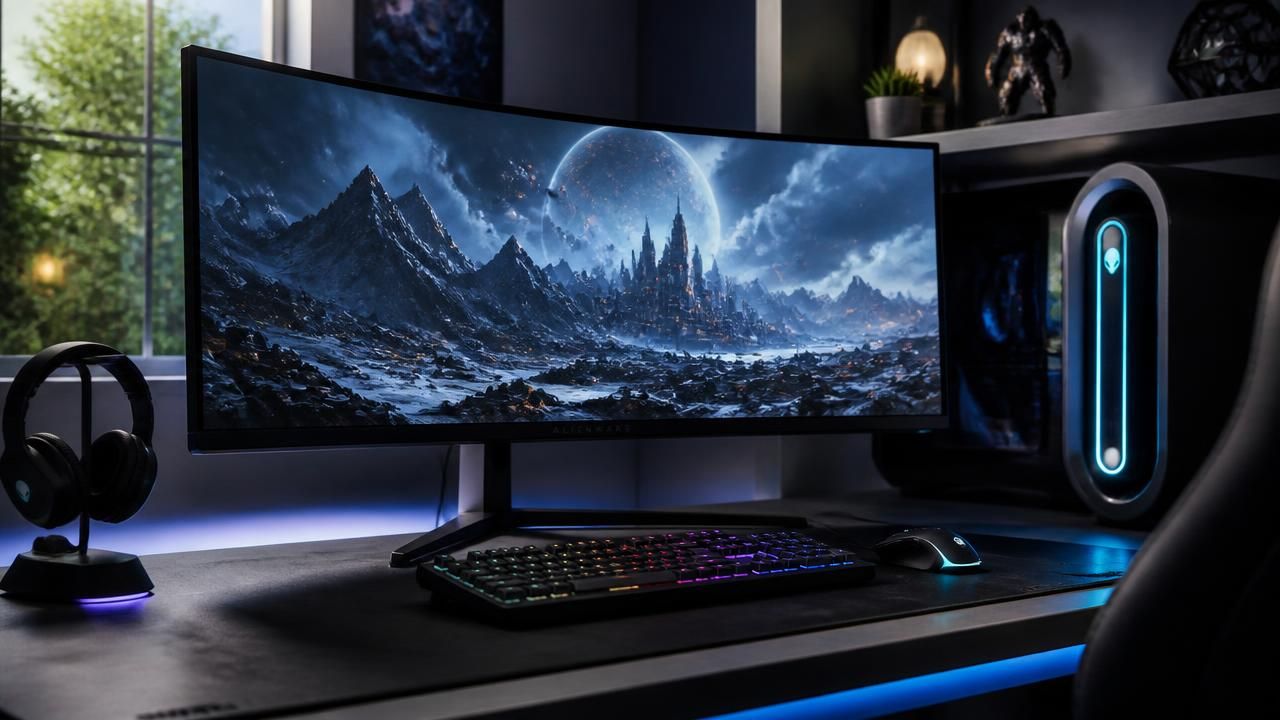
Dell's Alienware division has begun shipping its newest premium gaming display, the 34-inch AW3426DW, to European markets — a launch that coincides with a wave of discounting across the company's OLED lineup and a broader industry push to drive organic-light-emitting-diode panels downmarket.
The AW3426DW is a 21:9 ultrawide QHD curved gaming monitor built around a QD-OLED panel that uses Penta Tandem quantum dots, a layering technique Alienware says produces bolder, more saturated colors than earlier generations of the technology. It carries a 280Hz refresh rate — among the highest available on an OLED panel of this size — and an 1800R curve designed to wrap the screen around a player's field of view.
The monitor's rollout, reported by Gizmochina for Europe and covered extensively by US outlets as a retail story, marks the second major Alienware OLED launch in a matter of months and lands at a moment when the premium tier of the gaming display market is being squeezed from both above and below.
What the AW3426DW actually offers
According to specifications circulated by Dell and relayed by reviewers, the AW3426DW covers the bases expected of a flagship ultrawide:
- Panel: 34-inch QD-OLED with Penta Tandem quantum dots, 21:9 aspect ratio, 1800R curvature
- Refresh rate: 280Hz native, with adaptive sync support for both Nvidia G-Sync and AMD FreeSync Premium Pro
- Connectivity: Two HDMI 2.1 ports, DisplayPort, plus USB-A and USB-C for peripherals and charging
- Pricing: $799.99 list in the US
The Verge noted that the adaptive-sync pairing means "PC gamers with modern GPUs can enjoy a smooth frame rate when their systems can't output a frame rate that matches its native 280Hz refresh rate" — a meaningful detail for anyone running a midrange graphics card against an extremely fast panel.
The same outlet described the screen's appeal bluntly: "It's tough to get more OLED for your money than with this model when it's discounted."
A muddled — and unusually aggressive — price picture
If there is disagreement in the coverage, it is over price. The Verge reported the AW3426DW discounted to $742.22 at Amazon, just over $50 off list, calling it "not quite the lowest price we've seen" but still "a decent discount." PCWorld went considerably further, advertising Alienware's OLED ultrawide at $650 on Amazon and, in a separate post, saying it had "crashed to an all-time low." Macworld and Mashable both flagged $150 savings, while MSN and Kotaku framed the cuts around the 240Hz generation of the same family — with Kotaku going so far as to say shoppers should "forget Samsung Odyssey" because the Alienware had dropped below its Black Friday price.
The discrepancy is largely a matter of which SKU each outlet is tracking. Alienware has cycled several 34-inch QD-OLED models through the same retail channel in quick succession: the earlier 240Hz variants, and now the 280Hz Penta Tandem AW3426DW. Discount-hunting publications tend to aggregate across generations, producing headlines that credibly promise a record-low price on "an" Alienware OLED ultrawide without always specifying which panel revision is on sale.
For buyers, that ambiguity cuts both ways. The older 240Hz panels represent the better pure value; the AW3426DW represents the better display. The Verge's own hedged enthusiasm — the Penta Tandem model is, in its words, "less expensive than I feared" — captures the tension precisely.
The cheap tier is the real story
More consequential than any single discount is what Alienware is doing beneath the flagship. TechSpot reported the company launched a $350 QD-OLED monitor that deliberately trims brightness to cut costs, while Digital Trends described upgraded Alienware monitors starting at $300 with higher brightness and refresh rates than their predecessors. MSN's coverage of "$100 off the Alienware 34 240Hz QD-OLED" sits in the same value bracket.
That is a significant strategic shift. When QD-OLED ultrawides first appeared, they were widely treated as halo products — near-$1,300 luxuries with burn-in anxiety, limited supply and effectively no discounting. Three years later, the technology is being segmented: a halo tier at 280Hz, a mainstream tier around 240Hz, and now an entry tier that sacrifices peak luminance to reach a $300–$350 price point.
"Dell's new Alienware monitors are brighter, sharper, and cost less than expected," Digital Trends concluded — a sentence that would have been nonsensical applied to OLED gaming hardware at the start of the decade.
How reviewers are framing it
The enthusiast press has largely converged on a favorable view, though with caveats about diminishing returns. MSN's review of the 34-inch QD-OLED called the display "an ultrawide showcase for Samsung's latest display tech" — a reminder that Alienware, like most monitor vendors, is buying panels from Samsung Display and differentiating on firmware, industrial design and price.
"It's not quite the lowest price we've seen on this well-equipped gaming monitor, but still a decent discount." — The Verge
Longer-horizon reviewers remain more measured. The Telegraph's monitors guide, framed around two decades of hands-on testing, positions the Alienware ultrawide within a crowded field rather than as an automatic pick, reflecting a market where competing QD-OLED and WOLED panels from Samsung, LG, MSI and Asus now occupy nearly identical price points.
What to watch
Three things will determine whether this launch is remembered as a turning point or a footnote. First, whether the $300–$350 OLED tier holds — budget panels that sacrifice brightness have historically been either quietly discontinued or repositioned once yields improve. Second, whether 280Hz becomes the new ultrawide standard or a short-lived peak before 360Hz OLED arrives. And third, how European pricing settles: Gizmochina's report confirms availability, but the same monitor that sells for $742 in the US frequently lists 15 to 25 percent higher across the Atlantic after VAT.
For now, the clearest signal is directional. Flagship OLED gaming hardware is getting faster. Everything below it is getting cheaper. Both trends are accelerating at once.