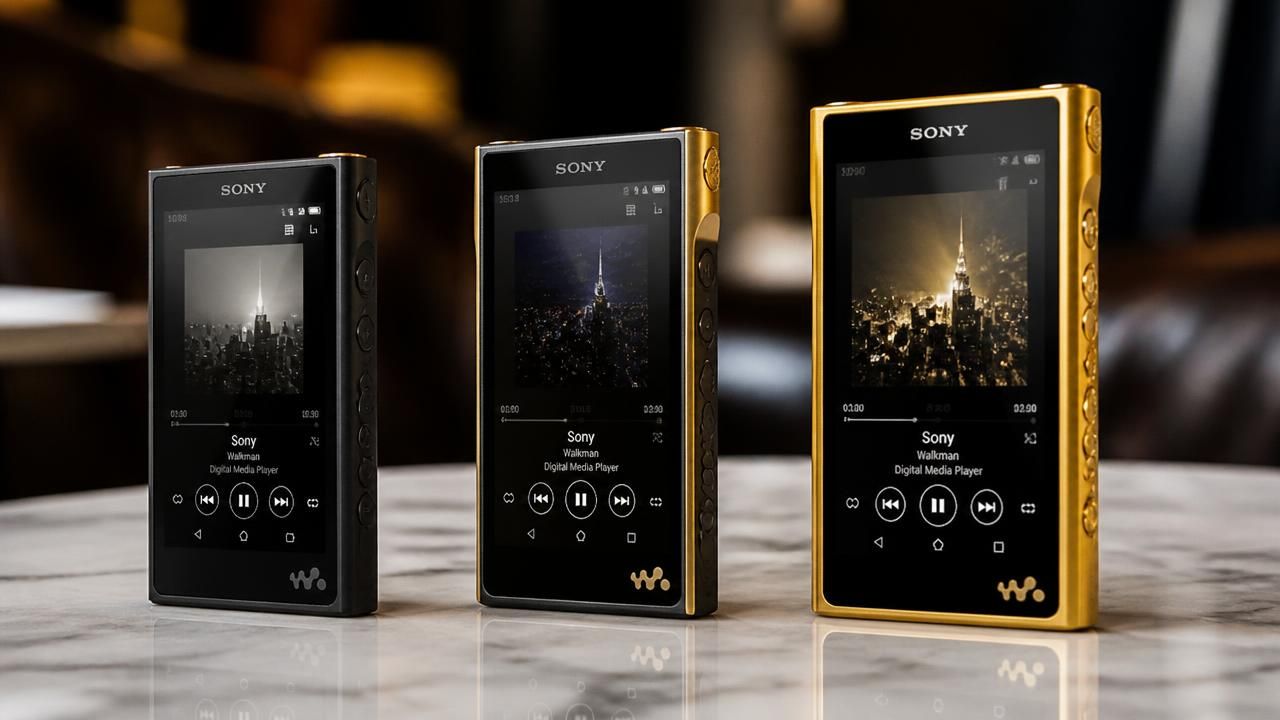
Sony has unveiled a trio of premium Walkman portable media players, a lineup that starts at an already steep $1,899.99 and climbs to $5,899 for a gold-plated flagship — a price that has reignited the long-running debate over how much dedicated portable audio hardware is worth in the smartphone era.
The new family comprises the NW-ZX900 at $1,899.99, the NW-WM1AM3 at $2,999.99, and the NW-WM1ZM3 at $5,899. All three are positioned squarely at the audiophile market, a segment Sony has cultivated for years with its Signature Series and ZX lines even as mass-market MP3 players vanished from shelves.
What the money actually buys
According to Sony, every model in the trio carries the company's DSD Remastering Engine, which upsamples conventional PCM audio into an 11.2MHz Direct Stream Digital stream — the equivalent of DSD256, roughly four times the data density of the 2.8MHz DSD used on SACDs. Sony claims the processing delivers a more analog-like character to compressed or CD-resolution files.
The other headline feature is gold plating. The top-tier NW-WM1ZM3 is built around a gold-plated copper chassis, a construction technique Sony has used on previous flagship Walkmans and long argues improves shielding and grounding in a device where every microvolt of noise matters. The premium is stark: at $2,999.99, the NW-WM1AM3 carries nearly identical internals, meaning buyers pay roughly $2,900 more for the gold shell and the components that accompany it.
How the press framed it
Coverage of the announcement split sharply along tone. The Verge led with skepticism, describing the entry price as already absurd and noting that for the middle model, the flagship is “nearly identical to the WM1ZM3, just minus the gaudy gold shell.” Its reviewer added a wry aside about renders being the closest most readers will ever come to touching the hardware.
“This render with a transparent background is the closest we'll ever come to touching one of these things.” — The Verge
The Next Web took the nostalgia-and-revival angle, framing the launch as Sony reviving the Walkman brand for a modern audience. MSN's headline emphasized the industrial design, leading on the gold-plated copper chassis rather than the price. TechPowerUp treated the news as a straightforward product-line update, with the technical specifications front and center.
Only Notebookcheck approached the story from the leak cycle, reporting on early indications of two flagship models and a top variant then expected to land near $4,000. The final announcement came in above that figure, a reminder that pre-release pricing leaks for niche hardware are frequently directional rather than precise.
A brand with an unusual afterlife
The Walkman name dates to 1979, when the original TPS-L2 helped normalize the idea of carrying a personal soundtrack everywhere. Sony sold hundreds of millions of units across cassette, CD and MiniDisc generations, but the arrival of the iPod, and then the smartphone, dismantled the mass market. Sony stopped producing cassette Walkmans around 2010, and the inexpensive MP3 player category effectively collapsed.
What survived is this: a small, high-margin digital audio player business aimed at enthusiasts willing to spend four figures on a music player. Sony's WM1Z and ZX series have anchored that niche since 2016, and the new models extend a lineup that competes less with phones than with dedicated players from Astell&Kern, FiiO, iBasso, Cayin and Luxury & Precision — a field where $2,000 to $4,000 price tags are not unusual.
The pitch for these devices has also shifted. Beyond sound quality, manufacturers market high-end players as a way to listen without notifications, algorithmic feeds or streaming-service interruptions — a digital-detox argument that resonates with a subset of buyers who already own expensive headphones or in-ear monitors. A $5,899 player paired with a $3,000 pair of headphones is the logical endpoint of that reasoning.
The strategic bet
For Sony, the economics are attractive precisely because the volumes are tiny. Flagship audio hardware functions as a halo product, reinforcing the company's engineering reputation and driving interest in more affordable headphones and wireless earbuds where the real revenue sits. The gold-plated chassis, the DSD engine and the price tags themselves all serve as marketing as much as engineering.
The risk is perception. As The Verge's framing suggests, each new price ceiling invites ridicule from mainstream buyers while the target audience treats it as incremental. Whether the NW-WM1ZM3 finds enough of those buyers depends on a question Sony has answered affirmatively for nearly a decade: in an era of streaming and wireless earbuds, is there still a market for a very expensive, very specialized music player? The company's answer, at $5,899, is yes — or at least, a profitable one.
Sony has not yet detailed regional availability or ship dates for the three models. Expect the gold-plated flagship to remain a boutique item, sold through specialist audio retailers and Sony's own channels, with the $1,899.99 NW-ZX900 acting as the entry point for listeners curious about what the fuss is about.