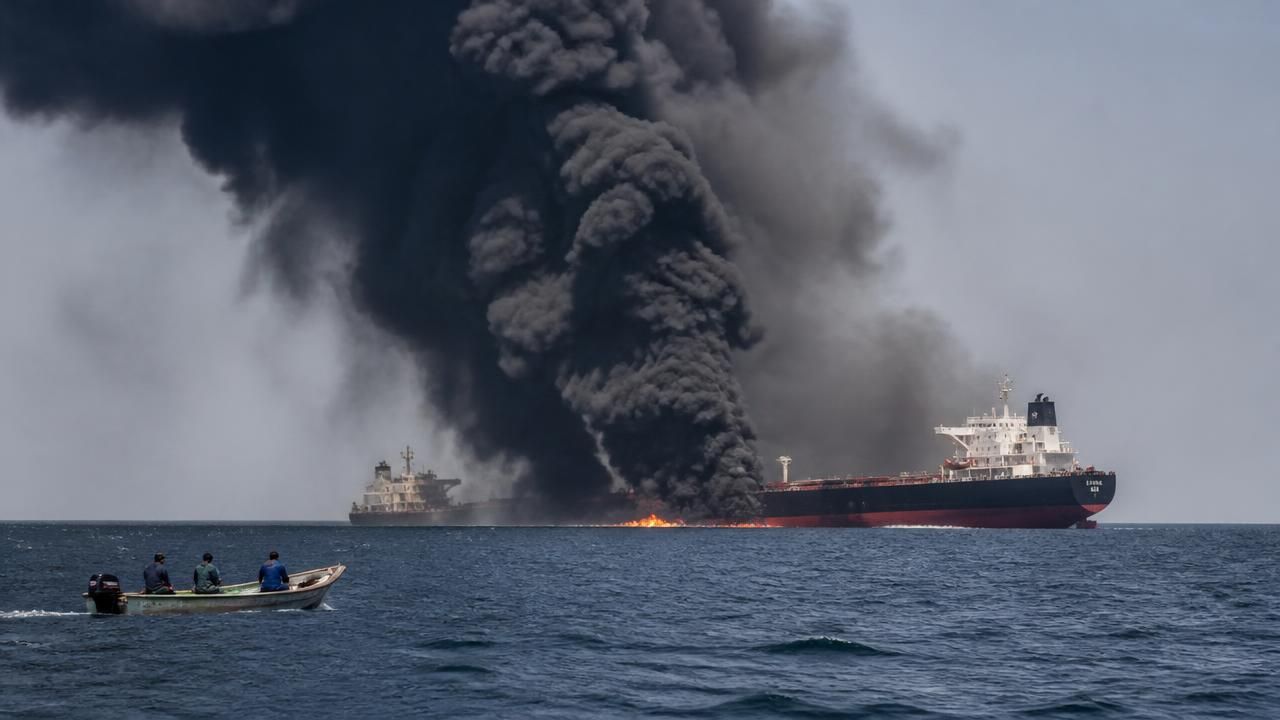
Two vessels went down in or near the Strait of Hormuz after being struck by projectiles, maritime authorities and regional officials said, the most dramatic escalation yet in a widening campaign of attacks on commercial shipping through the world's most important oil chokepoint. The sinkings sent crude prices sharply higher, knocked global shipping schedules off balance and raised fresh questions about how far Washington and Tehran are willing to push a confrontation that has been building for weeks.
According to the United Kingdom Maritime Trade Operations agency, both a tanker and a container ship were attacked in the strait. Separate reports described a dry bulk carrier going down after being hit by a projectile near Hormuz, while Iranian state media said a ship sank after striking a mine. At least one person was reported killed, according to Iranian statements carried by international outlets.
Conflicting accounts in a fog of war
The competing narratives — mines versus projectiles, one ship versus two, accidental versus deliberate — have become a hallmark of the episode. Iran's account, relayed through state media and reported by the Associated Press, framed the sinking as the result of a mine strike, a version that implicitly casts the incident as a hazard of contested waters rather than a directed attack. The UK maritime agency's report, carried by trade publication TradeWinds, pointed instead to hostile action against a tanker and a container ship.
Iran says a ship sank after striking a mine in the Strait of Hormuz — a characterization that maritime security analysts say is difficult to verify in waters where both moored mines and launched projectiles have been documented in past campaigns.
Because independent verification is nearly impossible in the strait's crowded, tightly controlled waters, the two versions may coexist in the public record for days. What is not in dispute is the outcome: hulls lost, cargoes spilled or abandoned, and crews placed in acute danger.
Oil markets price in the risk
Financial markets reacted immediately. Brent crude climbed to $106.60 a barrel, according to market reports, extending gains that followed a separate strike on Saudi Aramco infrastructure. Coverage from MSN's market desks described "oil flows crashing again" as Iran stepped up surveillance of the strait, with tanker traffic slowing and some operators pausing transits altogether.
The price move reflects more than the barrels actually lost. Traders are pricing the probability that Hormuz becomes partially or intermittently unusable — a scenario with no quick substitute. Roughly a fifth of the world's petroleum liquids and a substantial share of liquefied natural gas move through the strait each day, most of it destined for Asia. Even a brief interruption forces refiners to draw on inventories and pay up for alternative cargoes routed around the chokepoint.
Bloomberg's Middle East and Africa coverage, broadcast from Dubai, has tracked the region's markets through the escalation, underscoring how quickly a security incident in the Gulf becomes a global pricing event. The cost of insuring a voyage through the strait — war-risk premiums — typically spikes first, followed by freight rates, then by the pump price consumers eventually see.
Why Hormuz is uniquely fragile
The strait is barely 21 miles wide at its narrowest, with shipping lanes only a few miles across and bounded by Iranian territory to the north and Omani waters to the south. That geography gives Iran, which has repeatedly threatened to close the passage in times of confrontation, an outsized ability to impose costs without a formal blockade.
The playbook is not new. During the 1980s "Tanker War," hundreds of vessels were attacked as Iran and Iraq traded blows over oil exports. In 2019, explosions damaged tankers near Fujairah and in the Gulf of Oman, and Iran seized the British-flagged Stena Impero. Each episode produced the same sequence: insurance premiums jumped, navies escorted convoys, and prices settled only after the attacks stopped.
Alternatives are limited. Saudi Arabia's East-West pipeline to the Red Sea and the UAE's link to Fujairah can bypass Hormuz for some crude, but nowhere near all of it, and not for the Gulf's LNG exports.
Political timing sharpens the stakes
The escalation is unfolding in the run-up to U.S. midterm elections, a frame CNN emphasized in its coverage, arguing Iran is ramping up attacks as Washington's attention turns inward. That reading suggests Tehran may be testing the limits of the American naval presence — the Fifth Fleet is headquartered in Bahrain — while calculating that domestic politics constrain the response.
Other outlets have taken a more market-first approach. Reuters led on the sinking itself and the surge in attacks; the New York Times framed the episode as a sharp escalation without a single cause; Yahoo and MSN pushed oil and headline coverage to broad consumer audiences. The variation says as much about newsroom priorities as about the event: security desks see a confrontation, business desks see a supply shock.
The shipping industry's dilemma
- Crews: Thousands of seafarers transit Hormuz weekly, many on long-term contracts with little ability to refuse a dangerous voyage.
- Operators: Rerouting around Africa adds roughly ten days and enormous fuel costs on Asia-Europe runs.
- Insurers: War-risk underwriters can withdraw cover entirely, effectively halting commercial traffic without any government order.
- Navies: Escort operations stretch resources and risk direct confrontation.
TradeWinds and maritime security bulletins will remain the fastest source of ground truth, while oil futures will remain the fastest verdict on whether markets believe the strait stays open.
What to watch next
Three indicators matter most. First, whether the U.S. or its allies announce a formal convoy escort regime, which would mark a decision to treat the attacks as sustained rather than episodic. Second, whether war-risk premiums continue to rise after the initial shock — a sustained climb would signal that underwriters expect more attacks. Third, whether Tehran's own account of mine strikes, rather than targeted attacks, hardens into an official position, which would create room for de-escalation even as the physical risk to shipping persists.
For now, the strait remains open, the price of oil remains high, and the gap between the two narratives of what happened off Hormuz is as wide as the waterway itself.