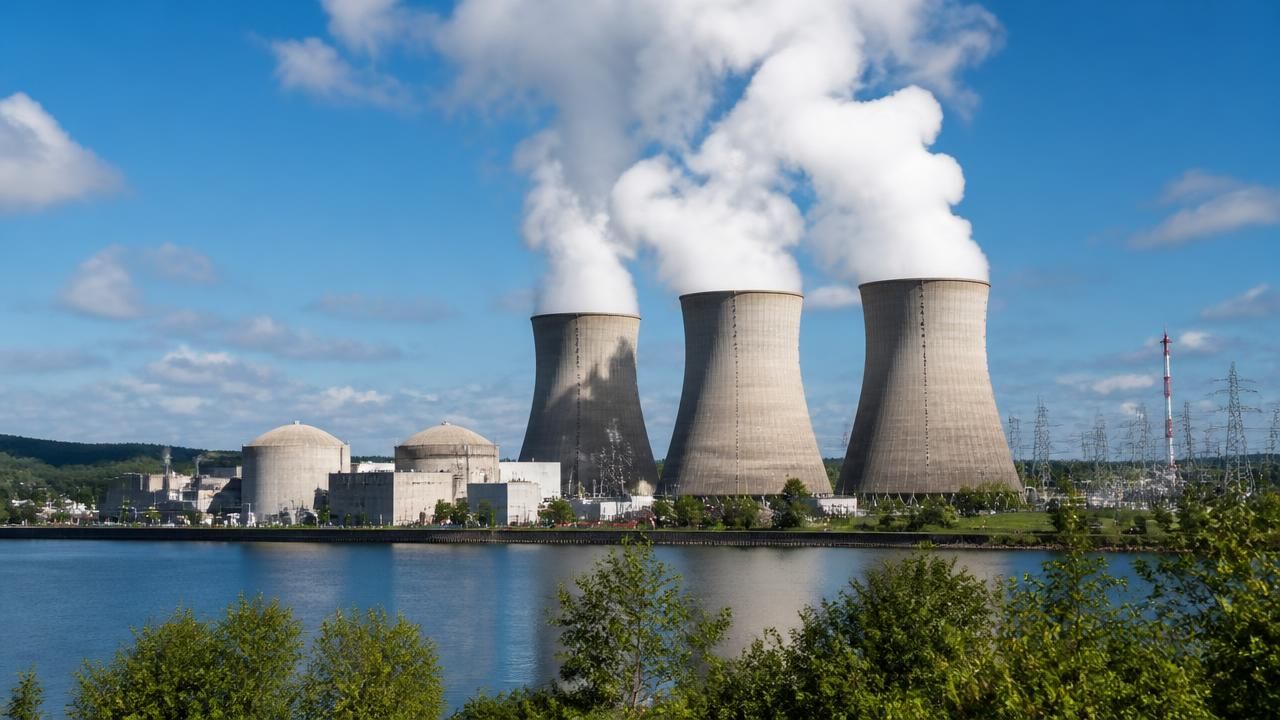
Global energy markets are being repriced around a single, uncomfortable question: not whether power is clean, but whether it is there when it is needed. Nuclear energy stocks have rallied sharply in recent sessions as demand for firm, round-the-clock clean power surges, a move that analysts tie directly to the electricity appetites of artificial intelligence data centers, electrified industry and an increasingly geopolitically charged energy landscape.
The shift marks a notable break from the past decade of investment logic, in which the clean-energy thesis was largely built on decarbonization mandates and climate targets. Today, the same assets are being bought for reasons that sound more like Cold War-era calculus: energy security, grid resilience and price stability.
A Market Repricing: Firm Power Comes Back Into Fashion
The rally in nuclear-linked equities — spanning reactor operators, uranium miners, fuel-cycle specialists and small modular reactor developers — reflects a broader revaluation of anything that can deliver uninterrupted baseload power without carbon emissions. After roughly two decades of flat electricity demand in advanced economies, forecasters now expect sustained growth, driven by data centers, heat pumps, electric vehicles and reshored manufacturing.
That reversal has been brutal for assumptions built into power markets. Renewables have become the cheapest source of new generation in most markets, but their output is variable. Grid operators increasingly value the complement: storage, long-duration batteries, transmission and firm low-carbon generation such as nuclear, hydro and advanced geothermal.
Big Tech Loved Green Energy — Until It Needed Reliable Power
No group illustrates the pivot better than the technology sector. Hyperscalers were once the most visible corporate buyers of renewable energy credits, and their pledges — 100 percent renewable, then 24/7 carbon-free energy, then net-zero by 2030 — became the benchmark for corporate climate ambition.
Those pledges have collided with the physics of AI. Training and running large models requires enormous, continuous loads that cannot tolerate intermittency, and the sector's own sustainability reports have acknowledged rising emissions even as renewable procurement grows. The result has been a wave of first-of-a-kind deals: long-term power purchase agreements for nuclear generation, investments in small modular reactor developers, and restarts of idled plants.
Critics on the political right argue the episode exposes the limits of green-energy idealism, while climate advocates counter that the same companies are simply proving that carbon-free power can be bankable at scale. Both readings contain truth — and both point in the same direction: capital is flowing to reliability.
Energy Security, Not Climate Goals, Is Now Driving the Boom
Energy analysts have increasingly framed the current investment wave as security-driven rather than climate-driven. The logic is straightforward: the 2022 energy shock exposed the vulnerability of import-dependent economies, and governments responded by subsidizing domestic generation of every kind — renewables, nuclear, hydrogen and, in many cases, fossil fuels.
That framing matters for policy durability. Climate-motivated subsidies can be repealed with a change of government; security-motivated ones tend to survive. It also changes which projects win: a solar-plus-storage portfolio co-located with transmission and a firming contract now looks far more attractive than an isolated wind farm with merchant exposure.
Reliability Data Challenges Fossil Fuel Assumptions
Fossil fuel advocates have long argued that intermittent renewables threaten grid reliability. But a growing body of grid data complicates that claim. Modern grids with high renewable penetration — supported by storage, interconnection, demand flexibility and diverse generation — have repeatedly demonstrated that outages are driven less by fuel type than by infrastructure age, extreme weather and market design.
The debate over whether clean energy is "more reliable" than fossil power now largely hinges on system-level engineering rather than ideology. A gas plant without fuel supply or a coal plant with an outage poses the same reliability risk as a wind farm on a still day — which is why portfolio diversity, and not a single technology, has become the dominant planning principle.
The View From New Delhi
Those tensions were on full display at the 2026 Bloomberg New Economy Forum in New Delhi, where Amy Brachio, chief executive of Carbon Measures, and Sumant Sinha, founder, chairman and chief executive of ReNew, dissected the investment, infrastructure and supply-chain requirements needed to meet rising power demand.
Investing in the infrastructure and supply chains needed to meet rising power demand — the central question put to energy executives at the 2026 Bloomberg New Economy Forum in New Delhi.
The choice of venue was not incidental. India sits at the center of the global demand story, balancing rapid industrialization and electrification against air quality and climate commitments, while simultaneously becoming a major manufacturing hub for solar modules, batteries and electrolyzers. Supply-chain concentration — particularly in China — was a recurring concern for panelists weighing how quickly Western and Indian capacity can scale.
Deals on the Ground
Meanwhile, the transition is being negotiated contract by contract. Avantus and Clean Power Alliance, a community choice aggregator serving Southern California communities, signed an agreement to deliver clean, reliable energy to the region — the kind of long-term offtake arrangement that developers say is essential to financing new capacity in a higher-interest-rate environment.
Such agreements matter because they transfer price risk from developers to creditworthy buyers, allowing projects to reach financial close. For community choice aggregators, they lock in supply as data centers and electrification tighten Western grids.
Political Backdrop and What to Watch
The politics surrounding energy are shifting as well. In the United Kingdom, the final legislative agenda of the Coalition government put energy policy alongside other priorities, a reminder that in mature democracies, electricity prices and supply security now rank among the most electorally potent issues.
- Watch the offtake market: long-term PPAs and capacity contracts will determine which technologies get built.
- Watch nuclear execution: equity rallies are easy; delivering reactors, fuel and licenses on time is not.
- Watch corporate climate language: expect more "resilience" and "security" framing from Big Tech.
- Watch supply chains: module, turbine and uranium supply bottlenecks could cap the boom.
The throughline is unmistakable. Whether the driver is AI, geopolitics or decarbonization, the premium is shifting from the cheapest electron to the most dependable one — and investors, utilities and governments are all repositioning accordingly.