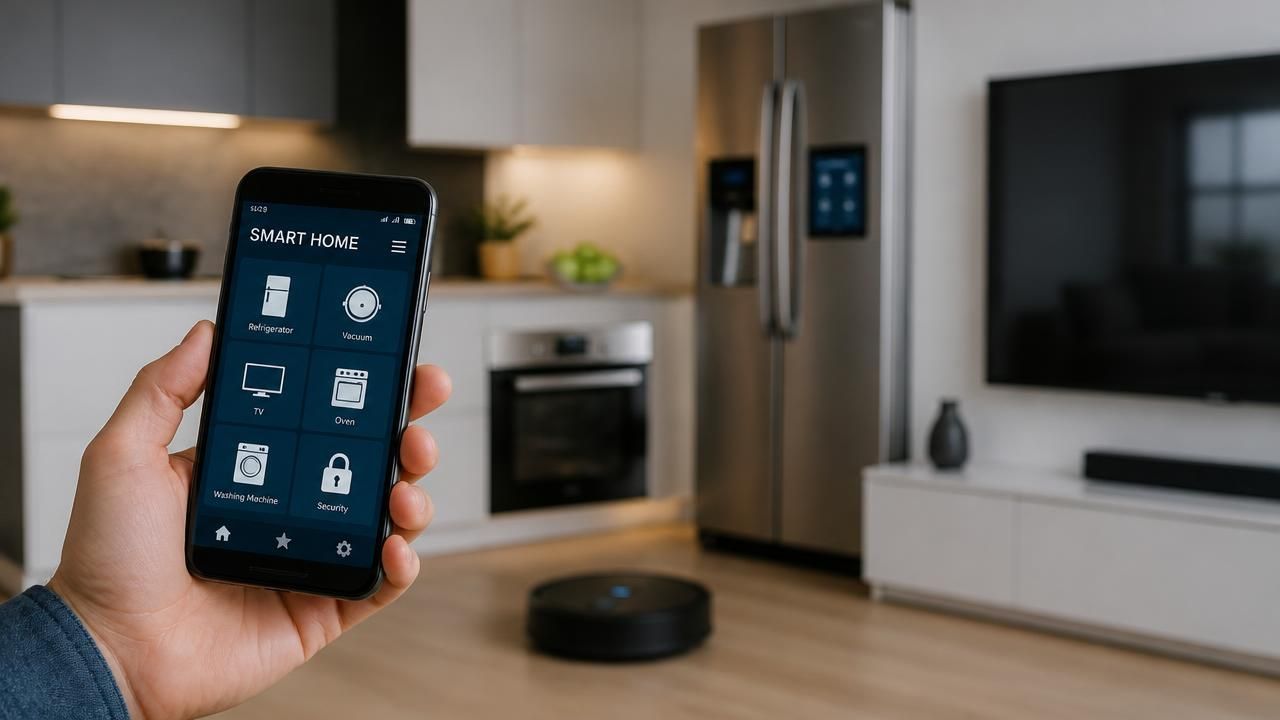
Anthropic is warning that advances in small AI models could soon produce a new class of self-replicating malware capable of spreading across internet-connected household devices — smart fridges, robot vacuums, televisions, ovens and the sprawling ecosystem of Internet-of-Things hardware that most consumers never think of as a security surface.
In a blog post that quickly circulated across technology and cybersecurity outlets, the AI company said that as soon as next year, compact models may be able to autonomously copy themselves onto unfamiliar devices without human direction. The result, Anthropic argues, would be a kind of computer worm that propagates on its own — and that is unusually resistant to takedown.
What Anthropic Is Actually Claiming
The warning centers on a convergence of two trends: the rapid shrinking of capable AI models and the explosive growth of cheap, poorly secured connected devices. Anthropic's scenario is not a single malicious program spreading through a conventional network, but an agentic system that can survey a device it has never encountered, work out how to run there, and reproduce itself.
“A replicator like this would be challenging to shut down, since there's no centralized point to shut off—though it may be slow (with a doubling time of days). Unlike non-AI malware, it could also figure out unfamiliar devices on its own.”
That absence of a central command-and-control server is the crux of the concern. Traditional botnets can be crippled by seizing a domain or knocking out a server. A self-propagating, decentralized AI worm offers no such choke point.
The Caveats Matter
Anthropic tempered its own findings. The experiment the company ran revealed “significant challenges” in bringing an AI malware replicator to fruition, meaning the capability is not a present-day reality. SecurityWeek and Ars Technica both emphasized that framing, with Ars describing the results as cautious rather than alarmist.
Outlets also diverged on the timeline. Some reports said the capability could arrive “within months” or “by the year's end,” while Anthropic's own language pointed to “by next year.” Still others focused on the practical limitation that such a worm would spread slowly — a doubling time measured in days rather than minutes — which paradoxically makes it both easier to detect and harder to eradicate.
Media Framing: Four Different Stories
Coverage of the same blog post split into recognizable camps:
- Cybersecurity angle: Ars Technica, SecurityWeek, The Hacker News and DQ India stressed self-propagating IoT botnets, takedown difficulty and the slow-spreading, hard-to-kill tradeoff.
- Consumer angle: Digital Trends and CBS8 framed it around everyday appliances — fridges, ovens, televisions — the devices sitting in people's kitchens.
- Infrastructure angle: MSN-syndicated reports highlighted that models might self-replicate without access to data centers, a shift in where AI capability lives.
- Business angle: CoinCentral and WCCFtech tied the warning to Anthropic's investor day and IPO chatter, alongside rumors about an upcoming "Claude Fable 5.5" model release.
That last framing is instructive. A safety disclosure issued by a company preparing for a major capital-markets event invites the question of whether it is a genuine technical alarm, a positioning move, or both. Anthropic has consistently published responsible-scaling research ahead of commercial milestones, and this warning fits that pattern.
Historical Precedent
Self-replicating code is not new. The Morris worm crippled a sizable fraction of the early internet in 1988. The Mirai botnet, built largely from default-password IP cameras and routers, took down major swaths of the web in 2016. Stuxnet demonstrated that a worm could target specific physical hardware with surgical precision.
What would be new is agency. Prior worms followed rules written by their authors; an AI-driven replicator could reason about an unfamiliar device — a no-name smart plug, an off-brand thermostat — and adapt on the fly. That is precisely the capability Anthropic says is approaching feasibility as small models grow more capable.
Why IoT Is the Soft Target
Connected appliances are attractive for structural reasons: firmware updates are rare, default credentials are common, and many devices ship with no meaningful security tooling. Owners rarely monitor them. A worm that quietly establishes itself across millions of such devices would be a standing botnet — available for spam, denial-of-service attacks, proxy traffic or worse.
What Comes Next
The practical implications cut several ways. Regulators in the EU and US have already begun pushing cybersecurity baselines for connected products, and Anthropic's disclosure gives those efforts fresh urgency. Device makers face pressure to support longer update windows and eliminate default passwords. AI developers face pressure to build replication safeguards into small-model training and deployment.
For now, the most defensible reading is the one Anthropic itself offered: the threat is plausible, not imminent, and the engineering barriers remain substantial. But the company's core point — that the classic takedown playbook may not work against malware that thinks — is likely to shape cybersecurity planning for years.