Kansas, a state that has not sent a Democrat to the U.S. Senate in nearly a century, has suddenly become the most closely watched battleground of the 2026 midterm cycle — a contest that Republicans once treated as a formality and that Democrats now describe as a real opportunity to break a generational losing streak.
The shift is driven less by local dynamics than by national ones. President Trump's approval ratings have sagged in several states he carried comfortably, and Republican candidates across the map have begun distancing themselves from the White House on immigration, Iran and the cost of living. In Kansas, that tension is playing out in a single, high-stakes Senate race.
A Tied Race in Deep-Red Territory
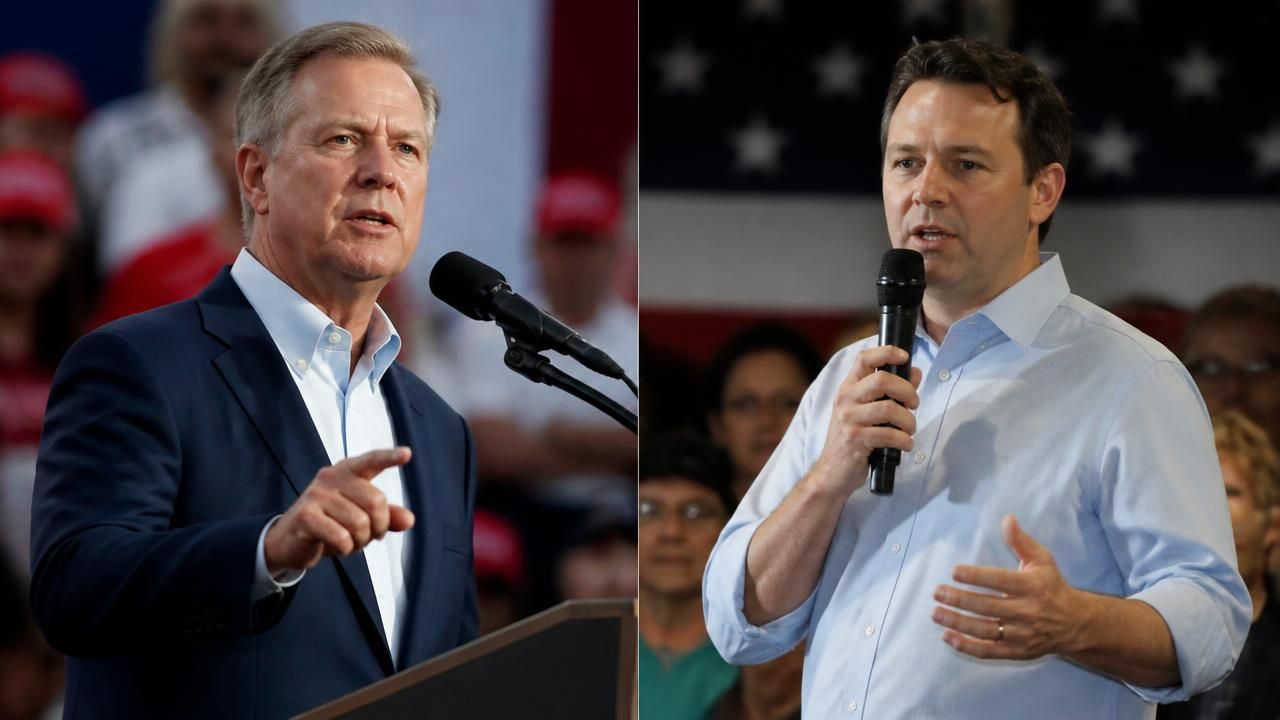
A new poll shows the Kansas Senate race tied between Republican Roger Marshall and Democrat Adam Hamilton, a result that would have been unthinkable in a state Trump won by double digits in each of the past three presidential elections. NPR Politics framed the contest bluntly: Kansas voters could elect a Democratic senator for the first time in roughly a hundred years — even as the governor's office could flip back to Republican control in the same cycle, a split-ticket outcome that would scramble conventional assumptions about the state's political geography.
Republicans are not treating the poll as an anomaly. Trump is scheduled to campaign in Kansas to boost Marshall's bid, a deployment of the president's personal political capital that carries its own risk: the same unpopular policies that make the trip necessary could also make it counterproductive.
“Unpopular policies have GOP worried of long unthinkable Senate loss.” — the framing MSN used to describe Republican anxiety about Kansas
The Money Race Accelerates
National Democratic groups have moved aggressively. The New York Times reported that a top Democratic group is pumping millions of dollars into the Kansas Senate race, a level of investment that signals the party views the seat as genuinely winnable rather than as a symbolic protest effort.
Republicans have responded by reallocating resources. A GOP super PAC has paused spending in the North Carolina Senate race and shifted money to Kansas, according to MSN — a decision that underscores both the party's concern about the state and the zero-sum arithmetic of a midterm map with few spare dollars. Taken together, the moves suggest that operatives in both parties now regard Kansas as a tipping-point state rather than an afterthought.
The spending surge has also spilled into a newer, less regulated arena: prediction markets. KSN reported that roughly $4 million in activity has flowed through wagers tied to the Kansas Senate race, activity that is legal, for now, under current rules. The volume is itself a data point — a real-time, money-weighted estimate of how uncertain the outcome has become.
Bracing for a Recount
With polls showing a dead heat, Kansas election officials are already preparing for the possibility of a recount in the tight Senate race, according to FOX4KC. The precaution reflects the practical reality of a contest that could be decided by a few thousand votes — and the likelihood of litigation, recounts and extended uncertainty in the days after polls close.
Beyond Kansas: A National Backdrop
Kansas is not an isolated case. Reuters has identified a small set of races that will decide control of the U.S. Senate, and Democrats now lead in five states Trump won by double digits, according to polling aggregated by MSN. NBC News is tracking the broader race for Congress as the 2026 midterms take shape, while IJR reported that primary elections and early voting have already begun across multiple states — meaning the calendar, not just the polling, is now driving the story.
The Trump-era coalition is also showing strains elsewhere. The New York Times reported that Vice President JD Vance visited South Texas as Republican support faded in a key GOP stronghold, a trip that illustrated how the party is being forced onto defensive terrain in places it once dominated. The pattern — unpopular national policies, defensive incumbents, and a resource fight among outside groups — is the defining dynamic of the cycle so far.
Down-Ballot Stakes: Education and Local Races
It is not only federal races at issue. Education Week has published a state-by-state guide to the education issues appearing on ballots this cycle, a reminder that school funding, curriculum policy and governance questions will be decided alongside the marquee Senate contests. Those down-ballot fights often drive turnout in suburban districts — precisely the voters both parties are courting in Kansas and in the other toss-up states.
Why It Matters
If Kansas truly is competitive, it would mark one of the most dramatic reversals in modern American politics, and it would signal that the Republican Party's Trump-era dominance in the Great Plains and parts of the Midwest has weakened. If Marshall holds on — aided by a presidential visit, a super PAC surge and the state's deep-red fundamentals — the result would reinforce a different narrative: that national polls overstate Democratic strength and that Kansas remains, in the end, reliably Republican.
Either way, the coming weeks will test how much of a national story one state's Senate race can carry. With millions in outside money, a four-million-dollar prediction market, recount preparations underway and the president himself headed to the campaign trail, Kansas has already become the clearest single measure of where the 2026 midterms are heading.