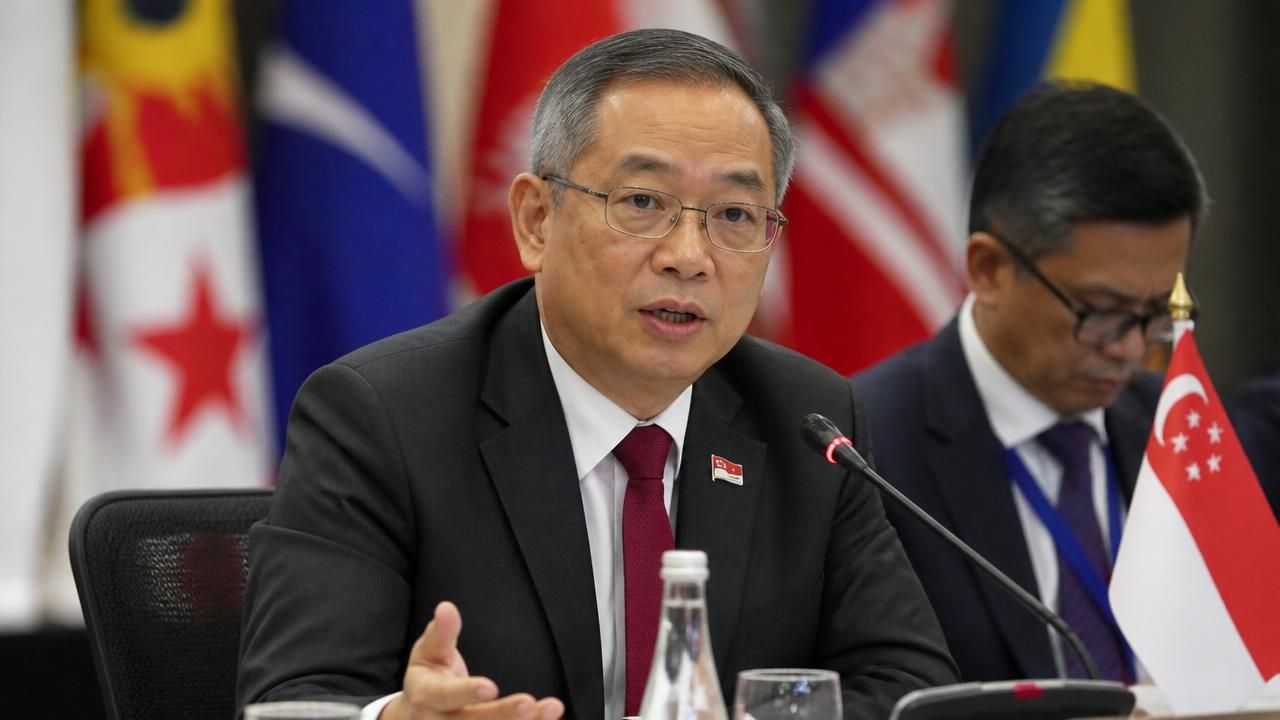
Singapore's Deputy Prime Minister Gan Kim Yong has placed trust, digital integration and supply-chain resilience at the centre of the city-state's economic diplomacy, using a series of engagements across ASEAN and beyond to argue that small, trade-dependent economies must deepen cooperation or risk being sidelined by a fragmenting global order.
Gan, who also serves as Singapore's Minister for Trade and Industry, framed the message around a single organising idea: that partnerships built on trust deliver more than transactional deals. He pointed to Singapore's long-standing economic relationships with China, India and Canada as evidence that collaboration can help countries meet their respective needs and build "a better future."
Trust and cooperation as economic doctrine
Speaking on the sidelines of a packed diplomatic calendar, Gan said the value of these relationships lies less in headline volumes than in their durability across political cycles. That framing — picked up by Bloomberg Markets, which headlined its coverage around the notion that "trust and cooperation are key" — positions Singapore as a broker rather than a bloc member, a role it has cultivated since the Cold War.
"Trust and cooperation are key," Gan said, citing Singapore's ties with China, India and Canada as examples of collaboration that helps the respective countries meet their needs and create a better future.
The emphasis is deliberate. Singapore's total trade dwarfs its domestic economy, leaving it acutely exposed to shifts in tariff regimes, export controls and shipping lanes. For a state that imports nearly all of its food and energy, diversification is not an aspiration but a survival strategy.
Digital economy push spans ASEAN and the EU
A second pillar of Gan's message was the digital economy. According to coverage from MSN and CNBC, Singapore is pursuing deeper digital-economy ties with ASEAN and with global blocs, and sees room for further cooperation between ASEAN and the European Union on digital trade.
The ASEAN Digital Economy Framework Agreement, whose negotiations were launched in 2023 and are targeted for conclusion this decade, is the centrepiece of that effort. Analysts project Southeast Asia's digital economy could approach $1 trillion in gross merchandise value by 2030, driven by e-commerce, fintech and cloud services — a prize that has drawn both Brussels and Beijing into competing connectivity proposals.
The EU and Singapore concluded negotiations on a bilateral Digital Trade Agreement in 2025, a deal Brussels has promoted as a template for the wider region. CNBC's framing of Gan's remarks stressed the ASEAN–EU angle, reflecting European interest in securing rules-based digital corridors as an alternative to Chinese-led infrastructure and standards.
Supply-chain resilience dominates Malaysia visit
In Malaysia, supply-chain resilience topped the agenda, according to Malay Mail. Gan's visit underscored how deeply the two neighbours' manufacturing bases are now intertwined — from semiconductors in Penang and Johor to data centres and logistics hubs catering to Singapore-based multinationals.
The Johor–Singapore Special Economic Zone, formalised in early 2025, has become the practical testbed for that interdependence, offering tax incentives and streamlined cross-border flows in a bid to capture supply-chain investment relocating from China amid US tariff pressures.
'Neutrality is not possible'
Perhaps the most pointed element of Gan's messaging, reported by Bloomberg, was his assertion that geopolitical neutrality is not possible for a country as globally connected as Singapore.
"Geopolitical neutrality is not possible," Gan said, in remarks that complicate Singapore's long-held doctrine of being a friend to all and an enemy to none.
The comment reflects a harsher operating environment: export controls on advanced chips, sanctions on shipping and the weaponisation of trade have made it increasingly difficult for small states to stay above the fray. Singapore has responded by tightening its own compliance regime while simultaneously courting investment from both US and Chinese firms.
Moving up the value chain
On the regional stage, Gan argued that ASEAN must move up the value chain rather than compete on cost alone, a message carried by The Star. His case rests on three propositions:
- Higher-value production: ASEAN economies must shift from assembly and low-cost manufacturing into advanced electronics, precision engineering and services.
- Collective bargaining power: A unified ASEAN bloc negotiates better terms on digital rules, green standards and market access than any single member state.
- China as a partner: Vietnam News reported Gan calling for a stronger ASEAN built partly through Singapore–China cooperation, positioning Beijing as a partner in regional integration rather than purely a competitor.
That balancing act is familiar. Singapore has served as an interlocutor between ASEAN and China and has upgraded its bilateral free-trade agreement with Beijing, even as it hosts a significant US corporate and military presence.
How the story is being framed
The divergence in coverage is telling. Bloomberg emphasised the philosophical — trust, cooperation and the death of neutrality. CNBC and MSN focused on the digital-economy dividend and the ASEAN–EU channel. Regional outlets, including Malay Mail and The Star, foregrounded the practical: supply chains, value chains and the bilateral Malaysia relationship. Vietnam News, meanwhile, read the trip through a Sino-ASEAN lens.
Together, the frames describe a single strategy: Singapore is trying to convert its vulnerability into influence, using digital rules and resilient supply chains as the connective tissue of a wider coalition.
What comes next
The tests are imminent. ASEAN must deliver a substantive digital agreement, the Johor–Singapore zone must show measurable investment flows, and Singapore must keep its compliance posture credible enough to satisfy Washington without alienating Beijing.
Gan's message — that trust, not neutrality, is the currency of the moment — is likely to define Singapore's economic diplomacy for years to come, and to serve as a template for other small, open economies navigating an era of great-power competition.