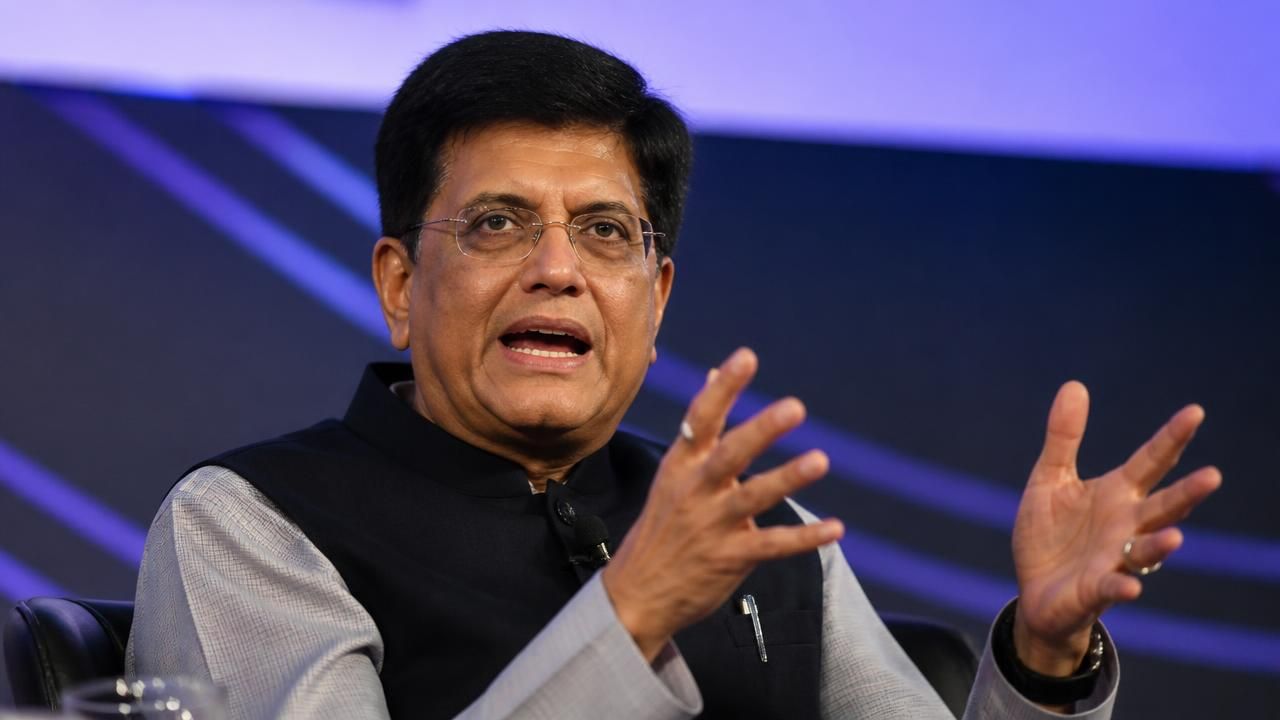
India found itself “let down miserably” by the rest of the world during the Covid-19 pandemic, Commerce and Industry Minister Piyush Goyal said, offering a blunt public account of the episode that persuaded New Delhi to double down on self-sufficiency.
Speaking at the Bloomberg Economic Forum, Goyal said India's inability to source essential equipment at the height of the crisis reshaped the country's industrial and trade thinking — a shift that continues to define everything from pharmaceutical policy to semiconductor incentives.
“We were let down miserably,” Goyal said, describing a moment when no country was willing to step forward with the supplies India urgently needed.
A pandemic reckoning
The remarks echo the darkest phase of India's outbreak. During the Delta wave of April and June 2021, hospitals in Delhi, Mumbai and beyond ran out of oxygen, antiviral drugs and beds as daily cases surged past 400,000 and crematoriums operated around the clock. Even as the world's largest vaccine producer by volume, India found its output constrained by shortages of critical inputs, after several wealthy nations restricted exports of raw materials and components — including under the United States' Defense Production Act — while prioritising their own inoculation drives.
For New Delhi, the lesson was stark. As Goyal tells it, the crisis exposed how vulnerable an economy can become when it depends on foreign supply chains for medicines, medical devices, electronics and defence equipment. The response was a decisive pivot toward indigenous manufacturing capacity.
From mantra to policy
That pivot took the form of the Atmanirbhar Bharat, or Self-Reliant India, programme, announced in 2020 with a package worth roughly ₹20 lakh crore — close to 10% of GDP at the time. What began as an emergency response hardened into a structural policy: production-linked incentive schemes across more than a dozen sectors, a drive to reduce dependence on imported active pharmaceutical ingredients, and a determined push into semiconductors, electronics and defence hardware.
Officials have consistently framed the strategy as self-reliance rather than isolationism — building domestic capacity so that India can engage globally from a position of strength rather than desperation. Goyal's comments give that framing its emotional anchor.
Trade: pacts covering $70 trillion in GDP
The self-reliance message has not come at the expense of trade diplomacy, at least according to the minister. Goyal said India now has trade agreements in place or under negotiation with partners whose combined economies cover roughly $70 trillion in GDP — a figure he deployed to argue that India is deepening integration even as it hardens its domestic base.
That portfolio has expanded rapidly: the comprehensive economic partnership with the United Arab Emirates, an interim pact with Australia, the EFTA trade and economic partnership agreement, and a long-delayed free trade agreement with the United Kingdom, alongside continuing talks with the European Union and others. For Indian negotiators, the goal is diversification — reducing exposure to any single supplier or market after the pandemic demonstrated how quickly those links can fray.
China and the US: two very different answers
The forum also surfaced India's delicate balancing act between its two largest strategic counterparts, and news outlets framed the story in markedly different ways. Where Bloomberg led on the pandemic grievance and the turn inward, Outlook India headlined Goyal's remark that India remains open to economic engagement with China, alongside his assessment that ties with the United States are “very safe.”
Engagement with Beijing is a sensitive subject in New Delhi. Since April 2020, Press Note 3 has required government approval for investment from countries sharing a land border with India — a rule aimed squarely at Chinese capital, introduced amid the military standoff in Ladakh. But Indian manufacturers, particularly in electronics and solar, have continued to rely on Chinese machinery, components and technical expertise, and there have been quiet signs of pragmatism in approving select joint ventures.
Goyal's characterisation of the US relationship as “very safe” is equally notable, coming at a time of global trade turbulence, tariff threats and renegotiation of supply chains among major economies. For Indian exporters, the American market remains the single most important destination, and the minister's language suggests confidence that commercial ties can weather political volatility.
The macro backdrop
The forum's live coverage also carried hard economic data: wholesale inflation, as measured by the Wholesale Price Index, rising to 11.4% in September from 9.9% in the previous month, according to Moneycontrol's running blog. Elevated input costs are an awkward companion to any manufacturing expansion, since they eat into the margins of the very producers the self-reliance programme is designed to nurture — and they complicate the calculus for exporters competing on price.
What it means
- Supply chains are now strategy. Covid converted a public-health shock into an industrial policy doctrine that outlasted the emergency.
- Self-reliance is being sold as leverage, not withdrawal. Goyal pairs the inward push with an outward trade agenda spanning trillions of dollars in partner GDP.
- China policy remains unresolved. Investment restrictions coexist with unavoidable dependence on Chinese inputs, leaving room for selective easing.
- The US is the anchor. Goyal's “very safe” verdict signals that Washington remains central to India's export ambitions.
For investors and trading partners, the message from the Bloomberg Economic Forum is that India intends to pursue both tracks at once: building domestic capacity while broadening its network of trade agreements. Whether those two impulses reinforce each other or collide will depend on execution — and on whether the memory of 2021 keeps driving policy long after the pandemic has faded from the headlines.