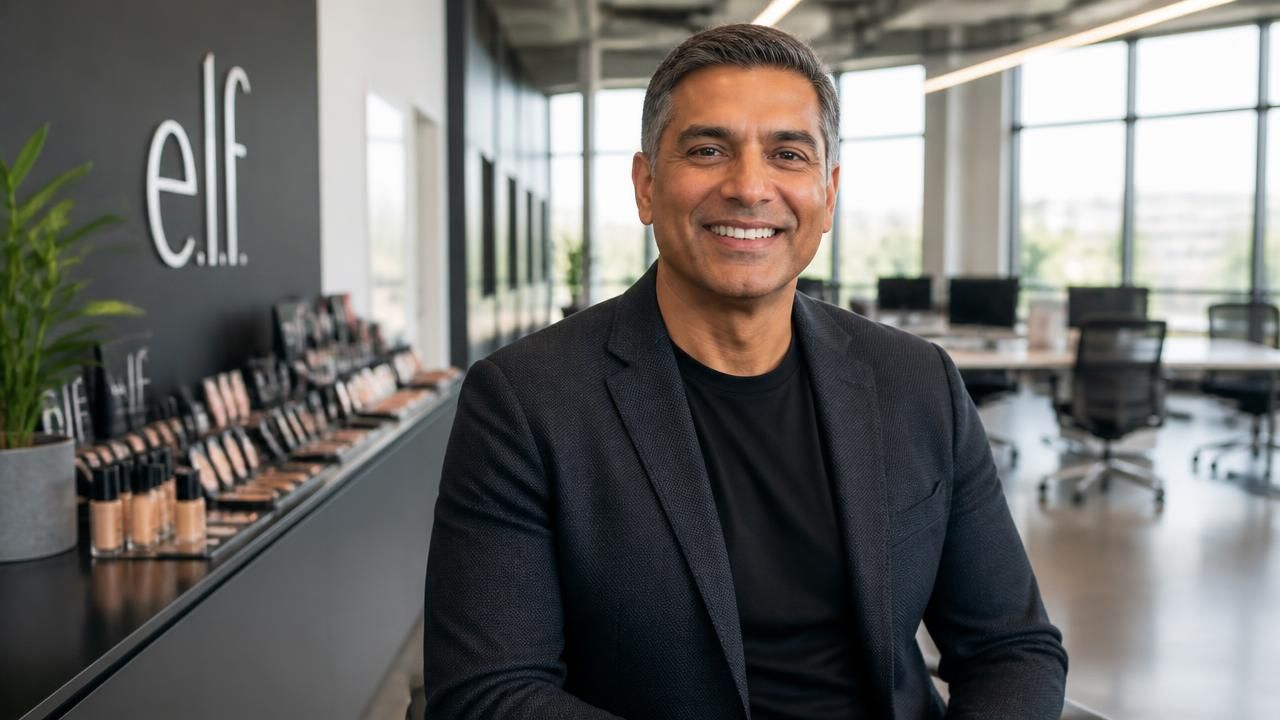
When recruiters first approached Tarang Amin about running e.l.f. Beauty, he said no. The company was small, the category was crowded, and the opportunity looked, by his own account, unremarkable. What changed his mind was not a spreadsheet but a habit he has evangelized ever since: taking the meeting anyway.
"It never hurts to have a conversation," Amin says, a line that has become something of a governing principle for the executive who has spent more than a decade turning a $190-million-a-year discount cosmetics label into one of the most consequential players in the global beauty business. The story of that initial hesitation — and the reversal that followed — is now central to how Amin talks about leadership, risk and the value of remaining curious even when the answer seems obvious.
A Job He Almost Didn't Take
Amin's path to e.l.f. was not a straight line. Born in India and raised as an immigrant in the United States, he built a career across consumer packaged goods and nutrition companies before the beauty opportunity surfaced. He has described his early dismissal of e.l.f. as a failure of imagination — one corrected only by sitting down and listening. That experience, he says, reinforced a broader conviction: the cost of a conversation is nearly always lower than the cost of a missed one.
He also credits his immigrant upbringing with shaping the way he leads. Growing up between cultures, he has said, breeds both empathy and a certain restless curiosity — a willingness to ask basic questions that insiders assume they already know the answers to. In an industry built on reading consumers' unspoken desires, he treats that outsider's instinct as a competitive advantage rather than a liability.
From the Discount Aisle to a Category Disruptor
When Amin took the helm in 2014, e.l.f. — short for "eyes, lips, face" — was known chiefly for $1 and $3 makeup sold at the value end of the shelf. Under his leadership, the company rebuilt itself around speed: a supply chain that can move a viral trend from social media to store shelves in a fraction of the time traditional beauty houses require, prices that undercut prestige brands by wide margins, and a marketing engine fluent in TikTok, meme culture and celebrity collaborations.
The results have been striking. e.l.f. crossed the billion-dollar revenue mark in recent years, with growth rates that repeatedly outran the broader beauty industry — a performance that has made the company a favorite of investors and a perpetual subject of case studies in how to unseat incumbents. Analysts frequently describe e.l.f. less as a cosmetics company than as a consumer-data and supply-chain operation that happens to sell lipstick.
Not everyone frames the story the same way. Where CNBC's interview zeroes in on Amin the leader — his curiosity, his thoughts on diversity, the decisions that shaped his career — the Wall Street Journal's Leadership Institute profile treats him as a builder of a multibillion-dollar empire, emphasizing scale, strategy and the institutional choices behind the growth. Forbes frames the same trajectory as a structural anomaly: a company that keeps outgrowing the industry it competes in, quarter after quarter. Business of Fashion, meanwhile, approaches it from the deal side, examining the portfolio machinery that now sits behind the group's most talked-about brands.
The Rhode Deal and the M&A Playbook
That portfolio machinery is where the story gets bigger than e.l.f. itself. The company's acquisition of Rhode — Hailey Bieber's fast-growing beauty line — marked a decisive shift from organic growth to a multi-brand strategy, adding a premium, celebrity-fronted label to a portfolio that had previously been defined by value pricing. The deal turned e.l.f. into something closer to a house of brands, valued in the multibillion-dollar range and capable of competing at price points it once disrupted from below.
The strategy mirrors a playbook the company has refined since its earlier acquisitions of brands such as Naturium: buy a fast-growing, culturally fluent label, then plug it into e.l.f.'s distribution, international reach and operational discipline. The risk, as analysts have noted, is that the formula that works for a single scrappy challenger does not always scale across a portfolio of brands with distinct identities and audiences.
What Comes Next
The broader beauty market has cooled from its post-pandemic boom, and e.l.f.'s stock — one of the great outperformers of the past several years — has not been immune to the reset. Tariff pressure on imported goods, uneven consumer spending and rising competition from both legacy houses and a new generation of independent brands all loom over the next phase of the story.
Amin's response, in public appearances and industry interviews, has been consistent: stay close to the consumer, move faster than the competition, and never assume the current playbook is the final one. It is the same logic that made him take a meeting he had no intention of taking — and, ultimately, a job that remade both his career and the company.
"It never hurts to have a conversation." — Tarang Amin, CEO, e.l.f. Beauty
For a company that built its reputation on being underestimated, that may be the most durable lesson of all: the willingness to listen, even briefly, to an offer that seems beneath consideration.