China is building electricity generation at a pace the world has never seen, and the reason is no longer just steel mills and apartment blocks. According to Bloomberg Markets, the country is "racing to power a future of artificial intelligence and robots with renewables" — but as it adds more capacity than ever before, a new bottleneck has emerged: whether the grid itself can move all that power to the places that need it.
The paradox is one Bloomberg has framed in two distinct ways. On one hand, a Bloomberg Markets analysis asks why China "generates too much power," casting the country's breakneck renewable build-out as a problem of overcapacity. On the other, a second Bloomberg piece argues that "China's AI dominance rests on harnessing excess energy" — framing the same glut as a strategic asset in the global race for artificial intelligence. Same facts, opposite conclusions.
A Build-Out Without Precedent
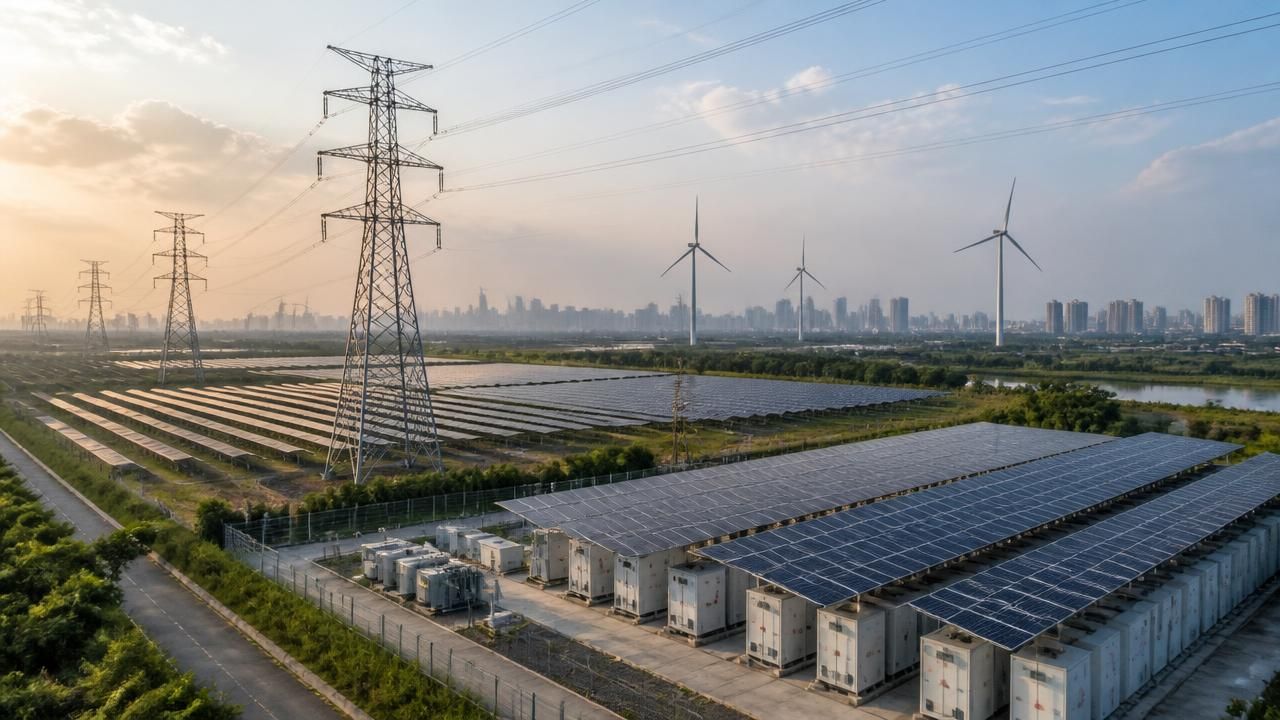
The scale is difficult to overstate. China's total installed generation capacity passed 3.3 terawatts in 2024, having added hundreds of gigawatts in a single year — more solar capacity annually than the entire installed base of most countries. Wind, solar, hydro and nuclear are all expanding simultaneously, and the country has spent a decade constructing ultra-high-voltage transmission corridors to move electricity from sparsely populated western provinces to coastal manufacturing and computing hubs.
That strategy has deep roots. The completion of the Three Gorges Dam — the world's largest hydroelectric project, with roughly 22.5 gigawatts of capacity on the Yangtze River — was reported internationally as a "mammoth" engineering milestone, and it established the template Beijing has followed ever since: build at colossal scale, worry about integration later. Three Gorges took decades to fully bring online and displaced well over a million people, but it also gave China proof that centralized mega-generation could underwrite industrial growth.
The Grid Becomes the Bottleneck
The problem today is not generation. It is delivery, storage and timing. Curtailment — the practice of switching off wind and solar farms because the grid cannot absorb their output — has been rising in several provinces, and utilization hours at renewable plants have fallen as new capacity outpaces demand growth.
"China is racing to power a future of artificial intelligence and robots with renewables. But as it builds more electricity capacity than ever before, it faces a new challenge: whether the grid can keep up." — Bloomberg Markets
The stakes are highest for data centers. AI training clusters are among the most power-hungry installations ever built, requiring not only enormous volumes of electricity but also extraordinary reliability — the kind of firm, always-on supply that intermittent renewables struggle to provide without massive battery storage or backup gas and coal.
Two Ways to Read the Same Numbers
- The overcapacity view: China has built so much generation that prices are falling, plants sit idle and investment risks being wasted. Cheap power is a symptom of misallocation.
- The strategic view: Cheap, abundant electricity is precisely the input advantage that lets Chinese firms train large AI models, run energy-intensive data centers and electrify manufacturing at costs Western competitors cannot match.
- The integration view: Neither framing is complete. The build-out is real, but without transmission, storage and market reform, surplus electrons in Inner Mongolia do not help a server farm in Guangdong.
Bloomberg's own coverage reflects this tension. Its Markets desk emphasizes the mismatch between capacity growth and grid capability, while its technology reporting positions energy abundance as the quiet pillar of China's AI ambitions. The difference is largely one of lens — a power-markets reporter sees a stranded asset; a tech reporter sees a competitive moat.
Why It Matters Beyond China
For the United States and Europe, the implication is uncomfortable. Western data-center build-outs are increasingly constrained by grid interconnection queues, transformer shortages and local opposition — not by capital. If China can convert surplus generation into cheap compute, it gains a structural cost advantage that no chip export control directly addresses.
For global climate policy, the picture is equally double-edged. China's renewable deployment is the single largest driver of falling global clean-energy costs. But if curtailment keeps rising, the effective carbon benefit of each new solar farm shrinks, and Beijing may lean harder on coal to guarantee reliable supply.
The likely resolution lies in markets and storage rather than more steel and silicon: reformed electricity pricing, expanded battery capacity, and demand-response systems that let data centers flex around renewable output. Whether Beijing manages that transition will determine if its power glut becomes a liability — or the foundation of an AI economy.
Note on sourcing: this article synthesizes Bloomberg's reporting on China's electricity surplus and its AI implications, alongside contemporaneous coverage of the Three Gorges Dam's completion. Several other items surfaced in the same aggregation feed — interviews with minor U.S. presidential candidates and a Wikipedia founder — were unrelated to this story and were excluded.