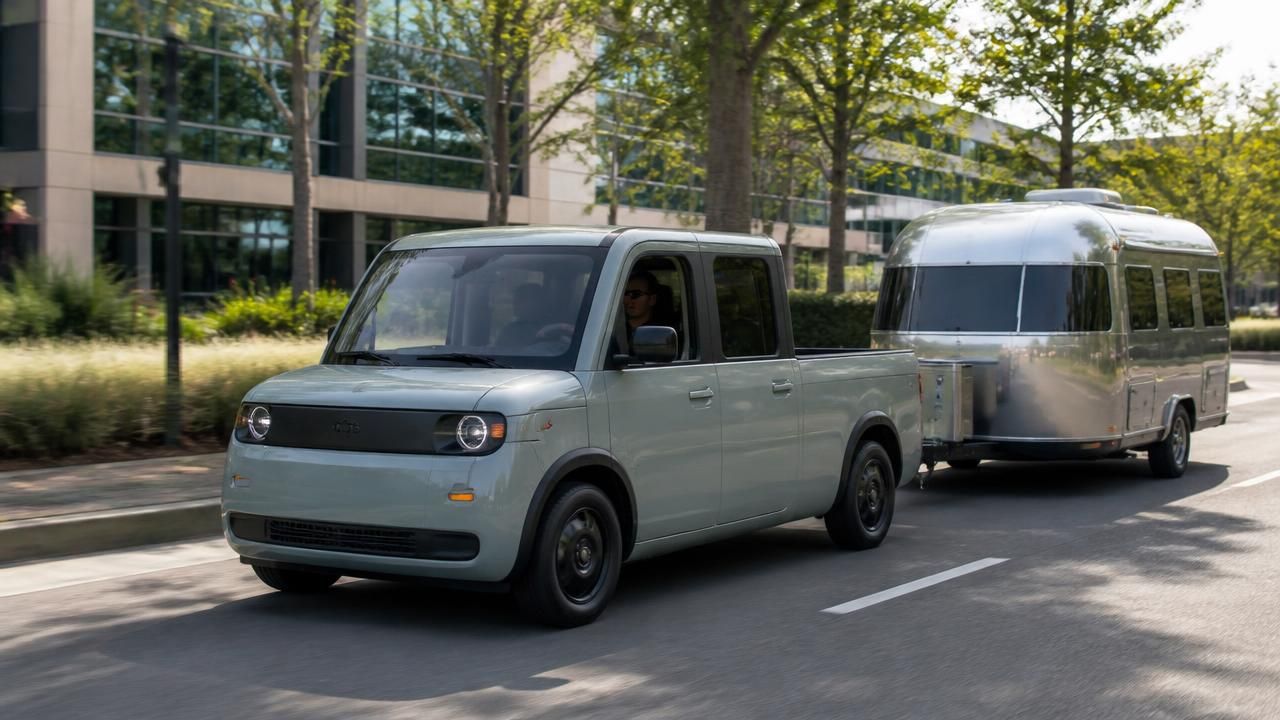
In San Carlos, California — a few blocks from the campuses of Oracle and Electronic Arts — a pale, boxy trucklet rolls silently past stoplights and turns heads for the simplest of reasons: nothing else on American roads looks quite like it. The Telo MT1, short for "mini truck," is a four-door electric pickup roughly the length of a Mini Cooper, and it is the vehicle that has spent the past several months generating the kind of outsize headlines usually reserved for full-size flagship trucks.
According to The Verge, which recently got behind the wheel, the MT1 is "America's smallest electric truck" — a machine with a nearly cab-over layout, a stubby nose and proportions that echo the Japanese kei trucks that never officially made it to U.S. shores. Passengers sit almost directly over the front axle, and the cabin, the outlet noted, is "surprisingly spacious" despite the vehicle's footprint, with firm seats and a quiet, zippy ride through Silicon Valley traffic.
A Small Truck Making Very Large Claims
The reason the MT1 keeps making news is not its size but its spec sheet. Telo says the truck will produce roughly 500 horsepower from a dual-motor, all-wheel-drive powertrain, accelerate from 0 to 60 mph in under four seconds, and offer up to 350 miles of range from its largest battery pack — figures that would have been supercar territory a decade ago and remain competitive in any segment today.
The headline-grabbing number, though, is towing. InsideEVs reported that Telo says its tiny truck can tow more than a base Ford F-150, while Carscoops framed the same claim even more provocatively: the co-founder's mini EV truck out-tows a standard Cybertruck. Autoguide summed up the competitive subtext bluntly: "Watch out Ford."
The pitch is simple arithmetic: a truck the size of a compact car that pulls like a full-size pickup.
Those figures — a towing rating in the neighborhood of 6,600 pounds and roughly 1,600 pounds of payload, per company statements — are manufacturer claims and have not been independently verified by third-party testing. But they are the core of Telo's marketing argument: that most truck buyers rarely use more than a fraction of a full-size pickup's capability, yet pay for it every day in fuel, parking difficulty and price.
Charging: The Quiet Differentiator
Perhaps the most technically surprising claim is about charging. MSN highlighted that Telo's tiny electric truck for cities has "surprisingly high-powered charging" — a detail that matters more than horsepower for urban buyers who lack a home garage. Telo has said the MT1 will accept DC fast-charging rates far above what its size and price class would suggest, allowing a 20-to-80 percent top-up in roughly the time it takes to drink a coffee, and it has discussed bidirectional capabilities that would let the truck power tools or a home during an outage.
That combination — small battery, high charge rate, vehicle-to-load output — is a deliberate design choice rather than an engineering accident. Smaller packs are cheaper and lighter; faster charging compensates for their limited capacity. It is a strategy that contrasts sharply with the bigger-is-better approach that has defined the American EV truck race so far.
The Founders and the Skeptics
Telo Trucks was founded in 2022 by Jason Marks and Forrest North. North is an early Tesla alumnus — frequently described in coverage as a Tesla co-founder or founding-team member — who went on to found the electric motorcycle company Mission Motors. That pedigree is a significant part of the company's credibility, and it is why InsideEVs devoted a separate piece to a direct question: "Is Telo Trucks the real deal?" The outlet interviewed the founders to test the gap between the renders, the reservation page and the factory floor.
The honest answer, echoed across coverage, is that the truck is real enough to drive and impressive enough to impress journalists — but it is not yet real enough to buy. Telo has taken refundable reservations (a deposit pegged symbolically to the truck's 152-inch length) and has said it aims to begin customer deliveries later this decade, dependent on the capital-intensive work of securing a manufacturing site, supply agreements and regulatory certification.
How the Coverage Differs
- Hands-on outlets like The Verge emphasize the experience: the stares, the kei-truck silhouette, the roomy interior, the sense that this is a genuinely new shape on American roads.
- Trade and spec outlets like InsideEVs, Carscoops and Autoguide lead with the numbers — towing, payload, charging — and with the implicit challenge to Ford, Tesla and Rivian.
- Enthusiast and lifestyle publications like Gear Patrol frame the story competitively, as Telo "upping the ante" against Ford and against Slate, the Jeff Bezos-backed startup promising a bare-bones, low-cost electric pickup of its own.
Several source pages for this story were partially inaccessible — Gear Patrol and Autoguide served JavaScript or 406-forbidden error pages, and Carscoops and MSN surfaced only headlines — a reminder of how much of the current auto-media cycle runs on press releases, spec sheets and embargoed drive events rather than independent verification.
Why It Matters
The MT1 arrives at an inflection point for the small-truck market. The Ford Maverick proved that Americans will buy compact pickups in volume when the price is right. Hyundai's Santa Cruz followed. Slate has promised an ultra-affordable EV truck, and Toyota has signaled interest in a smaller electrified pickup. Meanwhile, full-size electric trucks — the F-150 Lightning, the Cybertruck, the Rivian R1T — have struggled to convert early enthusiasm into sustained sales, in part because of price and size.
Telo's bet is that the winning formula is not a bigger battery but a smaller truck: a vehicle that fits in a city parking space, costs a fraction of a full-sizer's running costs, and still hauls a sheet of plywood or a small trailer. The company has indicated pricing in the mid-$40,000 range depending on battery and trim, which puts it in direct competition with well-equipped versions of the Maverick and entry-level full-size trucks — a tough neighborhood for a startup with no service network.
For now, the MT1 remains what it has been since its unveiling: a compelling proof of concept with a reservation list, a charismatic founder story and a set of numbers that, if validated in production, would genuinely rewrite what buyers expect from a small truck. The Verge's verdict — a big truck trapped in a tiny truck's body — is the promise. The question the next two years must answer is whether Telo can build it at scale, at a price people will pay, before the giants of the industry copy the idea.