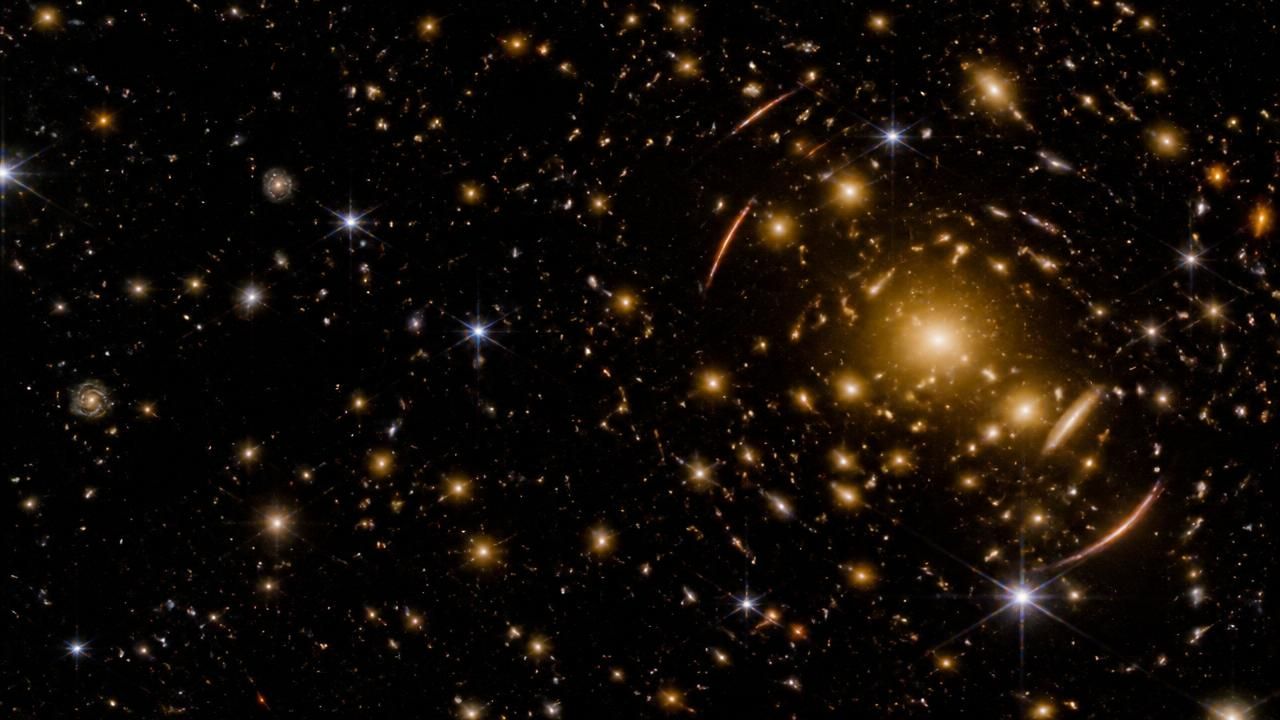
NASA and its European and Canadian partners released a striking new James Webb Space Telescope image on Sept. 29, 2026, showing a massive galaxy cluster acting as a natural lens in space. The image, described by the agencies as a "cosmic house of mirrors," captures galaxies that appear warped, stretched and in some cases duplicated as their light passes through the gravitational field of a foreground cluster roughly halfway across the observable universe.
At the center of the frame is MACS J0454.1-0300, a heavyweight cluster catalogued in the MAssive Cluster Survey (MACS), a long-running effort to identify and study the most massive galaxy clusters in the sky. The brilliant golden galaxies bunched on one side of the image are members of that cluster. The orange smudges scattered around it are not.
What the image actually shows
According to the image release, the orange galaxies are far more distant objects whose light has been bent and magnified by the cluster's gravity — a phenomenon known as gravitational lensing. The effect occurs when the enormous mass of a foreground object, such as a galaxy cluster, curves the fabric of spacetime enough to redirect and amplify light arriving from a background source.
"Galaxies warp and multiply as if in a house of mirrors in this image from NASA's James Webb Space Telescope," the agencies wrote in the caption accompanying the release. "This phenomenon occurs when the enormous mass of a foreground object such as a galaxy cluster bends and magnifies the light from a more distant object in the background."
The visual result is a kind of astronomical hall of mirrors. Individual background galaxies can appear as elongated arcs, stretched along invisible contours of magnification. In other cases, a single galaxy produces two or more images of itself, an effect that occurs when light from the same source travels along multiple paths around the lens and arrives at Webb's mirrors at slightly different times and angles.
The physics behind the funhouse
Gravitational lensing is one of the most durable predictions of Albert Einstein's general theory of relativity, which holds that mass and energy distort spacetime. The first confirmed example, the "twin quasar" Q0957+561, was identified in 1979 — two images of the same object produced by an intervening galaxy.
Cluster-scale lenses are more powerful still. Clusters such as MACS J0454.1-0300 pack hundreds to thousands of galaxies, plus vast reservoirs of hot gas, into a gravitationally bound structure that can weigh in at roughly a quadrillion times the mass of the Sun. Most of that mass is invisible dark matter, which astronomers cannot see directly but can map through its lensing signature.
That makes images like this one scientifically valuable in two directions at once:
- A map of dark matter: By measuring how severely background galaxies are distorted at different positions, researchers can reconstruct the distribution of mass in the foreground cluster, dark matter included.
- A natural telescope: The magnification makes faint, distant galaxies brighter and larger, allowing Webb to study objects that would otherwise be beyond its reach — including some of the earliest galaxies to form after the Big Bang.
- A test of cosmology: How efficiently a cluster bends light depends on the geometry and expansion history of the universe, giving researchers an independent check on cosmological models.
Webb is particularly well suited to this work. Its large segmented mirror and infrared sensitivity let it resolve faint lensed arcs and identify the multiple images of the same background source, which is essential for building accurate mass models. Earlier generations of telescopes, including Hubble, produced celebrated lensing images of clusters such as Abell 1689 and the Frontier Fields targets, but Webb's resolution and infrared reach extend the technique to fainter and more distant background galaxies.
Different headlines, one press release
Coverage of the image illustrated how a single scientific result travels through modern media. NASA and its partners leaned into the poetry of the phenomenon, titling their release "Cosmic House of Mirrors" and emphasizing the disorienting, fairground quality of the visuals. The image credit lists ESA/Webb, NASA and CSA alongside researchers L. Furtak and S. Fujimoto, reflecting the international and collaborative nature of the mission and the science teams that process and analyze its data.
Aggregators and secondary outlets took a more colloquial route. One headline asked readers whether they thought lens flare was bad, framing the effect as an extreme version of a familiar photographic annoyance, while another described "space scientists" unveiling a "cosmic house of mirrors" showing warped galaxies. Both framings describe the same observation: a foreground cluster bending background light into arcs and multiple images.
The divergence is mostly tonal rather than factual. The same underlying content, distributed through news aggregators, was tuned toward different audiences — one drawn to the aesthetics of cosmic distortion, another to the accessible analogy of a camera artifact. What remains constant is the physics and the dataset behind it.
Why it matters
Beyond its visual appeal, the image is a reminder that some of the most powerful telescopes in astronomy are not built at all. Massive clusters function as free, ready-made observatories, and each new Webb observation adds to a growing archive of lensed fields that astronomers will mine for years.
Those archives feed directly into questions at the frontier of cosmology: how dark matter is distributed on the largest scales, how galaxies assembled in the early universe, and whether the standard model of cosmology holds up under increasingly precise measurement. For now, the image offers the public something rarer — a visible, almost playful demonstration of general relativity operating on a cosmic scale.