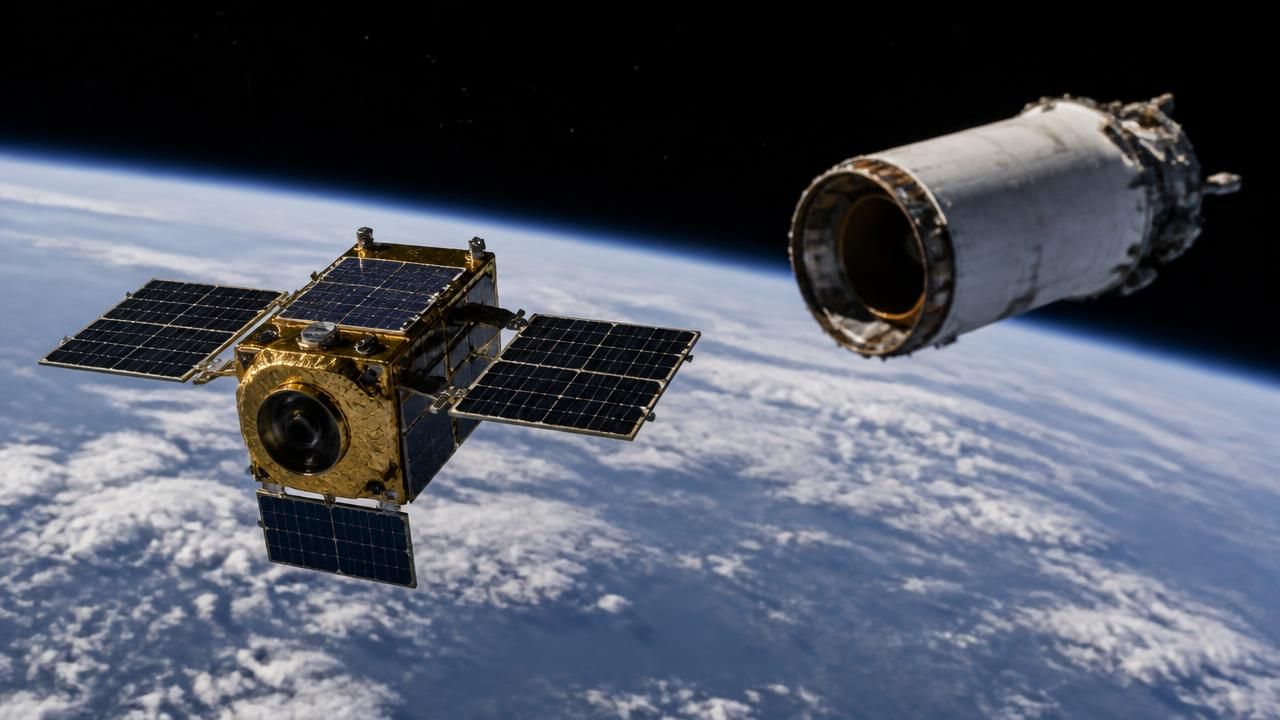
A new NASA-backed spacecraft is on orbit and preparing to do something no commercial vehicle has yet attempted at scale: fly up to dead satellites and spent rocket bodies, circle them, and take a close look. The Small Spacecraft Propulsion and Inspection Capability (SSPICY) mission launched Oct. 1 from Vandenberg Space Force Base in California on a SpaceX rideshare flight, carrying an Otter spacecraft built by the Washington state startup Starfish Space.
NASA describes SSPICY as a technology demonstration with an unusually ambitious itinerary. Over the coming months and years, the Otter vehicle will approach as many as four inoperable objects of U.S. origin in low Earth orbit — defunct satellites and discarded rocket stages — and inspect them, gathering data that could one day make in-space repairs routine and help slow the unchecked growth of orbital debris.
A slow, deliberate approach
The mission will not begin its headline work immediately. According to NASA, the Otter spacecraft is expected to begin navigating within hundreds of yards of each target in early 2027 — roughly a year and a half of checkout, drifting, and maneuvering after launch. The intervening period is not dead time: the spacecraft must demonstrate that its guidance systems, sensors, and propulsion all behave as designed before controllers allow it to close in on a tumbling piece of hardware.
“In early 2027, the Otter spacecraft, built by Starfish Space, will begin to navigate within hundreds of yards of each object to perform inspections, using autonomous guidance and control software with minimal input from ground controllers.” — NASA
Autonomy at the controls
That minimal ground input is the technical heart of the demonstration. Computer vision and onboard sensors allow the spacecraft's software to make real-time navigation decisions as it approaches each target, rather than waiting for instructions radioed from Earth. The distances involved are minuscule by spaceflight standards, and the margin for error is thin: a miscalculated approach to a non-cooperative object could produce exactly the kind of collision the mission is meant to help prevent.
During each inspection, the Otter spacecraft will gather information about the object's spin rate, orientation, and surface condition — the sort of physical intelligence that ground-based radar and telescopes cannot provide. That data is a prerequisite for any future servicing mission, whether the goal is refueling, repairing, or dragging a dead satellite out of a crowded orbit.
Propulsion and a robotic boom
An electric propulsion system will enable SSPICY to travel between objects, giving the small spacecraft the delta-v needed to hop from one target to the next rather than inspecting a single satellite. NASA says an articulating robotic boom will also test pointing the spacecraft's thrusters for precise maneuvering — a capability that bridges inspection and eventual physical interaction.
Why dead satellites matter
The mission arrives at a moment of growing alarm about congestion in low Earth orbit. Roughly 40,000 objects larger than 10 centimeters are currently tracked by space surveillance networks, alongside an estimated 1.1 million objects between 1 and 10 centimeters and about 130 million smaller fragments — each capable of catastrophic damage at orbital velocities. The nightmare scenario, known as Kessler syndrome, describes a cascade in which collisions generate debris that generates further collisions, potentially rendering some orbits unusable for generations.
Meanwhile, the number of active satellites has exploded, driven largely by megaconstellations. Every defunct satellite and spent upper stage left behind is a hazard that will persist for decades or centuries, depending on altitude. Inspection — knowing precisely how a dead object is behaving — is the first step in any credible plan to remove or mitigate it.
A commercial milestone
For Starfish Space, SSPICY is more than a government contract. GeekWire, which covers the Pacific Northwest technology sector, frames the flight as the orbital debut of the company's flagship Otter spacecraft — a crucial proving ground for a startup betting that satellite servicing will become a viable business. Starfish has been developing the Otter platform for years; an earlier, smaller demonstrator named Otter Pup launched in 2023 and ran into trouble after deployment, making this mission a reputational as well as technical test.
NASA, by contrast, frames the story in terms of public benefit. Its release emphasizes technologies that could support future in-space repairs and reduce orbital debris, presenting the agency as an enabler of commercial capability rather than a customer buying a service. That difference in emphasis — national interest versus startup ambition — reflects the hybrid nature of modern spaceflight, where government funding de-risks technology that private firms ultimately intend to sell.
How the story is being framed
Coverage of the launch has diverged along predictable lines. NASA's own account is technical and mission-focused, detailing the spacecraft's autonomy, electric propulsion, and inspection payload. SpaceX-oriented coverage highlights the rideshare itself, treating Otter as the milestone payload on a Falcon 9 flight that also lofted additional spacecraft. Other reports fold SSPICY into a broader narrative about NASA launching a trio of smallsats to advance space science and orbital technology — a reminder that rideshare missions have become the workhorse of the smallsat era, bundling disparate experiments onto a single booster.
What all the framings share is a recognition that the economics of orbit are changing. Launch is now cheap enough that hundreds of small spacecraft reach orbit each year, but the infrastructure for maintaining, inspecting, and disposing of them has lagged badly behind.
What comes next
Amy
If SSPICY succeeds, the implications extend well beyond four inspections. Autonomous proximity operations are a foundational technology for satellite servicing, active debris removal, and — in a national security context — monitoring other nations' spacecraft. The deliberate restriction to objects of U.S. origin is not incidental: approaching a foreign satellite raises legal and diplomatic questions under the Outer Space Treaty, and NASA has been careful to stay inside the lines.
The near-term milestones are unglamorous but decisive. Engineers will watch how the electric propulsion system performs over months of drift, whether the vision software holds up against harsh lighting and tumbling targets, and how well the robotic boom points the thrusters. Each of those tests feeds into the question that now hangs over the entire orbital economy: once we can inspect the debris we have created, will we be able to do anything about it?