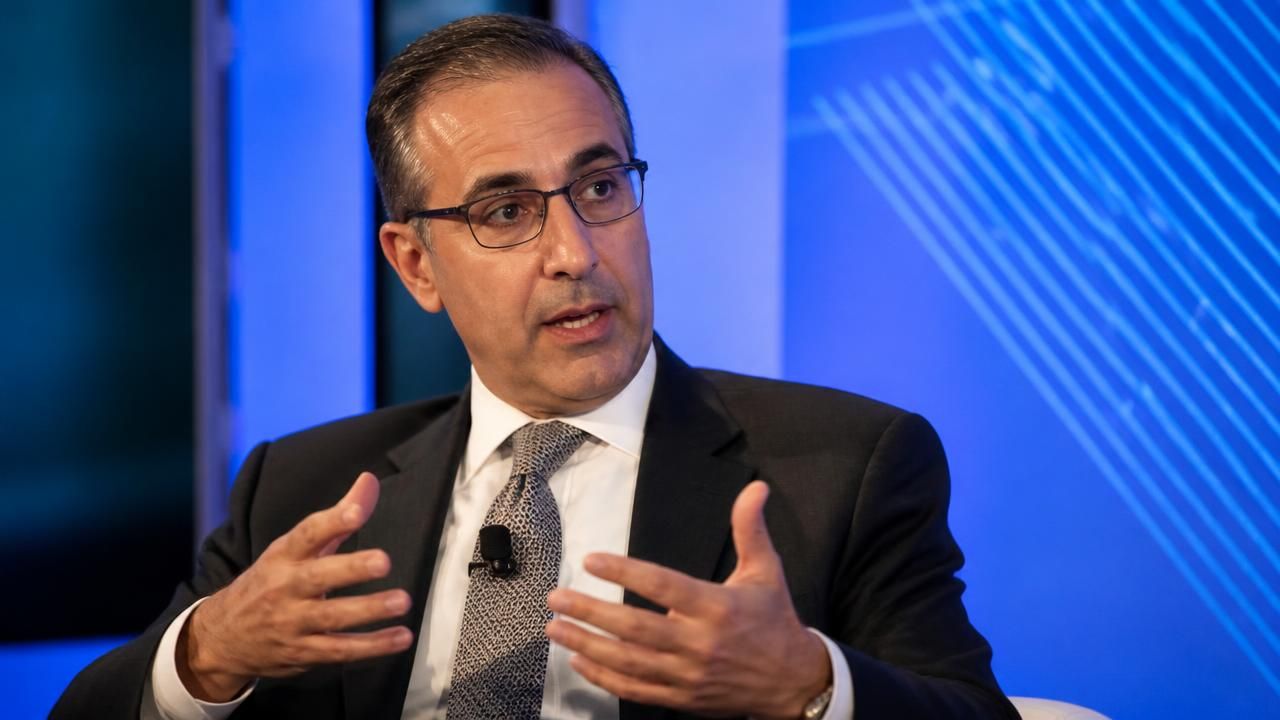
St. Louis Federal Reserve President Alberto Musalem said interest rates will likely need to rise over the next six to nine months to bring inflation down in a "timely manner," offering one of the most explicit signals yet from a sitting policymaker that the central bank's battle against rising prices is not over.
Speaking with Bloomberg's Mike McKee at the Future of Fixed Income conference in New York, Musalem framed the path forward in conditional but clearly hawkish terms — while pointedly declining to commit to a move at the Fed's next meeting.
"I don't go into any meeting prejudging the outcome."
The remarks, first reported by Bloomberg, were quickly picked up by Reuters, Yahoo Finance and Finance & Commerce, all of which led with the same core takeaway: more rate hikes are likely needed to curb — or, in Reuters' phrasing, "quell" — inflation.
A Deliberately Conditional Signal
Musalem's six-to-nine-month window is notable less for its precision than for what it rules out. By setting the horizon well beyond the Fed's October gathering, the St. Louis Fed chief effectively decoupled the near-term decision from the broader trajectory — leaving room for the Federal Open Market Committee to hold steady next month while still keeping additional tightening on the table.
That framing reflects a long-standing tension inside the Fed: policymakers want to avoid surprising markets with abrupt moves, but they also resist telegraphing decisions before incoming data arrive. Musalem's refusal to "prejudge" the October outcome is standard central-bank caution, but it lands in a different register when paired with an explicit call for higher rates over the medium term.
Why the Six-to-Nine-Month Horizon Matters
The phrase "in a timely manner" is doing significant work. It echoes language the Fed has used to describe the risk of allowing inflation to settle above its 2% target for too long — a scenario officials worry could unanchor public expectations and make future disinflation far more costly.
For markets, a six-to-nine-month window implies that any additional hikes would be gradual and data-dependent, rather than a return to the aggressive 75-basis-point cadence of the Fed's most recent tightening cycle. It also implies that the Fed is not yet prepared to declare victory, even after a prolonged period of restrictive policy.
How Different Outlets Framed It
- Bloomberg emphasized the forward guidance itself, headlining the six-to-nine-month timeframe and noting Musalem's refusal to endorse an October hike.
- Reuters framed the story around the likelihood of further tightening, using "quell" — a word that suggests inflation is still burning rather than cooling.
- Yahoo Finance used "curb," a softer verb that implies inflation is being contained but not yet tamed.
- Finance & Commerce kept its headline nearly identical to Reuters', reflecting how wire-style copy propagates across trade and regional outlets.
The differences are subtle but telling. "Quell" implies an active, ongoing fight; "curb" suggests a problem already in retreat. Both readings are consistent with Musalem's comments, which leave the door open to either interpretation depending on the data.
The Broader Policy Debate
Musalem's remarks place him among the more hawkish voices on the FOMC, though not at the extreme. His stance is rooted in the Fed's dual mandate — price stability and maximum employment — and in the judgment that persistent inflation poses a greater risk than a modest slowdown in hiring.
That view is not universally shared. Other officials have argued that keeping rates elevated for too long risks unnecessary damage to the labor market and to rate-sensitive sectors such as housing and manufacturing, where borrowing costs remain a significant drag.
Investors, meanwhile, have spent much of the year oscillating between those two narratives, repricing expectations with each inflation print, jobs report and Fed speech.
What Comes Next
Musalem did not specify the size or pace of any future increases, and he did not commit to a vote at the October meeting. That leaves the near-term decision genuinely open, with the FOMC likely to weigh incoming inflation and employment data before acting.
What the St. Louis Fed president has done is reset the burden of proof. Rather than asking whether the Fed will hike again, the more relevant question now — at least by his framing — is whether the data will give policymakers any reason not to.