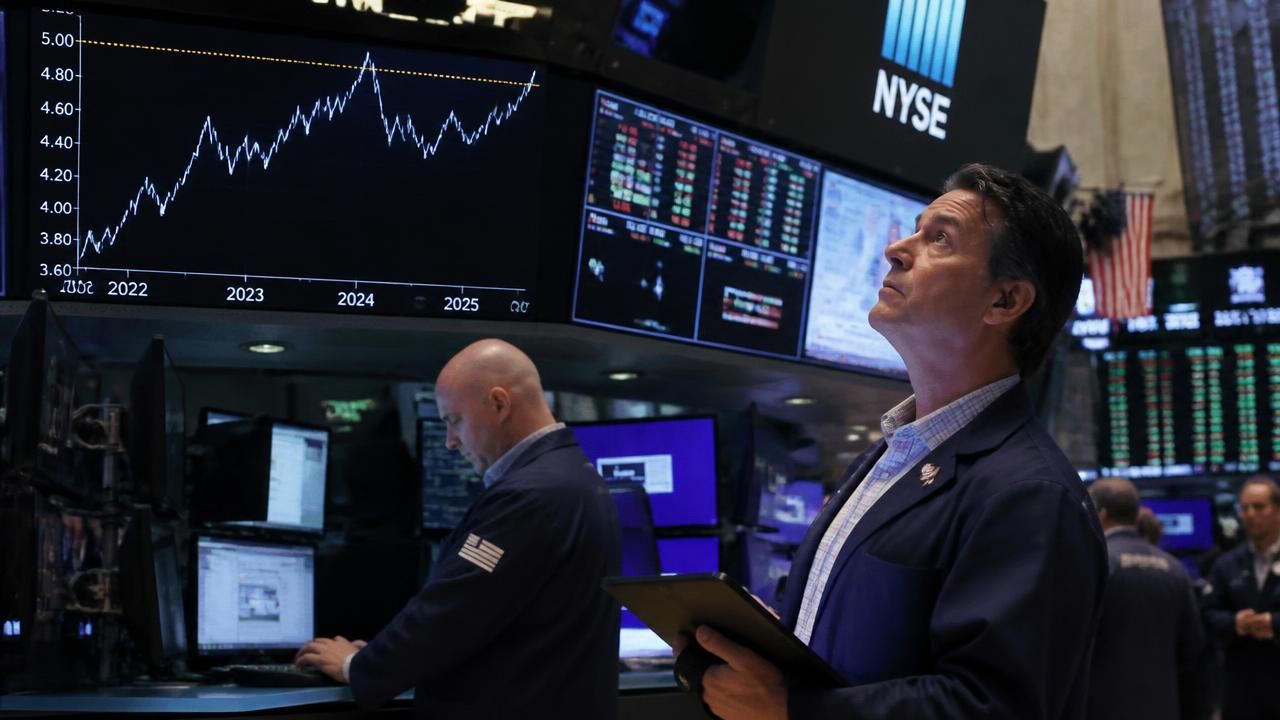
The most important number in global finance just crossed a line that once reliably triggered selling on Wall Street — and stocks, so far, have refused to blink. The 10-year Treasury yield has punched through 5%, a multi-decade high, even as major equity indexes have held near their highs and, on some sessions, pushed higher still. The divergence has become the central puzzle of the autumn market: if the risk-free rate is suddenly paying 5%, why would anyone keep buying stocks at these valuations?
The answer, according to a growing chorus of strategists, is that the old inverse relationship between bonds and equities is not a law of nature. It is a rule of thumb that holds only when rising yields are driven by something that also threatens corporate profits. Right now, the drivers look more benign — at least on the surface.
A Benchmark Breaks Out
The move in Treasuries has been relentless across maturities. The 10-year yield — the discount rate against which virtually every asset on earth is priced — has climbed to territory not visited in roughly two decades. Bloomberg Opinion characterized the level as the highest since 2002, while other market watchers point to 2007 as the last time yields traded this high. The discrepancy is a reminder of how many ways the milestone can be measured, but the direction is not in dispute: the bond market has repriced dramatically.
The causes are well rehearsed. A resilient U.S. economy has confounded recession forecasts, forcing investors to abandon bets on imminent rate cuts. Heavy Treasury issuance is testing the market's capacity to absorb supply. And a persistent term premium — the extra compensation investors demand for holding long-dated debt — has returned after years of near-zero.
Why the Textbook Said Stocks Should Fall
Bond yields and bond prices move in opposite directions, and the carnage in fixed income has been real. Longer-duration bonds have suffered double-digit drawdowns, and investors who bought at the 2020–2021 lows remain deeply underwater. The same math that produces those losses also raises the cost of capital for every company, compresses the present value of future earnings, and makes the equity risk premium — the extra return stocks must offer over bonds — look thinner by the day.
That is the mechanism Morningstar gestured at in its framing this week: stocks have so far survived rising Treasury yields, but that survival may be about to end. The site's analysis was unavailable when this article was compiled, but the headline alone captured the mood of a market that keeps waiting for the other shoe to drop.
Why Equities Have Held Up
Bloomberg Opinion's John Authers has argued that the assumption of a clean inverse relationship between yields and stocks deserves scrutiny. The historical record is messier than the folk wisdom suggests: in long stretches, yields and equities have risen together, because both were responding to stronger growth. Analysts offer several explanations for the current resilience:
- It's a growth story, not a fear story. Yields have risen largely because the economy has stayed strong, which supports earnings even as it lifts discount rates.
- Real yields, not nominal yields, are what matter. Adjusted for inflation, the climb is significant but less dramatic than the headline 5% suggests.
- Household and corporate balance sheets are sturdier. Unlike previous rate shocks, much of the private sector locked in low borrowing costs before the tightening cycle began.
- There is still nowhere else to go. With credit spreads tight and cash yielding 5%, investors continue to treat mega-cap equities as the only liquid source of long-term compounding.
Cracks Beneath the Surface
Beneath the index level, however, the tape tells a more turbulent story. In one recent session, indexes closed lower as oil prices rose and the 10-year yield touched 5%. Chip stocks dropped sharply on fresh concerns about AI safety, while software stocks jumped — a rotation that suggests investors are differentiating between AI winners and AI narratives rather than buying the theme indiscriminately.
That intraday split matters. The AI trade has been the single largest contributor to index gains this year, and any wobble in semiconductor names removes a key pillar of support. Meanwhile, the surge in crude prices adds a second pressure point, threatening to feed back into inflation just as the Federal Reserve hoped to be done tightening.
"Bond yields are assumed to have an inverse relationship with stocks, so a move of this magnitude should be a problem for equities. But it hasn't been." — Bloomberg Opinion
How Different Outlets Are Framing It
The coverage itself reveals the uncertainty. Yahoo Finance led with the rebound — stocks rallying as yields retreated from multi-decade highs — emphasizing the market's two-way volatility. MSN-distributed reports split between two narratives: one framing the move as an oil-and-yield double shock, the other highlighting sector rotation and AI jitters. Exchange-traded fund coverage has focused on why equities can rally despite 20-year-high yields, pointing to flows into quality and dividend strategies. Morningstar struck the most cautionary note, warning that the resilience may be temporary.
Together, the coverage describes a market that is not ignoring the bond market — it is actively negotiating with it.
What to Watch
The bull case for stocks does not require yields to fall; it requires them to stabilize. If the 10-year settles in a 4.5%–5% band while earnings grow, equities can absorb the shock. If yields break meaningfully higher, the arithmetic changes: mortgage rates, auto loans and corporate refinancing costs all reset, and consumer spending — the engine of the expansion — begins to sputter.
Bond investors, meanwhile, face their own reckoning. With yields at multi-decade highs, the fixed-income market is finally offering something it hasn't for years: genuine income. Whether that eventually pulls money out of stocks is the question every strategist is now trying to answer. For the moment, the equity market is betting it won't. History suggests that bet is not irrational — but it is far from guaranteed.