Two European countries, two very different political trajectories, and one shared symptom: the return of domestic strain that governments would rather keep off the front pages. In Russia, the costs of war are increasingly visible at the pump and in the rubble of civilian disasters. In Greece, a familiar cycle of austerity, protest, and policing is reasserting itself more than a decade after the country's debt crisis first convulsed the continent.
Neither story arrives as a single event. Instead, each is a cluster of incidents that, taken together, sketch the outlines of states under pressure.
Russia's Home Front: Energy Under Attack
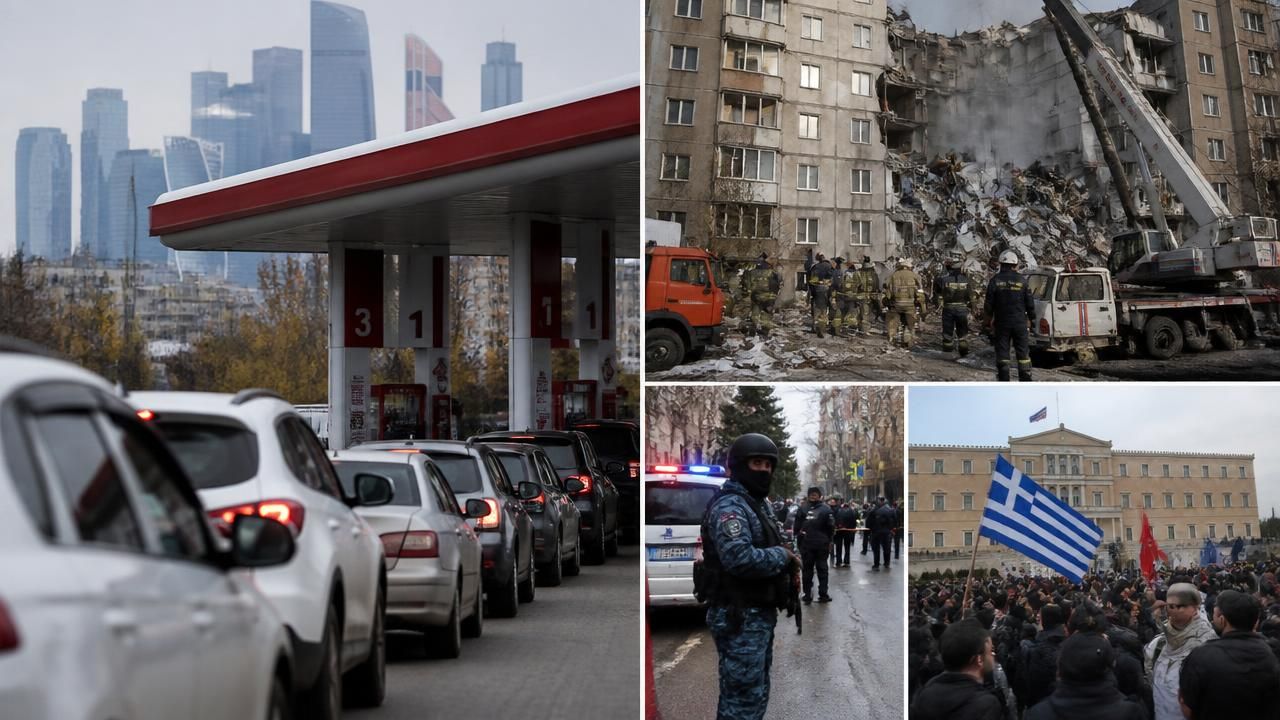
The most economically pointed development is the fuel crunch now visible across Moscow. In a video report, The New York Times dispatched correspondent Ivan Nechepurenko to filling stations across the capital to gauge how severe the shortages have become. The through-line is straightforward: Ukrainian drone strikes targeting Russian refineries have degraded refining capacity, and the effects are showing up in queues, rationing, and empty pumps in the country's largest consumer market.
The New York Times sent correspondent Ivan Nechepurenko to Moscow's filling stations to document how severe the shortages have become as Ukrainian attacks target Russian refineries.
The framing matters. Western outlets have treated the refinery campaign as one of Ukraine's most effective asymmetric tools — a way to strike at Russia's fiscal lifeline and, simultaneously, at the everyday convenience of Russian consumers who had largely been insulated from the war. Russian state media, by contrast, has tended to minimize the disruptions, emphasizing temporary regional shortfalls rather than a systemic problem.
The Times also issued a correction to its video, clarifying that Yandex, while Russian, is not state-run — a small footnote, but a reminder of how closely Western audiences scrutinize the ownership of the platforms through which Russians experience daily life.
Blast and Gunfire: Ruptures in the Russian Interior
The strain is not only economic. In Magnitogorsk, an apartment building collapsed following an explosion, leaving dozens dead — a disaster that turned a residential block into a mass-casualty scene and prompted the kind of emergency response that dominates Russian regional news for days. In Belgorod, a shooting spree left six people dead, adding another entry to the country's grim ledger of mass shootings.
These incidents are unrelated in cause, and reporting on both has remained sparse in the open-source record. But their proximity in the news cycle is instructive. Russia's interior is absorbing shocks at a moment when the state's attention, resources, and security apparatus are oriented decisively outward and toward the front.
Greece: The Old Argument, Again
Greece's cluster of stories reads like a rerun with higher stakes. Lawmakers approved contentious campus police legislation, a measure that puts uniformed officers on university grounds — something Greek students and faculty have long resisted as a violation of the asylum tradition that protected academic spaces during the military junta era. Protests followed, as they have every time the issue has surfaced.
Separately, parliament passed a new austerity law despite violent demonstrations in the streets — the latest installment in a fiscal argument that has defined Greek politics since the bailout years. And during a nationwide general strike, a bank fire in Athens killed three people, a tragedy that became a symbol of how quickly protest can turn lethal.
Together, the three items describe a governing pattern: legislation passes; unions strike; demonstrations escalate; and the human cost is measured in lives.
How the Framing Diverges
- Economic lens: The Moscow fuel shortages are covered as evidence that sanctions and strikes are biting, with implications for global energy markets.
- Security lens: The Magnitogorsk collapse and Belgorod shooting are treated as domestic emergencies, largely contained within Russian coverage.
- Political lens: The Greek measures are framed as a test of how far a government can push unpopular reforms while maintaining public order.
- Human lens: The Athens bank deaths and the Magnitogorsk fatalities share a common thread — civilians absorbing the consequences of decisions made far from them.
Why It Matters
The temptation is to read these as separate national stories. A more useful reading is that both countries are demonstrating what happens when external pressure and internal policy collide. For Russia, the question is whether refinery strikes translate into durable public discontent or remain a manageable inconvenience. For Greece, it is whether a new round of austerity and policing measures reopens the social fractures that nearly tore the country apart — or whether the political system has learned to absorb them.
What is clear is that in both capitals, the debate has moved from abstract policy to the tangible: the price at the pump, the safety of an apartment block, the presence of an officer on a campus, the smoke rising from a bank in central Athens.