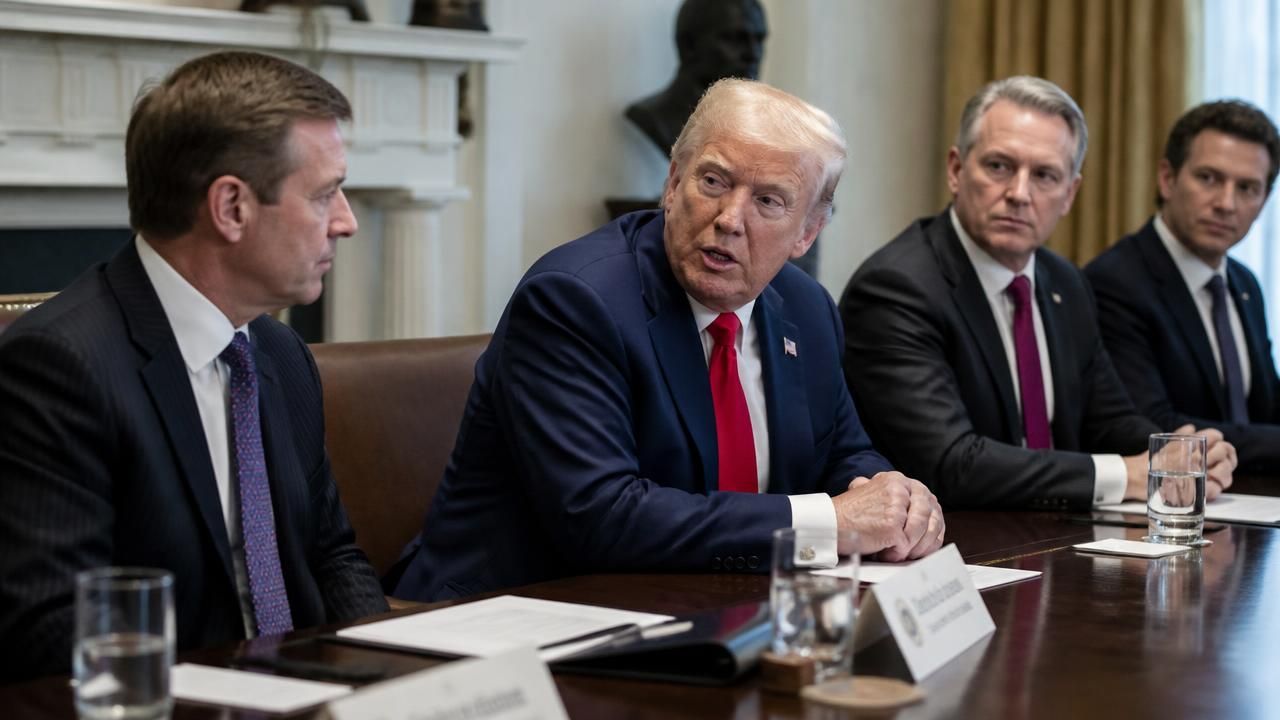
The White House is moving to put its stamp on the fast-moving artificial intelligence industry, pairing a newly announced task force on AI risks — led by former Securities and Exchange Commission chairman Jay Clayton — with a set of voluntary safety standards that U.S. technology giants agreed to after a meeting with President Donald Trump. The twin announcements, reported across multiple outlets, signal an administration that wants to be seen as both a facilitator and a referee of the AI boom, even as critics question whether voluntary commitments can hold up under competitive pressure.
According to headlines carried by MSN, Clayton has been tapped to lead what has been described as Trump's "super intelligence force" on AI risks — a body whose precise mandate, staffing and authority remain only loosely defined in early public accounts. The appointment places a veteran Wall Street regulator with deep ties to the financial industry at the center of a policy area that spans national security, economic competitiveness and consumer protection. It also raises immediate questions about whether the group will operate as a genuine regulator or as a coordinating council that stops well short of enforcement.
Voluntary standards, a familiar playbook
Alongside the task force, the administration announced that Trump and U.S. tech giants had agreed on voluntary AI safety standards following a White House meeting, according to Firstpost. The framing — commitments made by companies rather than obligations imposed by government — echoes earlier industry-led efforts such as the Biden-era voluntary AI safety pledges and the frontier-model agreements reached with major labs in 2023 and 2024.
Those frameworks generally asked companies to red-team their most capable models, share information on dangerous capabilities, and invest in security for model weights. They were widely praised as a fast, flexible first step, and just as widely criticized as unenforceable. Several of the participating companies have since restructured or quietly deprioritized their safety commitments as the race to ship products accelerated — a pattern that skeptics say is likely to repeat.
The case against voluntarism
That concern was voiced directly on Bloomberg Television. Bloomberg Opinion columnist Gautam Mukunda told Bloomberg This Weekend hosts David Gura and Christina Ruffini that voluntary safeguards may not be enough to manage AI risks, because competitive and financial pressures can push companies to prioritize growth over safety.
"Voluntary safeguards may not be enough to manage AI risks because competitive and financial pressures can push companies to prioritize growth over safety."
— Gautam Mukunda, Bloomberg Opinion columnist, on Bloomberg This Weekend
The logic is a classic collective-action problem: if one lab slows down to test a model more thoroughly, a rival may ship first and capture the market. Mukunda's comments, delivered in the same weekend cycle as the task force news, framed the White House effort as an open question rather than a settled solution — a test of whether increasingly advanced AI systems can be safely governed at all.
Mukunda also pointed to Anthropic's planned initial public offering as a lens on the tension. Anthropic, founded in 2021 by former OpenAI researchers and positioned explicitly around AI safety, has become one of the most valuable private AI companies, with backing from Amazon and Google. An IPO would hand the company a large pool of public capital — and a shareholder base that will expect quarterly growth. The same dynamic, critics argue, has historically pulled safety-focused firms toward faster release cycles.
A split with Beijing
The administration's posture abroad is equally consequential. As reported by MSN, Trump rejected cooperation with China on AI risks, saying the United States must maintain its lead in the technology. That position marks a sharp break from the longstanding view among many AI researchers and international governance specialists that frontier-model risks — from bioweapon design to cyberattacks — are inherently cross-border and cannot be managed by any single country acting alone.
Previous diplomatic efforts, including the 2023 Bletchley Declaration signed by the U.S., China, the EU and others, treated AI safety as one of the few areas where adversarial powers could find common technical ground. A retreat from that engagement risks fragmenting safety standards into competing national blocs and complicates any future attempt to verify that a dangerous model has not been trained.
Why it matters now
The announcements land at a moment of extraordinary financial intensity. AI infrastructure spending has become a dominant driver of U.S. equity markets, and any shift in regulation — or even the perception of it — moves valuations across semiconductors, cloud computing and data centers. A task force led by a former SEC chairman is likely to be read by markets as a signal that the administration is thinking about capital formation, disclosure and competition as much as about catastrophic risk.
- The task force: led by Jay Clayton, described as a "super intelligence force" on AI risks; mandate and enforcement powers still unclear.
- The standards: voluntary commitments agreed between Trump and major U.S. tech companies after a White House meeting.
- The critique: Bloomberg's Gautam Mukunda argues market pressure can overwhelm voluntary safeguards.
- The geopolitical angle: Trump has ruled out cooperation with China, insisting the U.S. keep its lead.
- The market angle: Anthropic's planned IPO looms as a test of whether safety-first labs can stay safety-first once public.
What to watch
Three questions will determine whether this week's flurry becomes durable policy. First, will the task force publish measurable criteria — model evaluations, incident reporting, compute thresholds — or remain an advisory body? Second, will the voluntary standards include any consequence for non-compliance, such as procurement preferences or disclosure requirements? And third, will the administration's refusal to engage Beijing survive contact with allies, many of whom are pursuing bilateral and multilateral AI safety channels regardless.
For now, the White House has staked out a distinctly market-friendly position: light-touch rules, American technological primacy, and industry at the table rather than in the dock. Whether that balance holds will depend less on the announcement than on what happens the next time a frontier model ships and something goes wrong.