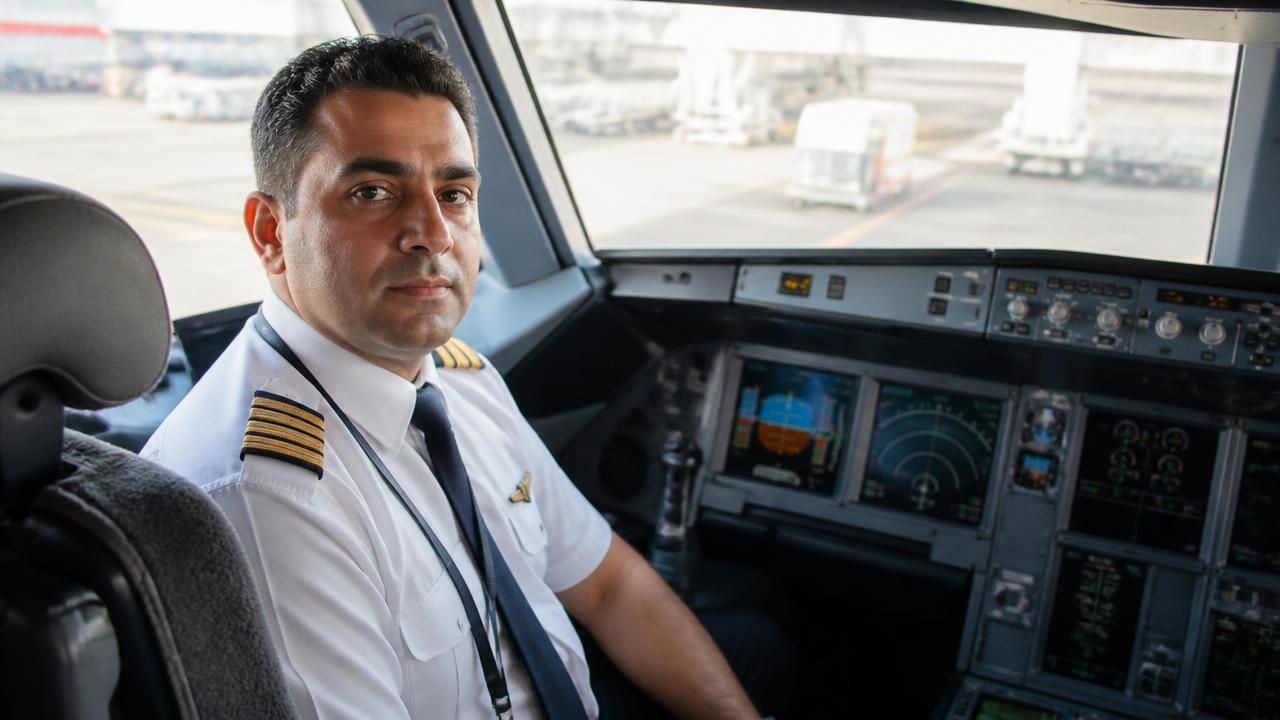
An Indian airline captain is being hailed as a hero on three continents after a violent attack inside the cockpit of a FlyDubai flight travelling between Dubai and Tel Aviv, an incident that has triggered a diplomatic outpouring, a repatriation operation and an international investigation into what motivated the assault.
Captain Smit Machchhar, the pilot at the controls, has spent the days since the attack recounting the ordeal to heads of state, family members and the news media. In a phone call with Indian Prime Minister Narendra Modi, Machchhar described how he fought to keep control of the aircraft, at one point telling the prime minister that he had opened the cockpit door himself during the struggle — a detail that has become central to the emerging narrative of the episode.
‘I was fighting for my life’
Accounts of the attack, first reported by Bloomberg and subsequently carried by outlets including The Times of India, India Today, Outlook India and NDTV, describe a harrowing scene in the confined space of the flight deck. Machchhar has repeatedly used the same phrase to describe the experience: he was, he said, “fighting for my life.”
During his conversation with Modi, the captain grew emotional as he recalled chanting the Hanuman Chalisa, a Hindu devotional hymn, during the attack — a detail that has resonated widely in India, where the story has dominated coverage and turned Machchhar into a household name. Modi praised the pilot’s conduct as “monumental,” according to accounts of the call.
“I was fighting for my life.” — Captain Smit Machchhar, recalling the cockpit attack in accounts carried by multiple outlets
Passengers have offered their own versions of events. One traveller told reporters that Machchhar was “conscious and communicating” throughout the aftermath, and described how the pilot opened the cockpit door — a moment that other passengers have cast as pivotal to how the situation unfolded. Israeli media carried the account of a dentist who treated Machchhar’s injuries, saying she had feared “we’d lose him.”
A family’s ordeal, and a flight school’s memory
The human cost of the attack has extended well beyond the aircraft. Sonal Machchhar, the captain’s wife, described the moment she learned what had happened, telling interviewers she was “very devastated” by the news before relief set in. OneIndia profiled her separately, underscoring how intensely Indian audiences have followed the story.
Others who knew Machchhar long before this week have also come forward. His flight school recalled him as a student who “stood out,” while a friend told Livemint that the captain had “taught us courage.” The testimonies form a portrait of a pilot whose professional training and personal composure are now being credited with preventing a far worse outcome.
Diplomacy and the politics of praise
The incident has quickly acquired geopolitical dimensions. Israeli Prime Minister Benjamin Netanyahu hailed what he called the Indian pilot’s “unbelievable courage,” invoking the memory of his brother Yonatan, who was killed leading the 1976 Entebbe rescue operation. The comparison, delivered in public remarks, framed Machchhar’s actions within Israel’s own vocabulary of heroic sacrifice — a striking rhetorical bridge between Jerusalem and an Indian aviator.
Modi’s personal phone call to the captain served a similar function, placing the Indian state squarely behind one of its citizens abroad. Indian outlets — India Today, Outlook India, PTC News, MSN’s syndicated feeds — have treated the call as the story’s emotional centrepiece, while international wires such as Bloomberg and Yahoo have emphasised the bare facts of the attack and its aftermath.
The framing differences are notable. Indian coverage has leaned heavily on the pilot’s bravery, his faith and his family, with headlines about a “hijack attempt” and a “hero.” International coverage has been more clinical, with The New York Times focusing on investigators’ search for a motive and the Boston Herald reporting on Israel’s decision to launch repatriation flights for passengers stranded in the United Arab Emirates.
Repatriation, investigation and unanswered questions
Israel’s move to organise repatriation flights for travellers left stranded in the UAE underscores the operational disruption the attack caused. The route between Dubai and Tel Aviv is one of the more recently established corridors in Middle Eastern aviation, a product of the 2020 normalisation agreements that reshaped regional travel. A security incident on that route carries symbolic weight beyond the immediate danger to passengers.
What remains unresolved is the question at the top of the investigation: why the attack happened at all. The New York Times reported that investigators are still seeking a motive, and no source in the material reviewed has offered a confirmed explanation for the assailant’s intentions or affiliations. Details of the attacker’s identity, the precise sequence of events inside the cockpit, and the full extent of Machchhar’s injuries have not been uniformly reported.
Even the captain’s name has appeared in two forms across outlets — Smit Machchhar in most Indian and international reports, and “Smeet” in some broadcast coverage — a small illustration of how quickly a breaking story can outrun precise verification.
What comes next
For FlyDubai, a Dubai government-owned carrier, the episode raises immediate questions about cockpit security on a politically sensitive route. For India, it has produced a national figure whose conduct is being cited by prime ministers on two continents. And for investigators, the central task remains what it was in the first hours after the flight landed: establishing a motive.
- Who: Captain Smit Machchhar, an Indian pilot flying a FlyDubai service between Dubai and Tel Aviv; passengers, including an Israeli dentist who treated him; his wife, Sonal Machchhar.
- What: A violent attack inside the cockpit, described in some coverage as an attempted hijacking.
- When: Earlier this week, with developments unfolding over several days.
- Where: The Dubai–Tel Aviv route, with diplomatic reaction in India and Israel.
- Why: Unknown; investigators are still seeking a motive.
- How: Machchhar says he fought for his life and opened the cockpit door; passengers and medical personnel later assisted him.
The full picture will depend on the investigation’s findings. What is already clear is that a routine commercial flight has become a diplomatic event, a security case study, and — for one Indian family and a global audience of millions — a story about survival.