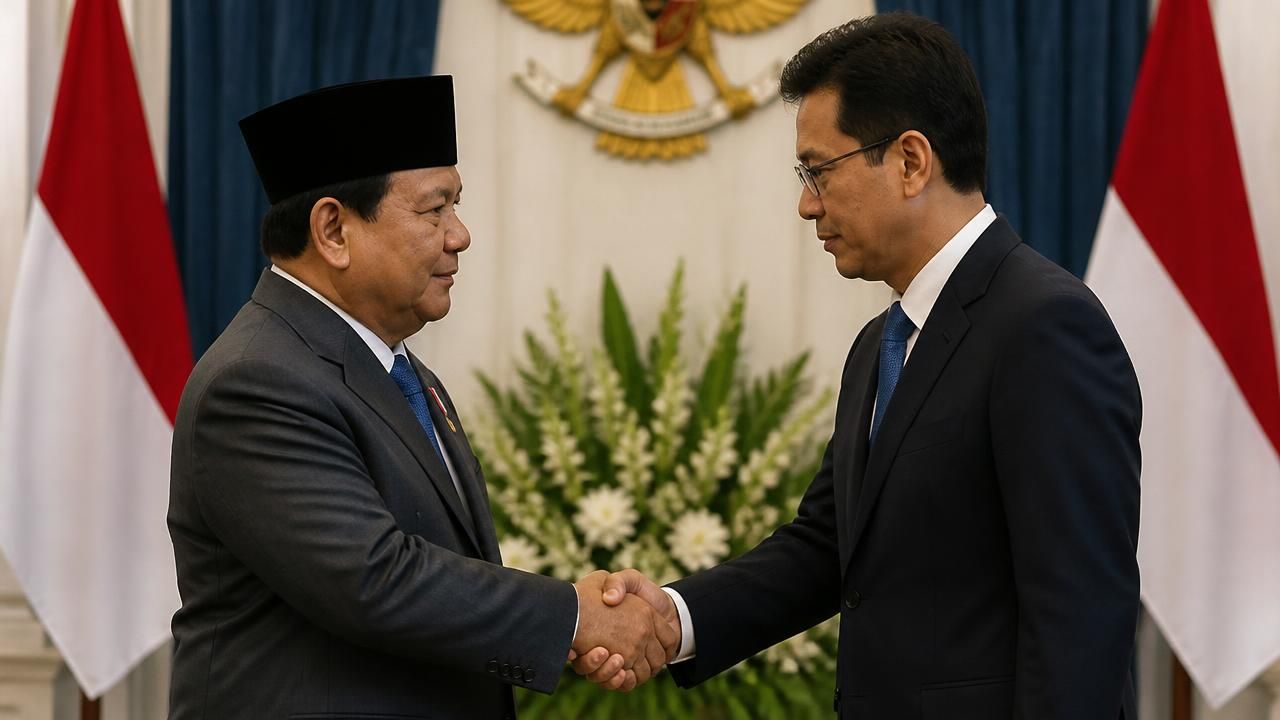
Indonesian President Prabowo Subianto has replaced Finance Minister Sri Mulyani Indrawati with Purbaya Yudhi Sadewa, a deputy minister drawn from the government's economic team, in a cabinet shake-up that immediately became a referendum on the country's fiscal credibility. The announcement, made through an official statement from the presidential palace in Jakarta, confirmed one of the most consequential personnel changes of Prabowo's young administration.
The move ends — at least for now — the tenure of Sri Mulyani, a former World Bank managing director who served as Indonesia's finance minister across two presidencies and who became, for global investors, the human embodiment of the country's fiscal discipline. Her successor inherits a budget under strain, a powerful new sovereign wealth fund, and a president who has promised to lift economic growth to 8 percent.
A 'Good Move' That Still Leaves Questions
The initial verdict from markets and analysts was, on balance, positive. An analysis circulated by MSN described the switch as a "good move" that would "ease investor jitters," framing the appointment as a signal of continuity rather than rupture. That framing was echoed across aggregators and wires that carried the story, with coverage emphasizing that Prabowo had elevated a figure already inside the economic policymaking apparatus rather than reaching outside it.
But the relief is conditional. A second MSN analysis struck a notably more cautious note, arguing that Indonesia's new finance minister "faces an uphill battle on fiscal credibility" — a reminder that in Jakarta, the bond market's confidence is a renewable resource that must be earned at every budget cycle.
"Indonesia's new finance minister vows fiscal discipline amid questions over growth ambitions." — Bloomberg Markets, Insight with Haslinda Amin
Bloomberg's framing, delivered through its daily interview-and-analysis program Insight with Haslinda Amin, captures the central tension of the transition: the new minister has publicly committed to fiscal prudence while serving a president whose political mandate rests on faster, more visible growth. Those two commitments are not inherently contradictory, but they are in constant competition.
Why Sri Mulyani's Exit Matters
Sri Mulyani's reputation was built on precisely this tension. During her first stint as finance minister, from 2005 to 2010, she steered Indonesia through the global financial crisis and earned a reputation for resisting politically popular spending. After six years at the World Bank, she returned to the finance ministry in 2016 and presided over a decade in which Indonesia retained investment-grade ratings from the major agencies and kept its budget deficit legally capped at 3 percent of gross domestic product.
That cap is written into law, and it is the single number foreign bondholders watch most closely. It is also the number most likely to be tested by Prabowo's agenda, which includes a multi-billion-dollar free nutritious meals program, an expanded social assistance footprint, and the Danantara sovereign investment fund — an entity designed to funnel state capital into industrial and resource projects.
Indonesia's debt burden remains comparatively light, at roughly 40 percent of GDP, and its tax ratio hovers near 10 percent, among the lowest in the G20. Economists across the spectrum agree that the country has fiscal room. They disagree sharply on whether it should use that room to stimulate growth or to rebuild revenue buffers first.
The Growth Ambition
The new finance minister arrives with a mandate that is, in effect, a growth mandate. Prabowo has repeatedly targeted 8 percent annual expansion by the end of his term — nearly double the roughly 5 percent pace Indonesia has posted for the past decade. Reaching that number would require a step change in investment, exports, and state spending, all of which must ultimately be financed.
The incoming minister has argued publicly in the past that Indonesia's low debt ratio gives it latitude to spend more aggressively in pursuit of that goal, a position that puts him at odds with the orthodox caution that defined his predecessor's tenure. Whether he maintains that view inside the finance ministry — where the cost of every rupiah is measured against bond auctions and ratings outlooks — is the question analysts are now asking.
The market's early response, according to the Reuters and MSN coverage, suggested investors are willing to extend the benefit of the doubt. Indonesian assets firmed on the news, with the rupiah and government bonds supported by the perception that the transition would be orderly rather than disruptive.
What to Watch
- The 2026 budget draft. The deficit ceiling, subsidy reform, and revenue targets will be the first hard test of the new minister's stated commitment to discipline.
- Danantara's funding model. How the sovereign fund is capitalized — and whether it draws on the budget or on state-owned enterprise dividends — will shape the fiscal math for years.
- Tax revenue. Any credible push to lift the tax ratio would reassure rating agencies more than any statement of intent.
- The ratings agencies. S&P, Moody's, and Fitch have all flagged Indonesia's revenue base as a constraint; a negative outlook revision would be the clearest rebuke.
- The president's spending priorities. If the free-meals program expands faster than revenue, the finance ministry's restraining role becomes the story.
The consolidated picture across the coverage is this: the switch is being read less as a break from Indonesia's reformist tradition than as a stress test of whether that tradition can survive contact with a more expansive political agenda. The new minister has said the right things about fiscal discipline. The harder question, as one analysis put it, is whether he can hold that line while the government he serves is asking him to fund a growth story the country has never managed to deliver.
For global investors, Indonesia remains a structural growth market and a relatively high-yielding one. But the premium they demand for holding its debt is a direct function of who sits in the finance ministry and what they are willing to say no to. That premium was priced on Sri Mulyani for nearly a decade. It is now being repriced — cautiously, and with the benefit of the doubt, but repriced nonetheless.