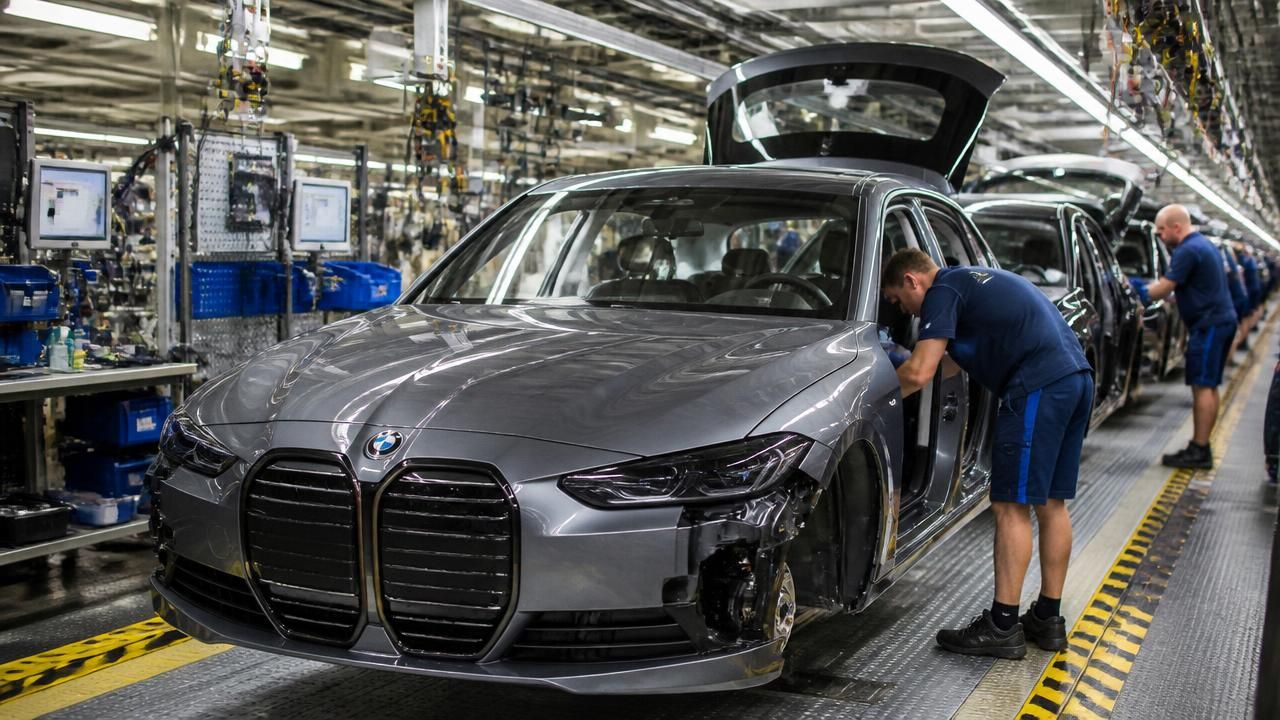
Europe’s automotive industry is entering a perilous new chapter, one in which the old playbook—using profits from China to fund the electric transition—has been torn up. BMW’s profit warning, a wave of hedge-fund short bets, Chinese EV makers’ rapid European expansion, and Donald Trump’s return to tariff politics have combined to create a genuine crisis of confidence. Even Renault’s charming retro electric 5, complete with an optional baguette basket, is being deployed as a weapon in a fight that is anything but nostalgic.
BMW’s warning: squeezed on two fronts
The Next Web reported that BMW slashed its profit forecast as China’s EV makers squeeze European carmakers on two fronts. The Munich-based group cut its automotive profit margin guidance, citing weaker-than-expected demand in China and intensifying competition in Europe. The two-front squeeze is brutal: in China, local champions such as BYD, Nio and XPeng are winning price-sensitive buyers with cheaper, software-rich electric vehicles; in Europe, those same brands are expanding aggressively, taking share from legacy automakers in their home market. BMW’s warning is not an isolated event. It is a signal that the pricing power and profits that European carmakers once enjoyed are eroding fast.
Hedge funds smell blood
MSN reported that hedge funds are betting against European carmakers on Chinese competition fears. Short sellers are targeting names including BMW, Mercedes-Benz, Porsche, Stellantis and Renault, wagering that margins will continue to compress as Chinese EV makers scale up in Europe. The bear case is straightforward: European automakers are burdened by higher labor costs, complex legacy production networks, and slower software development, while Chinese rivals benefit from vertical integration, cheaper batteries, and faster product cycles. For hedge funds, the sector looks like a value trap—cheap for a reason.
China’s carmakers expand their European footprint
Reuters reported that China’s carmakers are expanding their presence in Europe. A factbox from Yahoo Finance echoed the same theme. BYD, Chery, SAIC, Leapmotor and others are not just exporting cars; they are building local plants in Hungary, Spain, Turkey and beyond, partly to circumvent European Union tariffs on Chinese-made EVs. The EU imposed provisional duties of up to 37.6% on Chinese electric vehicles in 2024, but Chinese firms have responded by localizing production, turning a trade barrier into a reason to invest directly in Europe. That shift threatens European jobs and industrial capacity even as it gives consumers more affordable electric options.
Nostalgia as a counteroffensive
Bloomberg Opinion columnist Chris Bryant explains how the Renault 5 electric car, which comes with an optional baguette basket, proves that nostalgia sells. Reinventing iconic cars is a smart way for European manufacturers to compete with China, Bryant argues, because it leverages emotional attachment and heritage that Chinese startups cannot easily replicate. Renault has revived the 5 as an affordable EV; Fiat has the 500e; Mini and Volkswagen have leaned on retro designs such as the ID.Buzz.
Nostalgia sells—and in a price war, a familiar name can be a powerful differentiator.
Yet nostalgia alone cannot fix a cost gap. European carmakers still need competitive batteries, software and manufacturing efficiency. Charm may win showrooms, but it does not guarantee profits.
Trump blows up the China bet
Yahoo Finance reported that Trump has blown up European carmakers’ bet on China. For years, German and French automakers relied on Chinese profits to fund electrification and shareholder returns. Trump’s tariff threats—on Chinese goods, on European exports, and on vehicles made in Mexico or China—have scrambled that calculus. If the United States imposes steep tariffs on European cars, BMW, Mercedes-Benz and Volkswagen could lose a key profit center. If it targets Chinese-made vehicles, European brands that build in China for export to America could also be hit. And if Chinese EVs are blocked from the US, they may divert even more supply to Europe, intensifying the price war.
How the outlets frame it
Each outlet highlights a different piece of the same puzzle. Bloomberg sees a marketing opportunity in retro EVs. Reuters and Yahoo Finance focus on Chinese expansion and trade policy. MSN emphasizes investor skepticism. The Next Web zeroes in on BMW’s earnings warning. Together, they describe a sector under siege from multiple directions: competition, tariffs, investor doubt and the costly electric transition itself.
What happens next
The implications are stark. European carmakers are likely to accelerate plant closures, job cuts and partnerships. Some may seek alliances with Chinese firms, as Stellantis has done with Leapmotor. Others may lobby Brussels for stronger tariff protection while trying to build cheaper EVs. Governments will face pressure to support workers and battery supply chains. Investors will demand proof that legacy brands can grow margins again.
- Cost discipline: European automakers must cut fixed costs without sacrificing quality.
- Technology speed: Software and battery innovation are now the core battleground.
- Trade risk: Trump’s tariffs and EU duties could reshape where cars are built and sold.
- Consumer choice: Chinese competition may lower prices, but it also pressures local industry.
The Renault 5’s baguette basket is a clever symbol of European resilience. But the real test is whether Europe’s carmakers can move beyond nostalgia and deliver competitive electric vehicles at scale. For now, hedge funds are betting they cannot—and BMW’s profit warning suggests the skeptics have a point.