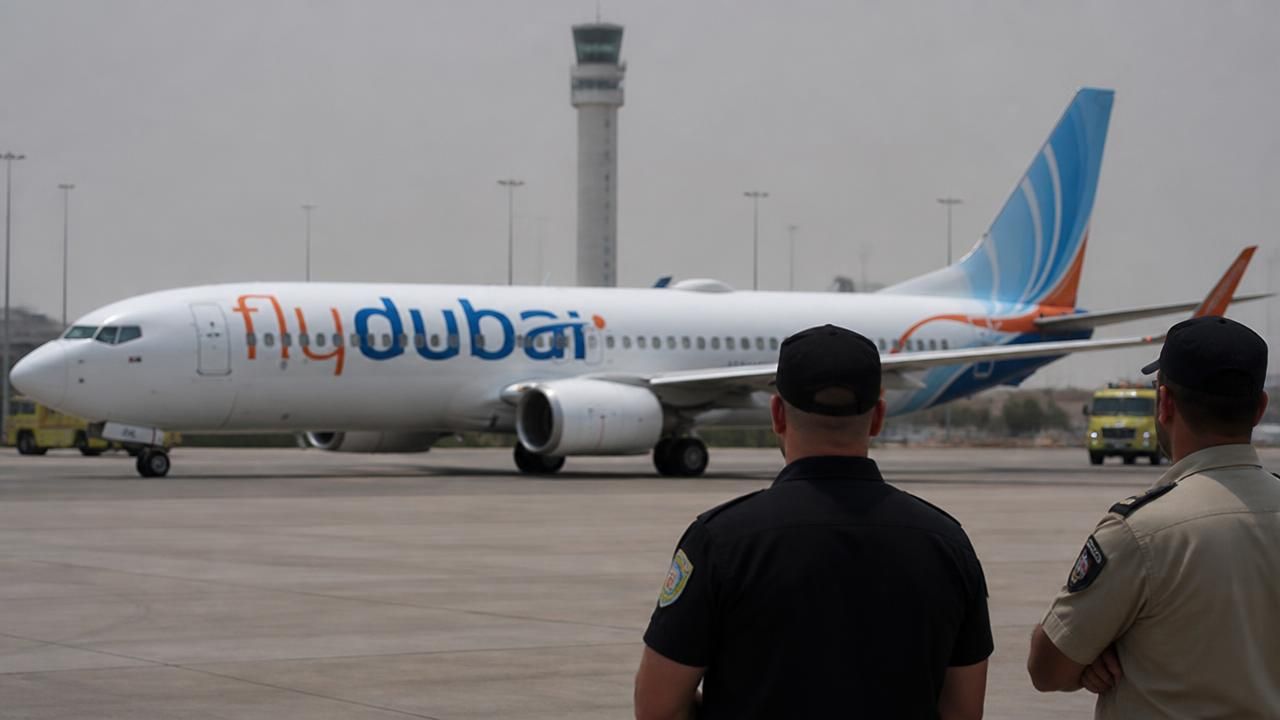
A routine commercial flight from Dubai to Tel Aviv turned into a mid-air emergency on Tuesday when a violent struggle erupted inside the cockpit, sending the aircraft into a steep plunge before passengers and crew members forced their way onto the flight deck, subdued the attacker and stabilized the jetliner, according to Israeli officials and multiple accounts of the episode.
The flight, operated by the Dubai-based carrier flydubai, was ultimately diverted to Saudi Arabia, where it landed safely. Israeli Prime Minister Benjamin Netanyahu characterized the stabbing as an apparent attempt to bring the aircraft down, turning what would ordinarily be a criminal aviation incident into a matter of international security.
A Terrifying Plunge
According to accounts relayed by Israeli officials and reported by NPR, The Associated Press and Reuters, the aircraft went into a spin and began dropping after the attack in the cockpit. Reports place the loss of altitude at roughly 14,000 feet before control was recovered — a descent steep enough that passengers described chaos in the cabin as the plane pitched and dove.
The New York Times described the sequence as a "bloody attack in the cockpit" followed by a "terrifying plunge," while MSN framed the same events as "cockpit chaos," emphasizing the altitude loss and the extraordinary mid-flight intervention. The Sun, meanwhile, gave the story its most dramatic treatment, quoting the phrase "Israel's 9/11" and publishing images of the wounded captain whom it credited with helping thwart the attack.
Conflicting Accounts of Who Stabbed Whom
The most significant divergence across news organizations concerns the direction of the attack. Reuters reported a "co-pilot-on-pilot stabbing," and The Associated Press headline stated that a copilot stabbed the captain before passengers stormed the cockpit. NPR and Boise State Public Radio similarly reported that the pilot was stabbed — with passengers tackling the attacker as the plane plunged.
NBC News, however, reported that the pilot stabbed his co-pilot in an apparent attempt to crash the Israel-bound plane, attributing that framing to Netanyahu. The Sun and MSN headlines point in the same direction as the AP and Reuters, describing a "co-pilot" who "goes on rampage" while the captain helped stop him. The discrepancy — which crew member was the assailant and which the victim — remains the central unresolved factual question in the coverage, and it reflects the difficulty of reporting on an incident still under active investigation, with initial details filtered through government statements rather than a completed inquiry.
Netanyahu said a pilot stabbed his co-pilot in an apparent attempt to crash the Israel-bound jet, and he praised the passengers and crew members who subdued the attacker and kept the aircraft aloft.
Passengers and Off-Duty Pilots Take Over
Several outlets highlighted the role of ordinary travelers in averting disaster. NPR and the AP reported that passengers and crew members entered the cockpit, subdued the attacker and forced the diversion to Saudi Arabia, where the aircraft landed. The New York Post, citing passengers, reported that off-duty pilots happened to be aboard the flight and heroically took the controls, helping land the aircraft after the stabbing.
That detail, if confirmed, would be highly unusual — and central to understanding how a crippled flight deck was stabilized in the minutes after the attack. It also underscores how quickly the story shifted from a criminal act to a tale of improvised heroism, a narrative arc that has defined much of the coverage.
Regional and Political Context
The diversion to Saudi Arabia is itself notable. The kingdom has no formal diplomatic relations with Israel, though it has permitted Israeli commercial overflights in recent years. Landing an Israeli-bound flight on Saudi soil — even under emergency circumstances — touches on one of the most sensitive fault lines in Middle Eastern aviation and diplomacy, and it hands Riyadh a delicate role in the aftermath.
The flight's Dubai–Tel Aviv route exists only because of the 2020 Abraham Accords, the U.S.-brokered normalization agreements that opened direct air links between the United Arab Emirates and Israel. A violent attack on that corridor carries symbolic weight beyond the aircraft itself, striking at one of the most visible products of the normalization era.
Aviation Security Questions
The incident also raises uncomfortable questions for airline security regimes. Cockpit doors were hardened worldwide after the Sept. 11, 2001 attacks specifically to prevent intruders from reaching the flight deck. That passengers were able to force their way into the cockpit underscores the exceptional nature of this event — an attacker who was already inside the most protected space on the aircraft.
Investigators have not publicly detailed a motive, and authorities in the UAE, Israel and Saudi Arabia are expected to coordinate on the inquiry. The carrier, flydubai, has not issued a detailed public account.
What remains clear from the reporting is the narrowness of the escape. A plane that could have become a mass-casualty disaster landed intact, its passengers credited by a prime minister with preventing a catastrophe thousands of feet above the desert.