Engineers have spent years chasing a deceptively simple goal: pulling carbon dioxide out of ordinary air. The dominant approach works like a reversible filter — air is passed through granules or a liquid that absorbs CO2, and the CO2-loaded material is then heated until it releases the gas into a separate, concentrated stream. It works. It is also energy-hungry, and energy is money.
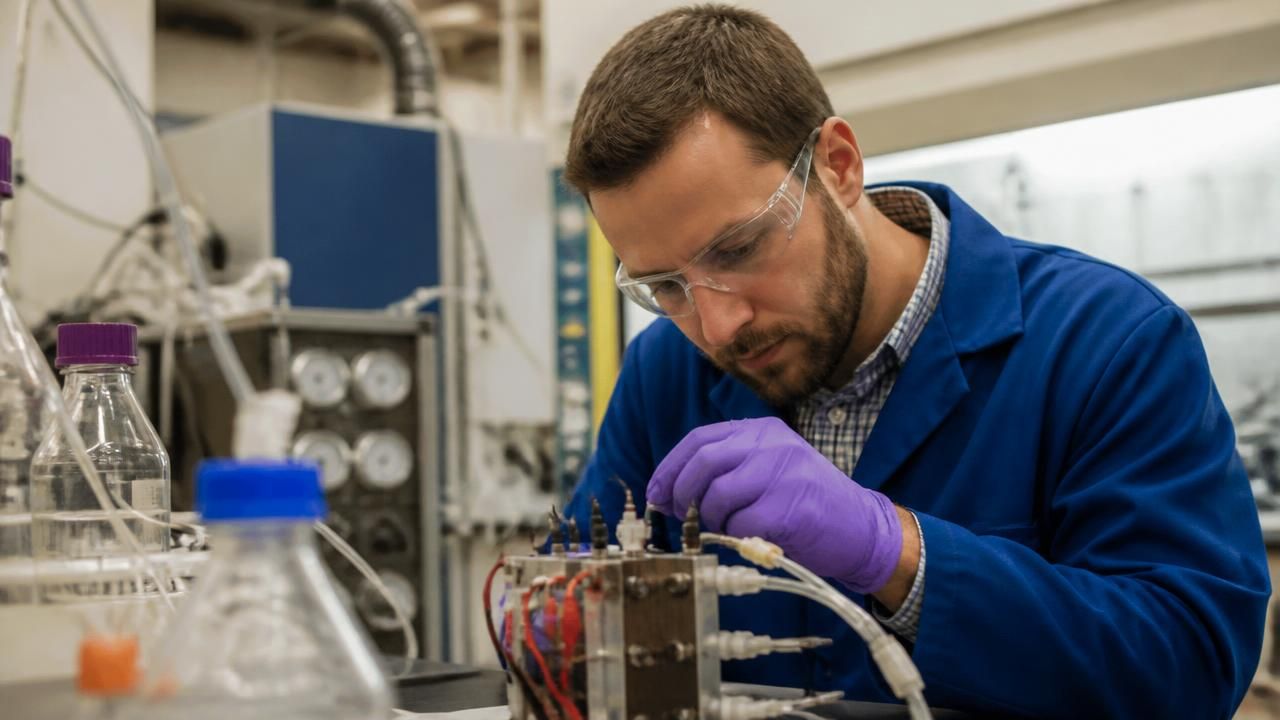
A new study led by James Buchen of the University of Delaware proposes a different route. Rather than cycling a solid or a liquid, Buchen's team built a battery-based electrochemical device that moves carbon dioxide through a cell as part of its normal charge-and-discharge chemistry. The researchers argue their approach is more viable than previous battery-based attempts and could require less energy — and therefore cost less — than the reversible-filter designs that currently dominate the field.
How a battery captures carbon
The mechanism hinges on ordinary acid-base chemistry, repackaged inside an electrochemical cell. At the cathode, the device produces hydroxide ions. Those hydroxides react readily with carbon dioxide, converting the gas into carbonate or bicarbonate. The charged carbonate species then migrates across a separator membrane to the anode.
At the anode, the environment is more acidic. That lower pH reverses the reaction: carbonate turns back into CO2 gas, which can be collected as a concentrated stream rather than released back into the atmosphere. The cathode's job is to make hydroxide; the anode's job is to consume it. Carbon dioxide, in effect, is pumped across the battery by the same ion flow that carries the cell's current.
It has the potential to require less energy—and therefore be cheaper—than the reversible-filter designs that currently dominate.
Why the energy question dominates
Direct air capture has always been a thermodynamics problem dressed up as an engineering one. CO2 makes up roughly 0.04 percent of the atmosphere, so any capture system must process enormous volumes of air to yield a modest amount of gas. Then it must release that gas — a step that traditionally means heating the sorbent, often to temperatures that eat up much of the system's lifetime energy budget.
That is why electrochemical approaches attract attention. Instead of paying for heat, they pay for electrons, and electrons can come from increasingly cheap renewable generation. If a cell can capture CO2 while being charged and release it on discharge, the process can in principle be driven by fluctuating wind and solar power, turning an intermittent supply into an advantage rather than a liability.
The economic stakes are substantial. Governments and investors have poured billions into direct air capture, betting that it will be needed to offset emissions from sectors — aviation, cement, steel — that are hard to electrify. But the industry's credibility rests on bringing costs down from hundreds of dollars per tonne toward the roughly $100-per-tonne target that public research programs have set. Every credible pathway to lower energy demand matters.
Four outlets, four framings
The way this research has circulated says as much about the media landscape as it does about the science. Technical outlets such as Ars Technica have focused on the chemistry — hydroxide at the cathode, carbonate transport across the membrane, pH-driven reversal at the anode — treating the story as a materials-science advance with a clear comparator in existing sorbent systems.
Consumer-facing aggregators have leaned on the headline-friendly framing: a device that "sucks carbon dioxide directly out of the air," a phrase that trades mechanistic detail for immediate legibility. Nanowerk's headline went further, describing a "gas battery" that "captures greenhouse gases and converts them into electricity," emphasizing energy output rather than capture cost — a reminder that the same laboratory result can be read as a climate tool, a power source, or both. And research portals such as Nature's carbon capture and storage channel situate the work within a much longer stream of peer-reviewed literature, where individual papers are incremental steps rather than breakthroughs.
The open questions
Several hurdles remain before battery-based capture can compete outside the lab. Longevity is one: electrochemical cells degrade, membranes foul, and a device that performs well over dozens of cycles may behave differently over thousands. Selectivity is another — real flue gas and real ambient air contain oxygen, water vapor, and trace contaminants that can interfere with the intended chemistry.
- Energy per tonne: whether the cell's voltage and current requirements genuinely beat thermal sorbent regeneration at scale.
- Durability: how many cycles the electrodes and separator can survive before efficiency drops.
- Purity: whether the collected CO2 stream is concentrated enough for sequestration or industrial reuse.
- Cost: whether cheaper electricity, not just cheaper hardware, is enough to close the gap.
None of these questions have definitive answers yet. What the Delaware work offers is a proof of concept with a favorable energy profile — the kind of incremental result that, repeated across dozens of labs, slowly turns an expensive curiosity into infrastructure. For a technology whose entire value proposition depends on the price of removing a single tonne of gas, that arithmetic is the whole story.