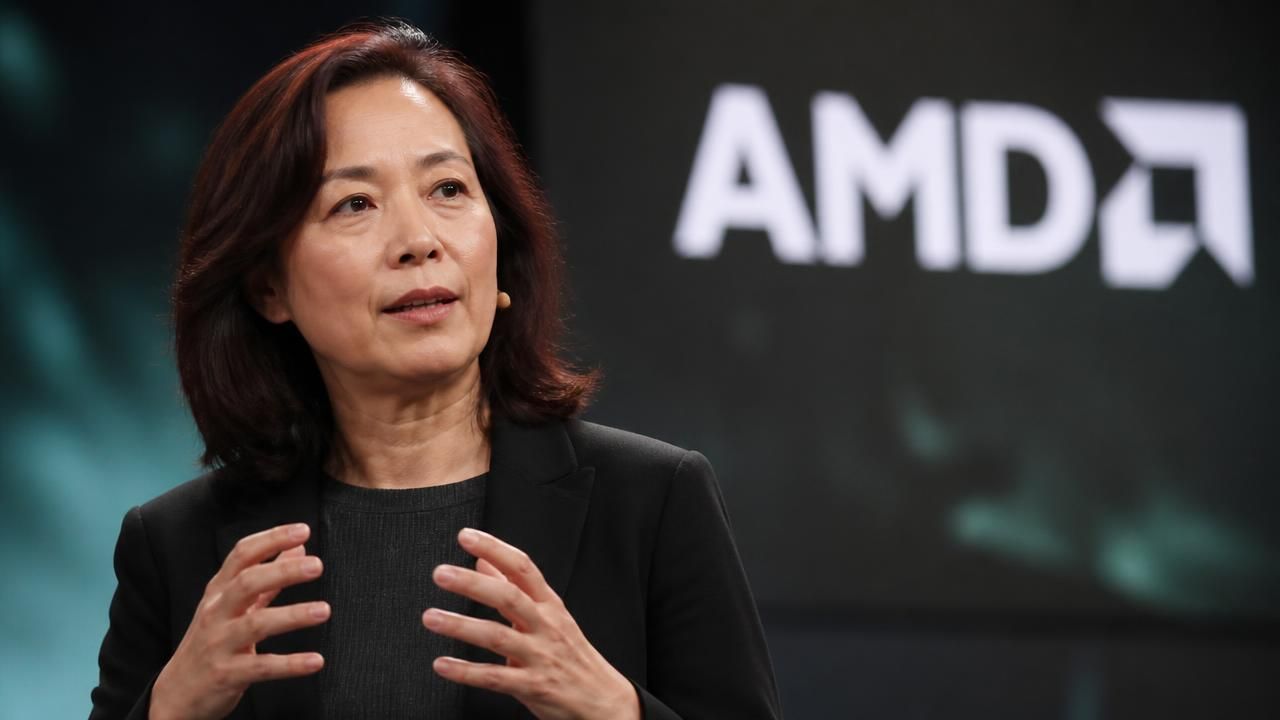
AMD announced Tuesday that it will acquire World Labs, the artificial intelligence research lab co-founded by Stanford professor Dr. Fei-Fei Li, in an all-stock transaction valued at approximately $8.2 billion. The deal, expected to close by the end of the year, marks one of the largest acquisitions of a pure AI research startup and instantly reshapes AMD's ambitions beyond the data-center chips that have driven its recent growth.
Under the terms disclosed by the company, World Labs' entire team will remain intact and "continue to focus on advancing AI model research." Li, who co-founded the lab in 2024 and has served as its CEO, will become executive vice president and chief scientist at AMD, reporting directly to chief executive Lisa Su.
"The World Labs team will continue to focus on advancing AI model research" as part of AMD, the company said in announcing the deal.
A Meteor Rise From Launch to $8 Billion
World Labs' trajectory has been unusually steep even by the standards of the current AI boom. The company launched in 2024 and, within months, was valued at roughly $1 billion, making it a rare female-led unicorn in a field dominated by giants such as OpenAI, Anthropic and Google DeepMind.
The lab's first commercial product, a world generation model called Marble, arrived in 2025. Marble lets users generate interactive, navigable 3D environments from a simple text prompt — a capability often described as "world models" or spatial intelligence. The technique sits at the crossroads of generative AI and computer graphics, and is widely seen as foundational to robotics, simulation, gaming, and the training of embodied agents.
Why AMD Wants a Research Lab
AMD has spent the past several years positioning itself as the primary challenger to Nvidia in the market for AI accelerators. Its MI-series GPUs and Instinct data-center products have won marquee customers, and Lisa Su has repeatedly framed AI as the company's central growth engine. Yet the acquisition of a model-research lab — rather than another chip or software-tooling company — signals a different kind of bet.
By acquiring World Labs, AMD moves up the stack. Instead of selling only the silicon on which models run, it gains a team that builds the models themselves — and, crucially, the person widely credited with helping ignite the modern deep-learning era.
From ImageNet to the 'Godmother of AI'
Li's reputation rests on ImageNet, the vast labeled image dataset she spearheaded in the late 2000s. That project is widely regarded as the catalyst for the deep-learning revolution that followed, when neural networks began beating human benchmarks in image recognition. She has since led Stanford's Institute for Human-Centered AI (HAI) and become one of the most visible voices calling for AI development that remains accountable to human needs.
Her move into a corporate chief-scientist role is notable precisely because she has been a prominent advocate for academic independence and public-interest AI research. The appointment gives AMD a scientific figurehead with rare credibility on both technical and policy questions.
How the Market Read the News
Coverage of the deal split along familiar lines. Technology outlets, led by The Verge, emphasized the strategic and human dimensions — the $8.2 billion price, Li's elevation, and the promise of continued frontier research. Business and market-focused publications, including Bizjournals and Blockonomi, led instead with the stock reaction: AMD shares fell on the announcement, as investors weighed dilution from an all-stock structure and questioned the near-term revenue contribution of a research lab.
That divergence reflects a genuine tension. The acquisition is expensive relative to World Labs' commercial footprint — Marble is young, and its enterprise revenue is unproven. In an all-stock deal, existing AMD shareholders absorb the dilution while waiting for returns that may be years away. Analysts pressing AMD for near-term margins on AI accelerators may not see World Labs as a quick win.
The Strategic Logic
Viewed over a longer horizon, however, the rationale is clearer. World models are increasingly regarded as the next frontier: training AI systems that understand physics, space, and cause-and-effect is essential to robotics, autonomous systems, and the kinds of simulation-heavy workloads that consume enormous compute.
- Talent: AMD acquires a research organization and a marquee scientific leader in a single transaction.
- Vertical integration: Chip design plus model research lets AMD co-optimize hardware and software, mirroring Nvidia's strategy.
- Product pipeline: Marble and successor world models could seed new markets in simulation, gaming, and embodied AI.
- Narrative: AMD positions itself as a full-stack AI company rather than a component supplier.
What Comes Next
The deal still requires customary regulatory approvals, though antitrust scrutiny is likely to be lighter than for a merger among direct chip rivals, since AMD and World Labs do not currently compete head-to-head. If it closes on schedule, World Labs will become AMD's principal AI research arm, with Li building out a scientific organization inside a public company.
The open question is culture. Can a lean, fast-moving research lab preserve its exploratory character inside a large semiconductor firm with quarterly earnings pressure? AMD is betting $8.2 billion that the answer is yes — and that the race for AI leadership will be won not only by whoever builds the fastest chip, but by whoever teaches machines to understand the world.