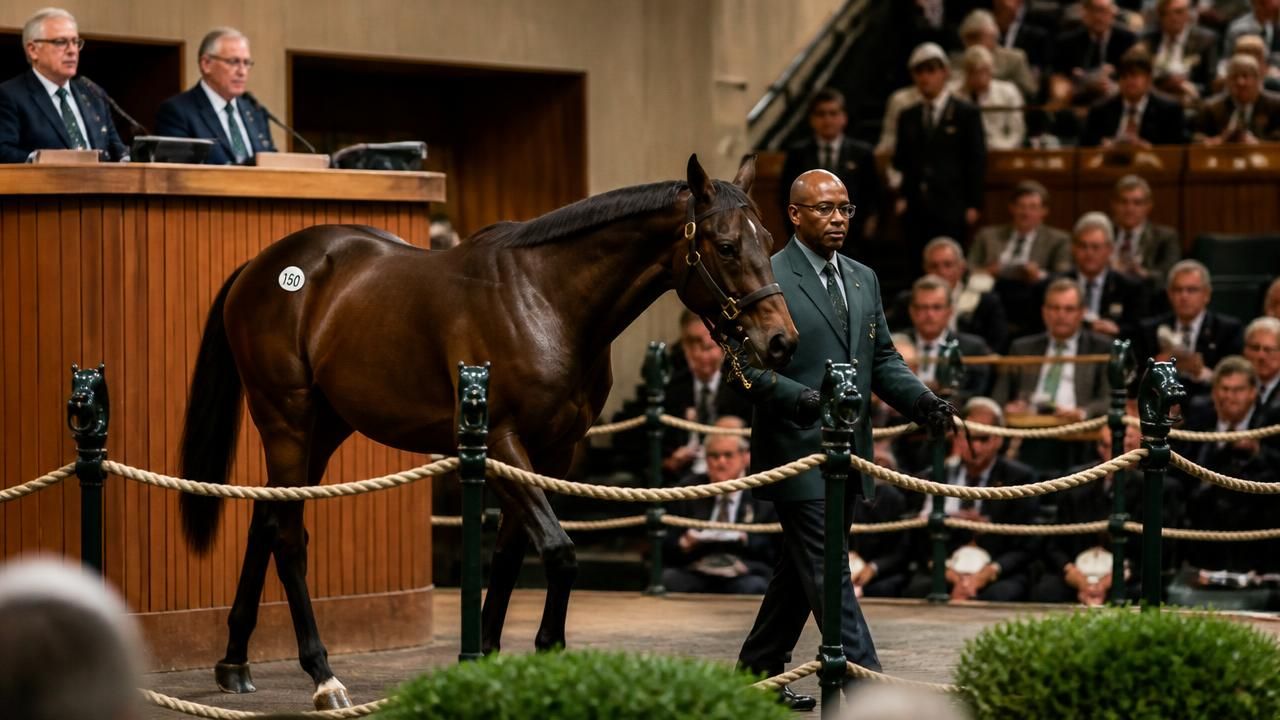
LEXINGTON, Ky. — Keeneland's September Yearling Sale, the largest horse auction on the planet, opened its 83rd edition this week with figures climbing across the board and management predicting the event will surpass $550 million in total sales before the gavel falls for the final time.
Shannon Arvin, the track and auction house's chief executive, said the sale is running 3% to 4% ahead of last year's pace — a notable achievement given that the 2024 edition already posted a 24% year-over-year gain. If the projection holds, Keeneland will cement its position as the world's preeminent bloodstock marketplace, outpacing rival sales in Europe, Australia and the Middle East.
"The yearling sale is running ahead of last year's pace and is on track to top $550 million, making it the largest horse sale in the world," Arvin said in an interview with Romaine Bostick on Bloomberg's "The Close."
Opening Day Sets the Tone
The auction's first session generated $71,770,000 in total sales, according to figures reported Monday, with gains registered across every major metric — gross receipts, average price per horse and median. That broad-based strength, rather than a single headline-grabbing lot, is what consignors and analysts point to as evidence that demand is deep rather than concentrated among a handful of elite buyers.
The momentum carried into Tuesday, with the second day of selling described as reaching new heights for the sale. Keeneland does not publicly release a running commentary on individual sessions in real time, but the pattern — a strong opening followed by an even stronger second day — mirrors the structure that has defined recent September auctions, where buyers with the deepest pockets typically wait for the upper tiers of the catalog to come under the hammer.
A Catalog Built for Scale
Keeneland cataloged 4,635 horses for this year's September sale, a volume that underscores both the auction's logistical scale and the breadth of the Thoroughbred breeding industry that supplies it. The sale runs across multiple books, with the most commercially prized pedigrees clustered in Book 1 and progressively more modest offerings in later books.
Even as this year's auction unfolds, Keeneland is already laying groundwork for 2026. The company confirmed it has added two horses to Book 1 of next year's September Yearling Sale — an early signal that consignors remain eager to place elite prospects at the top of the market rather than defer them to later sessions.
Why Demand Keeps Climbing
The strength of the September sale sits against a broader backdrop of robust spending in the Thoroughbred sector. Record purses at major tracks, fueled by casino and historical-horse-racing revenue in several states, have raised the ceiling on what a successful racehorse can earn. That, in turn, justifies seven-figure prices for yearlings with standout pedigrees.
- Purse inflation: Bigger race-day payouts increase the expected return on bloodstock investment.
- Global bidding: Buyers from Europe, Japan, the Middle East and Australia routinely compete at Keeneland, adding currency and demand diversification.
- Supply discipline: The Thoroughbred foal crop has been relatively stable, keeping quality lots scarce relative to buyer appetite.
- Two-year streak: A 24% gain last year followed by a further 3% to 4% rise suggests sustained, not speculative, interest.
How the Story Is Being Framed
Coverage of the sale has varied by outlet and by where in the auction calendar the reporting fell. Financial media, led by Bloomberg's interview with Arvin, has framed the story around the headline number — the $550 million projection and Keeneland's status as the world's largest sale — positioning the auction as a barometer of discretionary wealth and alternative-asset spending.
Trade and regional outlets have taken a more granular approach, emphasizing session-by-session results: the $71.77 million opening-day gross, the across-the-board increases recorded Monday, and the second-day surge that followed. That framing speaks to an audience of breeders, consignors and agents for whom the direction of the average and median — not the total — determines whether the market is genuinely healthy or merely top-heavy.
Still other coverage is forward-looking. Reports that Keeneland has already added two horses to Book 1 of the 2026 sale treat this year's auction as a baseline rather than an endpoint, reflecting an industry that plans its breeding and selling cycles years in advance.
The Bigger Picture
The September Yearling Sale functions as something close to a national economic indicator for Kentucky's equine sector, which supports tens of thousands of jobs across breeding farms, veterinary practices, transport, insurance and hospitality. A sale that clears $550 million — the vast majority of it spent within a few weeks in the Bluegrass region — ripples well beyond the auction ring.
For Arvin, who has led Keeneland through a period of both expansion and scrutiny, the result is also a validation of the company's strategy of investing in the sales grounds, digital bidding infrastructure and international buyer outreach. Whether the final tally lands above or below the $550 million mark, the trend line heading into the final sessions points in one direction — and the industry will be watching to see whether the momentum carries into 2026.