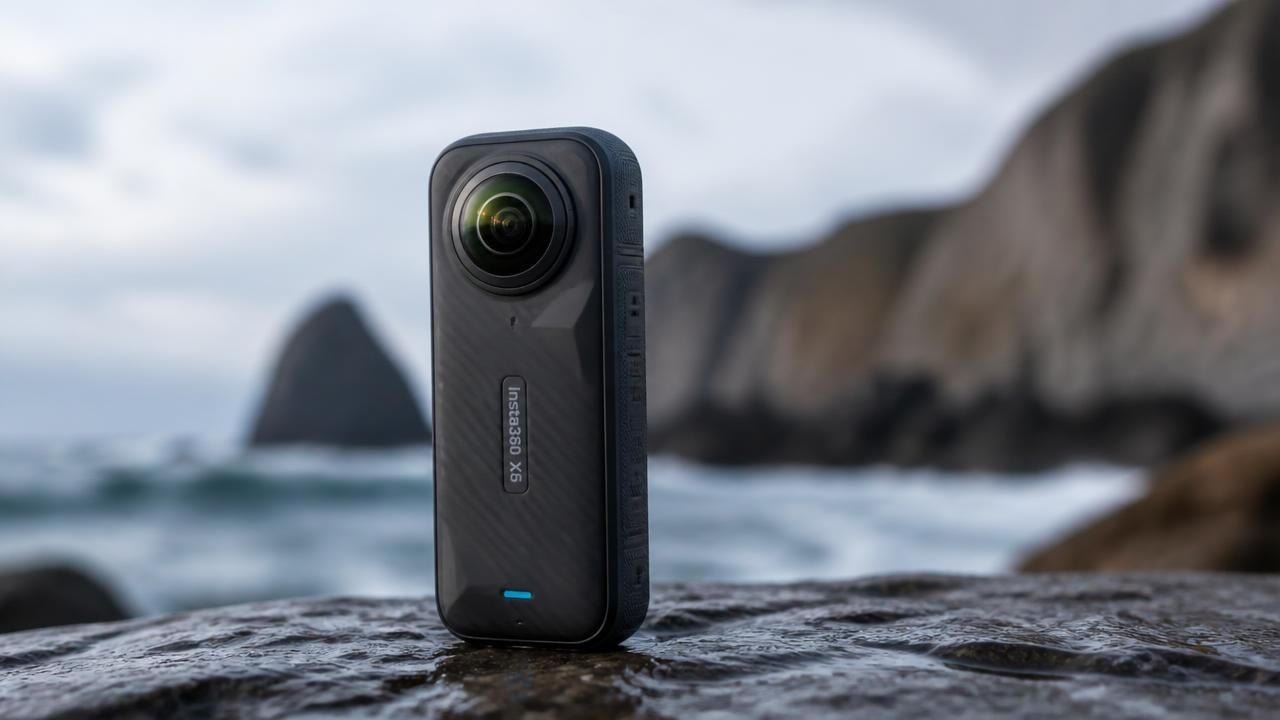
Insta360 has launched the X6, its new flagship 360-degree camera, positioning it as a hybrid 360-and-action device that pairs significantly larger image sensors with a body smaller than its predecessor. The launch marks the company's most aggressive attempt yet to move a format long dismissed as a novelty into the mainstream production toolkit — and it arrives at a moment when Insta360's dominance of the category is close to absolute.
According to The Verge, Insta360 now commands roughly 73 percent of the worldwide 360-camera market. It didn't invent the shoot-first-frame-later concept, but it has become so synonymous with it that the product category and the brand are effectively interchangeable. The company recently shipped its 10 millionth camera and opened its first flagship United States retail store in New York City's Times Square — a physical statement of intent in a market where most competitors sell exclusively online.
The scale of the operation is also visible in the company's supply chain. Insta360 disclosed spending $298 million on memory chips alone — a single-component outlay larger than the entire valuation of GoPro, the company that once defined the action-camera market.
What the X6 Actually Changes
Leaks and filings tracked by Android Authority and Gizmochina flagged the X6's arrival weeks ahead of launch, with FCC approval paperwork confirming a redesigned chassis and 8K capture. The Verge's early reporting described the headline hardware shift plainly: bigger sensors in a smaller design, a combination that has historically forced camera makers to choose one or the other.
The practical result, according to early hands-on coverage, is smoother 8K footage with better low-light performance than the X5 it replaces. Mashable framed the launch as the arrival of Insta360's flagship 8K 360-degree camera, while reviews consistently emphasized the dual identity of the device.
Five Upgrades That Matter
A direct X5-versus-X6 comparison published by MSN distilled the generational jump into a handful of meaningful improvements, arguing that most of the spec-sheet noise matters far less than a few specific changes:
- Larger sensors that improve dynamic range and performance in dim conditions
- A more compact, lighter body that makes the camera easier to mount and carry
- Improved 8K video stabilization and smoother stitching between the two lenses
- Better battery and thermal behavior for longer continuous recording
- Refined action-camera features that reduce the need to carry a second device
A Crowded Field and a Price Fight
Insta360's position is strong but not uncontested. Geeky-Gadgets, reviewing the competitive landscape, highlighted that DJI's Osmo 360 II offers 8K at 60 frames per second for $499 — framing it as an undercut of the X6 on both headline frame rate and price. The comparison captures the central tension in the category: 360 capture is becoming a commodity fight over sensors, frame rates, and dollars, even as Insta360 tries to argue the battle is really about software and workflow.
How the Reviews Frame It
The most striking thing about the X6's reception is the near-uniform refusal to treat it as a gadget. Forbes titled its review with the verdict that improved visuals mean the camera is “no longer just for play,” positioning it as a credible tool for professional and semi-professional work rather than a toy for skiers and skateboarders.
WIRED called the X6 “a great 360 and action camera hybrid” — a verdict that speaks to the device's core strategic bet: that buyers would rather carry one camera that does both jobs than two that each do one.
PetaPixel went further, arguing in its headline that Insta360 wants the X6 to be “way more than a 360-degree camera.” Android Authority's review struck the same note, describing a company determined to sell “the camera that can replace them all” — and conceding that it might actually succeed. The consistency across outlets with very different audiences suggests the X6's pitch is landing with more than just the 360-video faithful.
The Bigger Ambition: Glasses and the Camera Giants
Perhaps the most consequential signal came from The Verge, which reported that Insta360 is thinking well beyond two hemispherical lenses on a stick. The company is exploring wearable eyewear, an area where Meta and others are already investing heavily, and is openly eyeing a challenge to incumbent imaging giants such as Canon and Sony.
That ambition reframes the X6 not as an endpoint but as a foundation. A dominant position in 360 capture gives Insta360 something the traditional camera makers lack: a software pipeline built for computational reframing, automatic subject tracking, and footage that is edited after the fact rather than composed in the moment. Those capabilities translate naturally to glasses, where a wearer cannot aim a lens at all.
Why This Matters
The 360-camera market has spent a decade as a niche within a niche, popular with extreme-sports creators, real-estate virtual tours, and the occasional ambitious music video. The X6's reception suggests the technical barriers that kept it there — resolution, sensor size, bulk, and battery life — are finally falling away at the same time that AI-assisted editing tools make reframed footage far easier to work with.
For competitors, the message is uncomfortable. Insta360 is spending at a scale its rivals cannot easily match, is vertically integrating its own software, and is now building retail presence in the world's most visible shopping district. For buyers, the immediate beneficiary is the price-performance curve: DJI's aggressive $499 positioning already shows that the fight for the 360 market is going to be settled on value as much as on specifications.
What remains unresolved is whether the X6 can convert market share into something more durable. Dominating a category that is itself still small is not the same as winning the broader camera business, and the eyewear bet — if it materializes — puts Insta360 against some of the best-capitalized hardware companies on earth. But as a statement of trajectory, the X6 is unambiguous: the company that owns 360 capture has no intention of staying inside that box.