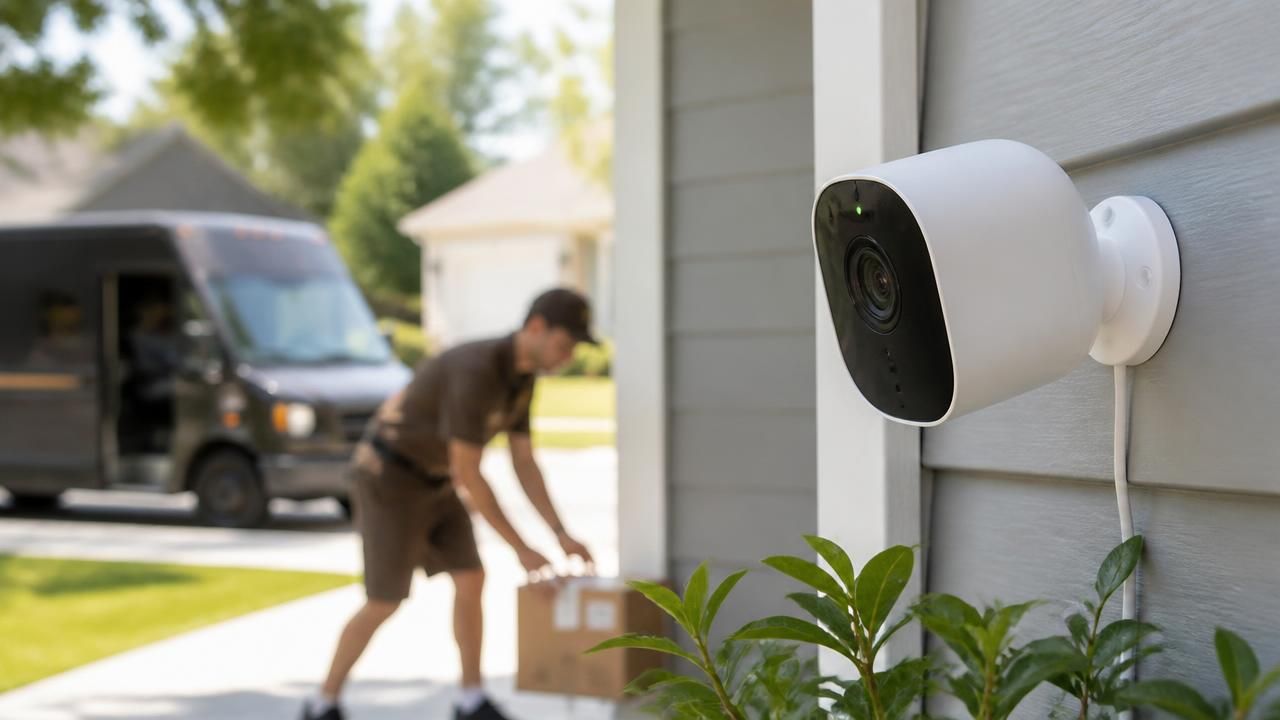
The pitch is seductive: a security camera that doesn't just tell you "motion detected," but tells you what it saw. A dog trotting across the yard. A delivery driver leaving a package. A raccoon knocking over the recycling bin at 2 a.m. Apple, Google, and Amazon have all spent the past two years racing to bolt generative AI onto their home cameras, promising to replace a firehose of useless push alerts with a single, human-readable sentence.
But as reviewers and analysts dig into Apple's newest home-camera features, a second story is emerging — one about money. The intelligence may be baked in, but the storage, the clip history, and the advanced detection tiers increasingly sit behind iCloud+ subscriptions that climb as high as $60 a month.
A Smarter Camera, If It Can Load
The Verge's Jennifer Pattison Tuohy put the three rival systems head-to-head, wiring up Google's Nest Doorbell, Aqara's HomeKit-compatible G400, and Ring's Pro 4K to compare Gemini for Home, Apple Intelligence for Home, and Amazon's Ring AI in real-world conditions. Her framing was personal: a memory of a beachside Easter egg hunt years ago, phone buzzing relentlessly with "motion detected" alerts that turned out to be nothing, each clip refusing to load as her kids filled their baskets.
That frustration — notification fatigue plus playback lag — is precisely what the AI layer is meant to cure. And in Tuohy's testing, it largely does. Instead of a generic alert, the systems generate natural-language summaries that describe the scene in a sentence, letting users triage without opening a single clip.
AI-powered text descriptions paint the whole scene in a sentence.
The gains, however, are uneven, and the trade-offs differ by ecosystem. Google's Gemini for Home leans on the company's broader assistant stack; Ring's AI plays to Amazon's long lead in camera hardware and its enormous installed base; Apple's approach ties the intelligence tightly to on-device processing and iCloud — a privacy-forward design that is also, by design, a subscription funnel.
The iCloud Storage Tax
That funnel is where the tone of coverage diverges sharply. Digital Trends did not mince words, framing Apple's rollout around what it called a "bizarre iCloud storage tax" — the requirement that users pay for cloud tiers to unlock the features that make the cameras worth owning. The Verge's own headline was blunter still: Apple Home's new security camera features, it reported, cost as much as $60 a month.
The mechanics are familiar to anyone who has used HomeKit Secure Video. Camera clips and AI-generated activity descriptions require an iCloud+ plan, and the tiers scale with how many cameras you run and how much history you want to keep. Apple's top consumer tiers reach $59.99 a month for 12TB of storage — the same figure that anchors the $60-a-month framing.
Critics argue this is a quiet shift in the economics of home security. The camera is a one-time purchase; the intelligence is a recurring bill. Over a five-year lifespan, a single subscription can easily eclipse the hardware itself — and because the AI descriptions depend on cloud processing and storage, there is no meaningful way to opt out while keeping the features.
Defenders counter that the cost is transparent, that competitors impose similar fees, and that Apple's privacy posture — processing as much as possible on-device and encrypting what travels to iCloud — is a genuine differentiator in a category where customers are literally pointing cameras at their front doors.
How the Big Three Stack Up
- Apple: Tightest hardware-software integration, strongest privacy story, steepest practical cost once storage tiers are factored in.
- Google: Gemini for Home benefits from the broadest assistant ecosystem; Nest hardware remains a default for many households.
- Amazon: Ring's advantage is sheer scale and an entrenched install base, with AI summaries layered onto a mature camera lineup.
The competitive question is no longer whose camera has the best sensor. It is whose AI produces the fewest false alarms, whose clips load fastest, and whose subscription feels least like a toll booth.
The Road Ahead: Hardware Built for AI
Apple, notably, is not content to let third-party HomeKit cameras carry its AI story. According to MacRumors, the company is developing its own AI-powered home security camera alongside a companion service, with plans pointing toward a 2027 window. That timeline aligns with Apple's broader smart-home ambitions: a revamped Siri, a home hub device, and an ecosystem designed so that the camera, the intelligence, and the subscription are all Apple's.
If that vision lands, 2027 could mark the moment Apple stops renting shelf space in other companies' security setups and starts competing directly with Ring and Nest — a shift that would make the subscription economics even more central to the pitch.
What It Means for Buyers
For now, consumers face a genuinely new kind of decision. The AI descriptions are a real improvement over motion spam, and early testing suggests they work. But the value proposition depends entirely on which ecosystem you already live in, how many cameras you own, and whether you are willing to treat home security as a monthly line item rather than a one-time purchase.
The race between Apple, Amazon, and Google is often framed as a battle over silicon and sensors. In practice, it is being fought over cloud storage tiers and the willingness of homeowners to keep paying for intelligence they have already bought.