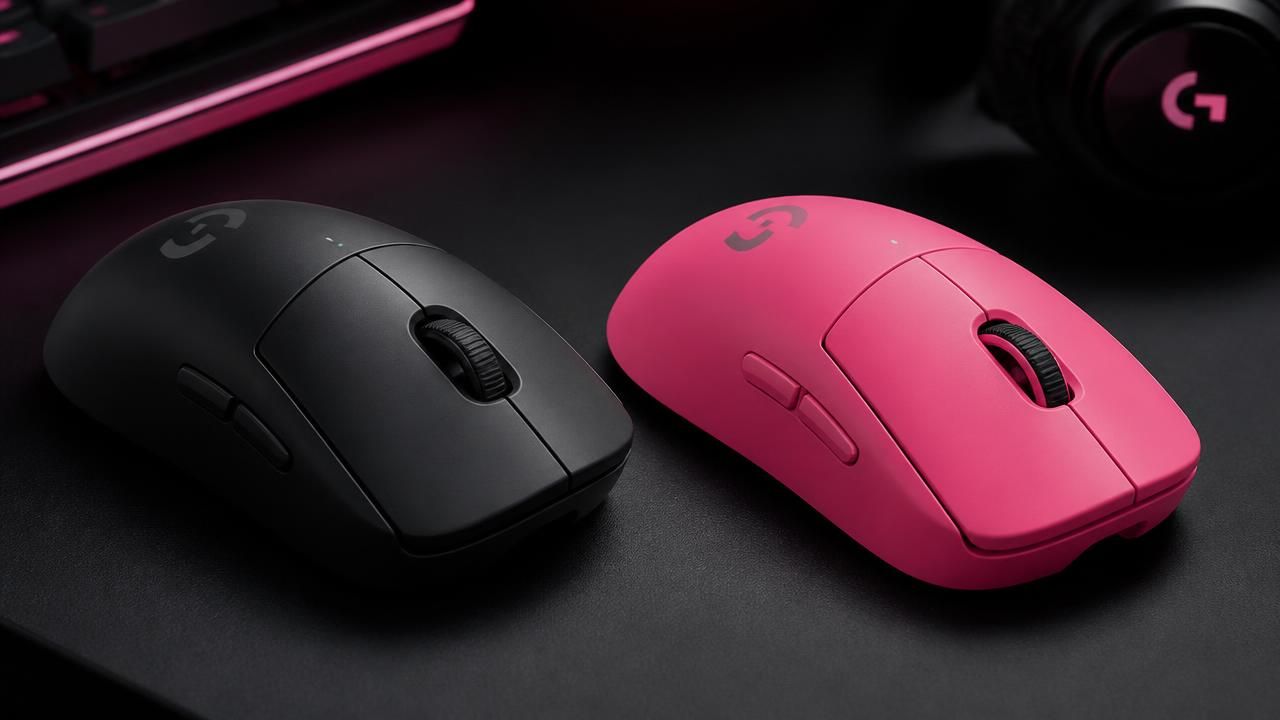
Logitech is pressing forward with the most unconventional idea to hit the gaming mouse market in years. The company confirmed that the G Pro X3 Superstrike — a refined version of its switchless, haptics-driven flagship — will launch on October 6 for $199.99, arriving in a bold pink finish or a more understated black. The original G Pro X2 Superstrike, which debuted in February, will remain on sale at $179.99, including its "lunar eclipse" colorway.
The announcement cements Logitech's commitment to a design philosophy that abandons the mechanical switches found in virtually every other competitive mouse. Instead of a traditional click mechanism, the Superstrike line places haptic actuators beneath the two primary buttons, paired with inductive sensing. Logitech says the arrangement reduces latency while allowing players to tailor the feel of every click — from a barely perceptible tap to a sharp, jolty snap, or no tactile feedback at all.
A Modest Upgrade, Not a Reinvention
The Verge was blunt in its framing, describing the X3 as "more like a 1.5 rather than a true successor" and noting that Logitech's new flagship is "a little better and $20 more." That characterization is likely to define early reaction: the core technology is unchanged, the improvements are incremental, and the price gap between generations is now a meaningful $20.
Still, the X3's existence signals that Logitech views the February launch as a success worth iterating on rather than an experiment to be quietly retired. Keeping the X2 in the lineup at its original price also gives buyers a genuine choice — the company is effectively running two tiers of the same idea simultaneously, unusual for a product line that historically replaced itself outright.
The Case For — and Against — Haptic Clicks
Reviewers have split sharply, and the division is instructive. PCGamesN treated the X2 as a landmark release, with one review taking a full month to write because, in the site's words, "this is a true game-changer" — language rarely applied to peripheral hardware. IGN's assessment focused on personalization, arguing that the ability to customize the click itself is the mouse's most compelling feature, not its latency figures.
"I admire Logitech's attempt to revolutionize the gaming mouse — but I'm not quite sold on its haptics just yet."
That verdict, from a widely syndicated review, captures the counterargument: removing mechanical switches solves a problem many players do not believe they have. Muscle memory built over two decades of mechanical clicks is not easily discarded, and a customizable click can just as easily feel like an unnecessary variable as a competitive edge.
Notebookcheck highlighted the technical underpinnings — inductive mouse buttons working alongside haptic feedback — while BetaNews framed the product's pitch around the same central trade: a $179.99 mouse that "ditches mechanical switches for haptic clicks." The throughline across outlets is that the technology is real, differentiated, and genuinely novel; what remains unsettled is whether it is better in the way that matters to competitive players.
India and the Global Rollout
Logitech's ambitions are not confined to North America and Europe. The G Pro X2 Superstrike launched in India, bringing haptic click technology to one of the world's fastest-growing PC gaming markets. That move matters commercially: esports infrastructure in the region has expanded rapidly, and peripherals priced above $150 have found a receptive audience among enthusiasts and aspiring professionals.
A simultaneous push across established and emerging markets suggests Logitech is treating haptics as a platform rather than a one-off gimmick. Each additional region recruited to the format increases the odds that third-party developers and game studios consider building click-feedback profiles into their titles — the kind of ecosystem lock-in that turns a feature into a standard.
Why It Matters Beyond One Mouse
Peripherals are a conservative category. Sensor upgrades, weight reductions, and wireless improvements have driven competition for years, but the fundamental click has remained mechanically identical since the 1980s. A switchless design that substitutes software-defined feedback is a structural change, not a spec bump.
- Latency: Logitech claims actuation without mechanical travel reduces input delay.
- Customization: Click feel is adjustable per user, and can be disabled entirely.
- Durability: Eliminating mechanical switches removes a known failure point — double-clicking — that has plagued high-end mice for years.
- Price: The X3's $199.99 sticker pushes Logitech's flagship above a psychological threshold its rivals largely avoid.
That durability argument may ultimately prove the most persuasive to skeptics. Mechanical switch degradation is one of the most common reasons competitive players replace mice, and a design without switches theoretically sidesteps it. If the X3 demonstrates longevity in the field, the debate shifts from feel to reliability — a far more favorable battleground for Logitech.
The Road Ahead
For now, the Superstrike line sits in a familiar position for genuinely new hardware: praised for ambition, questioned on necessity, and priced for early adopters. The X3's October 6 release will test whether a second generation — even a modest one — can convert curiosity into adoption.
What is no longer in question is that Logitech intends to keep pushing. With the X2 remaining available at $179.99, the company has created an unusually low-stakes entry point into its haptic ecosystem, preserving an on-ramp for players unwilling to pay the new premium. Whether the click of the future is silent, jolty, or something in between, Logitech has decided it will at least be programmable.