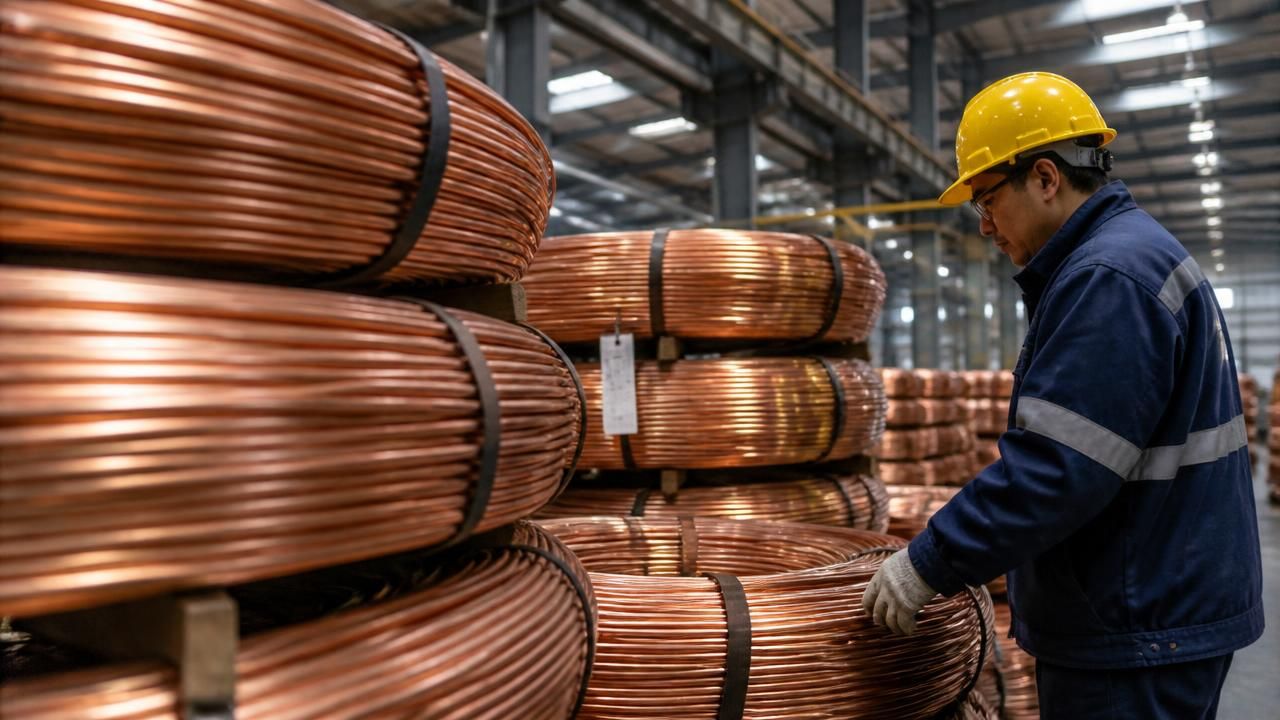
Copper extended its advance for a sixth consecutive session on Tuesday, with London prices pressing toward an all-time high and New York futures notching a fresh record, as a combination of shrinking inventories, seasonal buying in China and the threat of US import tariffs tightened the global market for the industrial metal.
Benchmark copper on the London Metal Exchange climbed toward its previous peak, while COMEX futures in New York — the venue most directly exposed to American trade policy — pushed into uncharted territory. The two contracts have diverged sharply, with the US benchmark trading at a historically wide premium to the global LME price.
A Physical Market That Is Running Dry
The immediate trigger, according to market participants, is the state of China's spot market. Inventories held in exchange warehouses and bonded depots have fallen steadily in recent weeks, leaving consumers and traders scrambling for near-dated material.
“Falling inventories and pre-holiday buying signaled tightening supplies in China's physical market.”
That description, which has circulated widely among traders and was captured in early market coverage by Bloomberg, captures the prevailing read: this is not simply a financial-market phenomenon driven by speculative positioning, but a genuine squeeze in the metal that fabricators need to make wire, cable, motors and pipe.
Pre-holiday restocking
Part of the demand pull is calendar-driven. Chinese manufacturers typically build inventories ahead of major national holidays, when factories slow and logistics networks thin out. With inventories already low, that routine restocking has an outsized effect on prices — every additional tonne purchased removes supply that was already scarce.
A thin cushion for error
The problem is amplified by how little slack exists in the system. Unlike oil, where producers can often lift output in response to price signals, copper supply responds slowly. New mines take years, sometimes decades, to permit and develop, and ore grades at major deposits have been declining. That structural rigidity means modest shifts in demand can produce violent moves in price.
The Tariff Overhang
The second force at work is Washington. Fears that the United States could impose tariffs on copper imports have pulled metal into American warehouses ahead of any potential duty, inflating COMEX prices relative to the global benchmark and draining supply from other regions.
The dynamic is a familiar one from recent years: when a tariff is anticipated, the arbitrage between the protected and unprotected market widens, and traders race to front-run the deadline. The result is a two-tier global market — one price for America, another for everywhere else — and a persistent incentive to divert cargoes toward US ports.
Several outlets framed the story around this interplay of forces. Bloomberg emphasized the near-term tightness in the physical market, while Yahoo Finance coverage led with the tariff dimension, describing copper as “ascending to new heights on tight supply and tariff fears.” Businessworld took a similar line, headlining the record as a function of “tight supply” and “US tariff fears.” MSN and other aggregators focused on the simplest headline fact: copper was rising for a sixth straight day on signs of tightening Chinese supplies.
Why Copper Keeps Setting Records
Beneath the daily swings lies a longer-term revaluation of the metal. Copper is the backbone of electrification. It is used roughly twice as intensively in an electric vehicle as in a conventional one, it underpins grid expansion and renewable energy installations, and it is essential to the data centers powering the artificial intelligence boom.
- Electric vehicles: Each EV requires substantially more copper wiring than a comparable internal-combustion car.
- Grid investment: Aging networks in the US, Europe and China require trillions of dollars of transmission and distribution upgrades.
- Data centers: Power distribution, cooling and cabling for AI facilities are copper-intensive.
- Supply constraints: New mining projects face permitting delays, community opposition and declining ore grades.
Analysts have long argued that these demand vectors collide with a supply pipeline that cannot keep pace. Every rally, in this view, is less an anomaly than an early reading of a structural deficit.
What to Watch
The near-term path depends on several variables. First, whether Chinese inventories continue to fall after the holiday period — a rebuild would ease the squeeze and cool prices. Second, whether Washington formalizes tariffs or leaves the threat unresolved; a decision either way would reshape the COMEX-LME spread. Third, the direction of the dollar, which typically moves inversely to dollar-denominated commodities.
For industrial consumers, the practical question is hedging. Fabricators who locked in prices earlier in the year are protected; those buying at spot now face elevated costs that will eventually feed into the price of wire, cable and finished goods — and, with a lag, into headline inflation.
For investors, copper's run raises a familiar dilemma: chasing a record is uncomfortable, but the fundamental case — electrification demand meeting inelastic supply — remains intact. The metal's latest high is a snapshot of a market that is tight today and structurally tighter tomorrow.