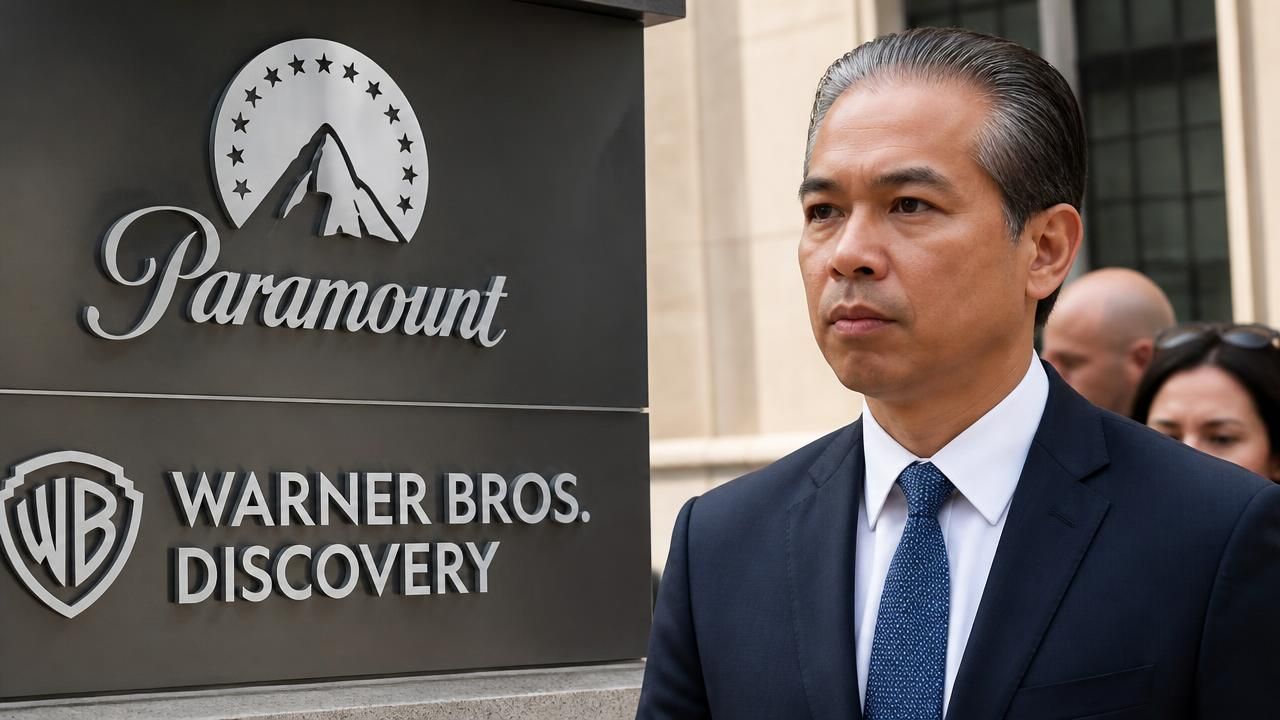
Paramount's long campaign to acquire Warner Bros. Discovery — a $111 billion union that would redraw the map of Hollywood — has narrowed to a single, contentious bottleneck: a dozen Democratic state attorneys general who sued to block it on antitrust grounds. This week, that bottleneck showed signs of cracking, then briefly seized up again, as settlement talks lurched between reported breakthroughs and a public walkout by California Attorney General Rob Bonta.
At the center of the standoff is David Ellison, the Paramount CEO who has spent months clearing regulatory and financial hurdles, only to find the final one — a multistate antitrust lawsuit — the hardest to surmount. According to reporting across multiple outlets, Paramount's owners have offered a package of concessions aimed at settling the suit and preserving the deal.
A Deal One Signature Away — Or Not
The story's framing diverged sharply by outlet. Deadline declared the matter effectively closed, reporting that Paramount had settled the antitrust suit and was "set to seal" the Warner Bros. Discovery deal. Other outlets described a process still very much in motion: MSN reported that settlement talks between Paramount and California were accelerating, and that the prospect of a resolution had lifted shares in both Warner Bros. Discovery and Paramount.
Then the narrative flipped. Variety reported that Bonta had cancelled a scheduled settlement meeting, saying he would return to the table only when Paramount stopped "playing games." The Washington Examiner and MSN carried similar accounts of the cancelled session, underscoring how quickly the finish line can recede.
Bonta's message, as relayed by Variety, was blunt: he would meet again when Paramount stopped "playing games."
What's Actually on the Table
The concessions under discussion are substantial, and they cut in two directions. The Wall Street Journal, as summarized by MSN, reported that Paramount and the California attorney general's office discussed a package including a $1.5 billion investment commitment. Separately, CNN reported that Paramount is seeking a $1.9 billion bond from the state attorneys general — essentially asking the states to post financial security to cover the costs of delaying the transaction.
That request has rankled critics. The New York Times reported that Paramount has asked states to shoulder the costs of delaying the Warner Bros. deal, an unusual demand in antitrust settlements, where defendants typically offer behavioral remedies or divestitures rather than asking plaintiffs to underwrite the cost of their own litigation.
According to NY1 and NPR affiliate reporting, Paramount's owners have made concessions to the 12 Democratic attorneys general in an effort to resolve the suit — a sign that the company views the states, not federal regulators, as the decisive obstacle.
Bonta's Terms: 'Robust' or Nothing
Bonta has publicly set a high bar, asserting that any Paramount-WBD combination would require "robust" concessions from Ellison. Forbes examined the California attorney general's posture in a two-part analysis, framing the dispute as a test case for state-level antitrust enforcement against media consolidation.
Advocacy groups have amplified that pressure. A coalition opposed to the deal told the attorneys general that no "empty concessions" should be accepted, arguing that cosmetic promises would not address the concentration of studios, streaming platforms and news assets that a merged Paramount-WBD would control.
Local Costs and Market Stakes
The economic case against the merger is not limited to national market share. The Hollywood Reporter reported that Los Angeles County estimates the deal would threaten $2.78 billion in economic value — a figure that speaks to production spending, jobs and ancillary businesses that depend on a competitive studio landscape.
Investors, meanwhile, have treated every headline as a signal. Paramount Global stock has been pressured by the antitrust pushback, while shares in both companies have rallied on reports that a California settlement could clear the last hurdle. The pattern — spikes on optimism, slides on procedural setbacks — reflects how much of the deal's equity value is now tied to litigation risk rather than operating performance.
What Happens If It Collapses
If the settlement fails, the path forward for Warner Bros. Discovery is genuinely uncertain. MSN explored the question directly: without Paramount, WBD would face renewed pressure to find another partner, restructure its debt-laden balance sheet, or continue a standalone strategy that has struggled to convince Wall Street.
For Paramount, the calculus is equally stark. Ellison's strategy rests on scale — combining two legacy studios with complementary streaming services and deep film and television libraries. Walking away would leave Paramount smaller in a market increasingly dominated by technology platforms with global reach and near-unlimited content budgets.
The Bigger Picture
The dispute has become a proxy battle over who gets to police media consolidation in the United States. With federal antitrust enforcement in flux, a coalition of state attorneys general has effectively inserted itself as the final gatekeeper for one of the largest media transactions in history. That precedent — should it hold — could reshape how future deals are negotiated, giving state officials leverage they have rarely wielded over Hollywood.
For now, the deal sits in a familiar limbo: concessions offered, a meeting cancelled, a settlement reported by some and disputed by others. What is clear is that Ellison's final hurdle is not financial, and not technological. It is political — and it belongs to twelve state attorneys general who have shown they are willing to wait.