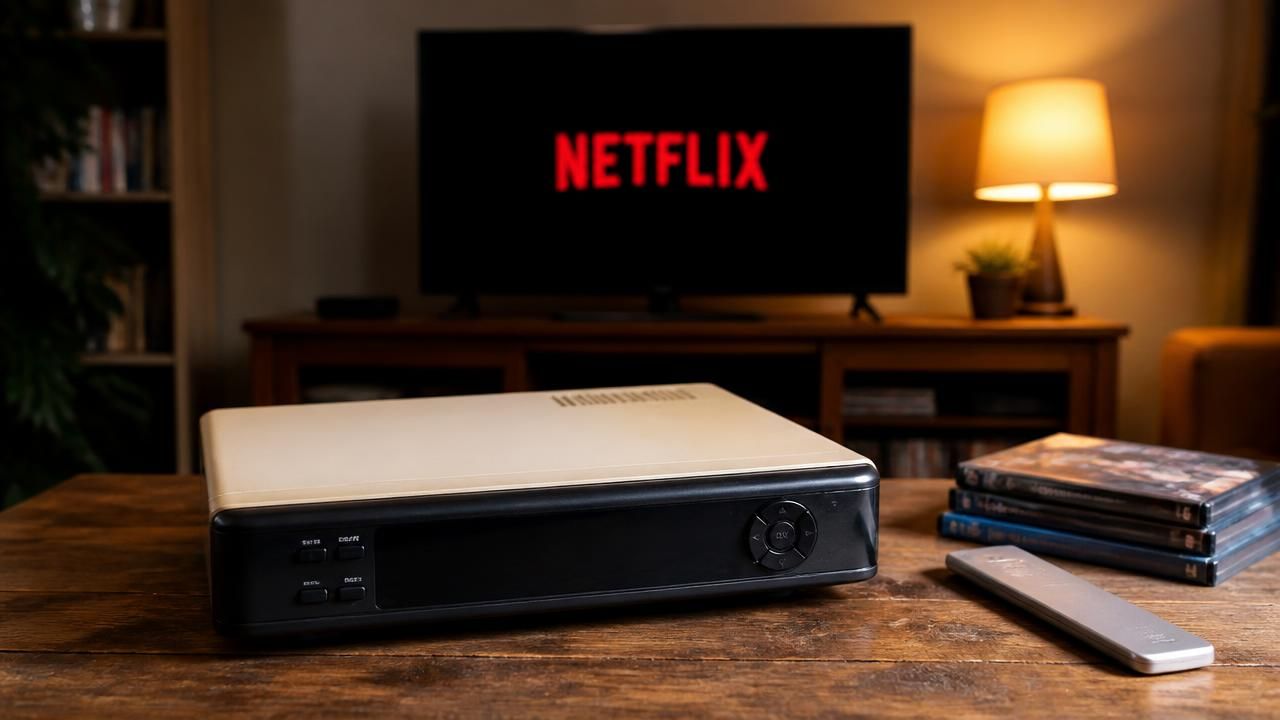
In the streaming industry, the past has a habit of arriving dressed as the future. That is the through-line of a widely read newsletter dispatch this week from The Verge, whose Stepback column turned its attention to a forgotten footnote in Netflix's history: a physical box the company once considered shipping to subscribers so they could watch high-resolution films downloaded overnight.
The conceit, as described by The Verge, was simple enough. Rather than rely on bandwidth at the moment of viewing, Netflix would push films to a set-top device in the evening; by the next day, they would be waiting for the subscriber to press play. It was, in effect, a broadcast model wearing a streaming costume — a cache disguised as a service.
"Before Netflix fully committed to becoming a streaming service and leaving DVDs behind, the company experimented with the idea of giving its subscribers a physical box that could access high-resolution digital copies of movies," the newsletter notes.
The company abandoned the idea, of course, and the decision looks obvious in hindsight. But the logic behind it — that reliable delivery beats infinite choice, that the pipe matters as much as the programming — has never really gone away. It has simply changed owners.
From Streaming Back to Cable
What makes the Netflix anecdote timely is the direction of travel across the entertainment business in 2024 and 2025. The unbundling that defined the last decade is reversing. Streaming services that once promised to kill the cable package are now assembling their own: Disney+, Hulu, and ESPN under one roof; Warner Bros. Discovery licensing content back to rivals; Comcast and Charter striking bundle deals with streamers they once treated as existential threats.
The term of art is "rebundling," but the consumer experience is unmistakably cable-like — a single bill, a fixed monthly price, and a channel guide by another name. Free ad-supported television, or FAST, has accelerated the drift. Services such as Tubi, Pluto TV, and Roku Channel now offer hundreds of linear channels that look and behave exactly like the cable dial, complete with scheduled programming and commercial breaks.
The Verge frames this as an inevitability: all roads lead to cable. The economics support the claim. Content costs have ballooned, subscriber growth in the United States has plateaued, and Wall Street has shifted its demand from user counts to profits. Bundling reduces churn, raises average revenue per user, and spreads acquisition costs across multiple brands.
The Wire, Unfiltered
If the entertainment industry is consolidating, the news industry is doing the opposite — and the week's aggregation sweep offered a blunt illustration. Alongside the streaming dispatch, the same automated collection surfaced three wire items from Wikinews: a report on the Taliban's enforcement of Sharia law in Pakistan, a notice that Toyota would recall the Sienna minivan in North America, and a roundup of shorts dated November 18, 2008.
Full text for all three was unavailable to automated readers, which were redirected to the site's robot policy. Even so, the headlines alone sketch the range of what a modern news feed carries in a single pass: geopolitics, product safety, and a sixteen-year-old anniversary item, all filed under the same algorithmic roof.
Three stories, three clocks
- Pakistan: Enforcement of Sharia law by a resurgent Taliban raises questions about governance, militancy, and the fragile relationship between Islamabad and its western border regions — a story that has cycled through the wire repeatedly since 2008.
- North America: A Toyota recall affecting the Sienna minivan places the world's largest automaker back in the familiar position of managing defect liability at scale, a recurring theme for the brand since the unintended-acceleration recalls of 2009–2011.
- Archive: A November 2008 shorts roundup is a reminder that wire copy is built to be disposable, and that its value is cumulative rather than individual.
The contrast is instructive. Streaming platforms are racing toward fewer, bigger bundles because attention is scarce and content is expensive. News, meanwhile, is fragmenting into an ever-wider set of feeds, each optimized for a different alert, a different handset, a different moment.
Why It Matters
The older Netflix experiment failed for a mundane reason: the hardware was expensive, the licensing was complicated, and the company found a cheaper way to reach the same destination. But the underlying problem — how to deliver high-quality video reliably to a mass audience without asking viewers to think about it — was never solved so much as temporarily outrun by faster broadband.
That is why the current rebundling wave deserves scrutiny rather than nostalgia. If the packagers win, they will control pricing, promotion, and the order in which shows are discovered — the same levers cable once pulled. Consumers may get simplicity back. They will also get fewer choices about which channels they pay for and which ones disappear into a tier they never asked for.
The wire items remind us of the stakes beyond entertainment. A recall notice, a security crackdown, and an archival roundup all depend on distribution to reach the people who need them. Whether that distribution arrives through a bundle, a feed, or a box under the television, the question is the same one Netflix asked two decades ago: who controls the pipe, and what do they let through?
For now, the answer appears to be a familiar one. All roads lead to cable — they just take longer to get there than anyone expects.