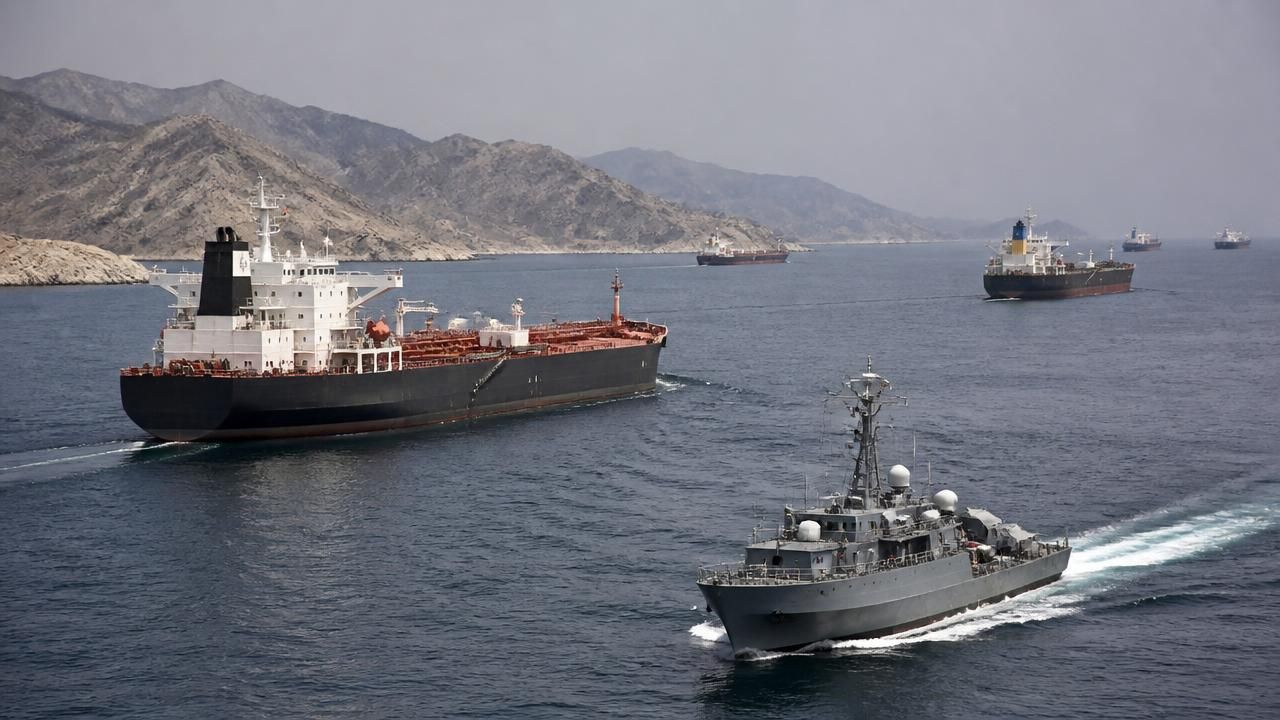
Oil and liquefied natural gas shipments through the Strait of Hormuz climbed to their highest level in six months over the past two weeks, U.S. Central Command said, arguing that American naval protection and mine-clearance operations are "paying off" even as the waterway endures its most violent stretch since the war with Iran began.
The competing signals — record throughput on one hand, the largest wave of tanker attacks in six months on the other — have left markets, insurers and shipowners struggling to price risk in a corridor that carries roughly a fifth of the world's seaborne crude.
"The escort and mine-clearing effort is paying off," a regional U.S. commander said, crediting the increased traffic to sustained naval protection of commercial vessels.
According to CENTCOM, more than 2,000 ships have now been escorted through the strait. The claim came just one day after Iran struck a tanker in the same waters, underscoring how quickly the security picture can shift.
A Strait Caught Between Reassurance and Risk
Al Jazeera framed the same data far more skeptically, publishing an analysis titled "Why Hormuz remains high risk for ships despite US claims of mine-clearing." The outlet noted that clearing known minefields does little to neutralize the threat from drones, fast-attack craft and anti-ship missiles, which have driven the recent attacks.
Shipping-industry publications echo that caution. Lloyd's List reported that the VLCC — very large crude carrier — market has hit a "historic high" as the crisis enters a new phase, a reflection less of confidence than of scarcity: owners willing to transit the strait are demanding extraordinary premiums, and many are simply refusing to go.
MarineLink reported that U.S. and Iranian forces struck oil tankers in the biggest single attack wave since the conflict's outset, with two vessels targeted in one episode as President Trump weighed his next move.
The Numbers Behind the Surge
- Hormuz throughput: highest in six months over the past two weeks, per CENTCOM.
- Escorted vessels: more than 2,000 since operations began.
- Crude benchmark: oil prices reached $97 a barrel as the U.S. and Iran exchanged ship strikes, according to CoinCentral.
- U.S. diesel: retail prices hit a record high, Fox News reported.
- Iranian exports: collapsed as the standoff dragged on, per MSN.
The picture is not uniformly bullish for supply. Bloomberg and MSN both highlighted the six-month high in shipments, while a separate MSN report described the strait as "choked off" as the two sides targeted tankers. Reuters added a further complication: the United States is set to import the most Middle East crude since the war began, meaning Washington's own energy supply chain is now more exposed to the very chokepoint its navy is policing.
Escalation in Washington
President Trump warned that "we're going to hit them hard" after Iran targeted U.S. forces in Jordan, CNBC reported — a signal that the administration is prepared to widen the geographic scope of its response.
Vice President JD Vance said "everything" remains on the table to pressure Tehran, while simultaneously claiming that the White House and the U.S. military had prevented an "energy crisis." That framing sits uneasily with record diesel prices at the pump, a tension Fox News Digital's live coverage captured without resolving.
The Cost Multiplying Through Global Trade
OilPrice.com reported that global shipping costs have exploded as Hormuz disruptions ripple through key trade routes. War-risk insurance premiums for Gulf transits have repriced sharply, and carriers rerouting around the Cape of Good Hope are adding days and fuel burn to Asia-Europe voyages.
The knock-on effects extend well beyond crude. LNG shipments — which the CENTCOM data also tracked — underpin European and Asian gas supply, and any sustained interruption would tighten markets already sensitive to weather-driven demand.
Financial markets have responded to each headline in turn. Yahoo Finance reported that oil prices rose and equities fell after U.S. strikes on Iranian sites in the Strait of Hormuz, a now-familiar pattern in which the same waterway alternately signals reassurance and alarm depending on the hour.
Why the Contradiction Persists
The gap between official optimism and industry anxiety is structural rather than rhetorical. Escort convoys and mine clearance can raise throughput in the aggregate while doing little to reduce the tail risk for any individual hull. A six-month high in volume is compatible with a six-month high in attacks if the number of ships attempting the passage has grown faster than the threat.
"Everything is on the table," Vance said, describing the administration's posture toward Tehran.
For shipowners, that ambiguity is the problem. Insurers price the worst case, not the average, and the recent spate of strikes gives underwriters ample reason to keep premiums elevated — costs that ultimately reach consumers through fuel and freight.
What to Watch
Three indicators will determine whether the six-month high in shipments represents a durable reopening or a temporary spike before another contraction: the frequency of attacks on escorted convoys; the trajectory of VLCC charter rates, which Lloyd's List describes as historic; and whether Iranian crude exports recover or continue to collapse. Until those lines converge, the Strait of Hormuz will remain what it has been for months — the world's most consequential contradiction.