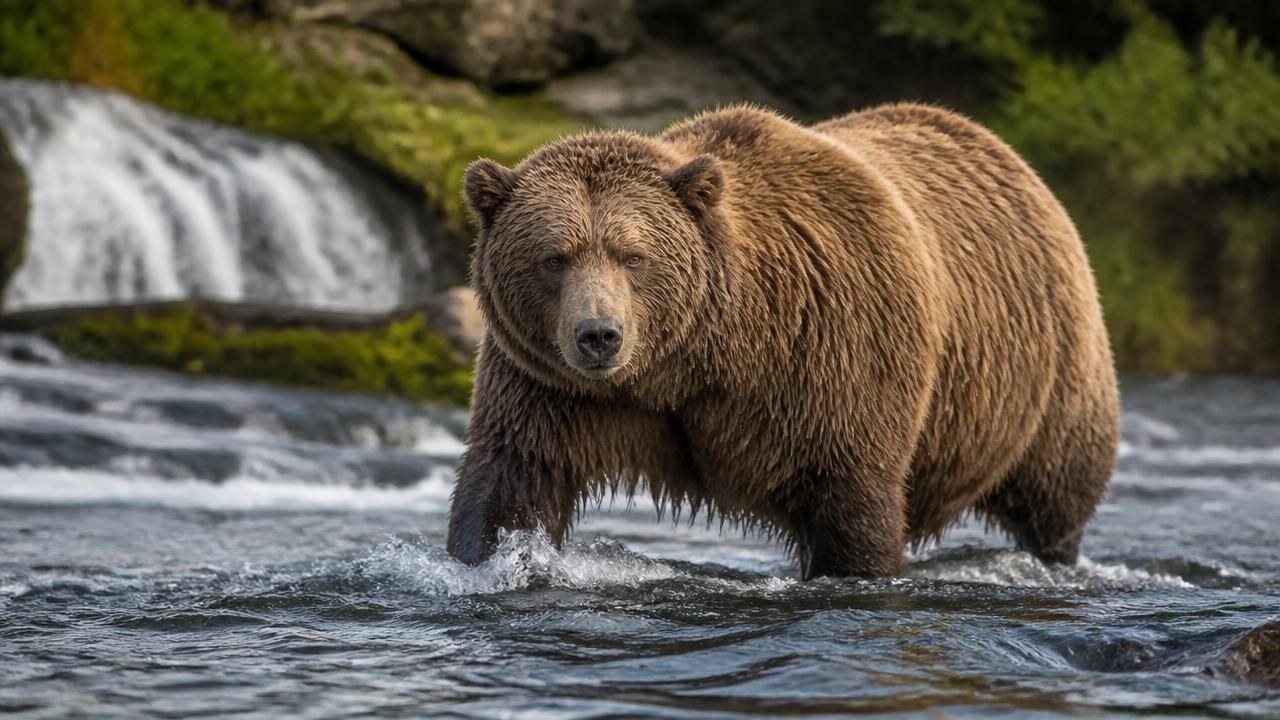
Katmai National Park and Preserve's brown bears are about to get their annual close-up — and this year the bracket is bigger than ever. Fat Bear Week, the single-elimination popularity contest that pits Alaska's most accomplished salmon-eaters against one another, will feature 16 competitors, up from 12 in past years, according to NPR News. Voting is scheduled to begin September 22, a date confirmed in early coverage from Yahoo and flagged in advance guides from USA Today urging fans to mark their calendars.
The expansion of the field is not the only sign of abundance on the Brooks River. Park officials report more cubs in Katmai this year than they have seen in recent memory — a detail that suggests the salmon run and the broader ecosystem are producing enough calories to support the next generation of gargantuan bears. NPR published a photo of one such contender credited to C. Loberg.
From ranger gimmick to global spectacle
Fat Bear Week began in 2014 as a modest educational tool devised by rangers at Katmai, a vast, roadless swath of the Alaska Peninsula reachable mainly by floatplane. The premise was simple: use the park's famous brown bears — and the live webcams trained on Brooks Falls each summer — to teach the public about hibernation, salmon ecology and the brutal arithmetic of survival in the subarctic.
A decade later, the contest has become a genuine internet phenomenon, drawing hundreds of thousands of votes from around the world and spawning a subculture of devotees who track individual bears by number, name and backstory. Smithsonian Magazine has called it "the wildest reality show in Alaska," an assessment that captures both its low-fi appeal — grainy camera feeds of bears standing in rushing water — and its capacity to generate genuine drama.
Organizers have long framed the contest as "a celebration of success and survival" — a rare competition in which every contestant's goal is simply to be heavier than it was in the spring.
How the tournament works
The format is deliberately straightforward. Rangers seed the bracket, usually pairing bears whose summer fishing résumés make for compelling matchups, and the public votes online in head-to-head rounds until a single champion remains.
- Field size: 16 bears, a four-competitor increase over previous editions.
- Format: Single-elimination, with fans voting in successive rounds.
- Start date: September 22, per early announcements.
- Platform: Votes are cast through the contest's official online hub, with live cameras streaming from Brooks Falls on explore.org.
- Criteria: Not necessarily the largest bear, but the one that has packed on the most impressive mass since emerging from hibernation in spring.
Why fat is the point
For a brown bear, autumn fat is not vanity — it is life insurance. A bear that enters its winter den with insufficient reserves may not survive the months without food, water, urination or defecation that define hibernation. Females must also nurse cubs through the denning season, drawing on stored fat to produce milk.
Katmai, created as a national monument in 1918 in the aftermath of the 1912 Novarupta volcanic eruption, now supports an estimated 2,200 brown bears — one of the densest concentrations on Earth. Each summer, millions of sockeye salmon surge up the Brooks River, and the bears assemble at Brooks Falls to intercept them mid-leap. Past champions have included famous repeat winners such as Otis, 747 and Grazer, each of whom became a minor celebrity with a devoted following.
The contest has also become an indirect barometer of ecosystem health. Salmon runs are sensitive to ocean conditions, stream temperature and fisheries management, and climate change is reshaping all three across Alaska. When the fish are plentiful, the bears get enormous — and the bracket gets crowded. This year's bumper crop of cubs may be the clearest signal yet that the river is doing its job.
The viral moment that keeps giving
If there is a single image that explains the contest's hold on the internet, it is the salmon that leaps directly into a waiting bear's mouth. Clips of bears feasting — and of fish effectively volunteering themselves as snacks — circulate widely every season, and MSN was among the outlets highlighting such a moment this year. The footage is equal parts nature documentary and slapstick, and it is precisely the kind of content that turns a park service outreach project into a global event.
How the story is being framed
Coverage of this year's edition reflects each outlet's instincts. NPR leads with the news peg: a larger bracket and an unusually strong cohort of cubs. Smithsonian leans into the culture angle, treating the contest as a reality-TV franchise with a cast of characters. USA Today plays the service journalist, telling readers exactly when to start voting. The Daily Mail goes straight for scale, touting "gargantuan 1,200-pound bears" pitted against one another. Yahoo and MSN push the practical, shareable essentials: dates, contenders and irresistible footage.
Such is the demand for Fat Bear Week content that several of the source pages compiled for this article returned traffic-limit or access errors — a fitting, if accidental, tribute to how thoroughly a contest about fish-eating bears has saturated the web.
What to watch for
As the September 22 start approaches, followers can expect ranger-authored bear biographies, side-by-side "before and after" photo comparisons and live-camera commentary from Brooks Falls. The winner will be the bear voters judge to have made the most of the summer — though as any longtime observer will note, the real victory was secured weeks ago, one salmon at a time.