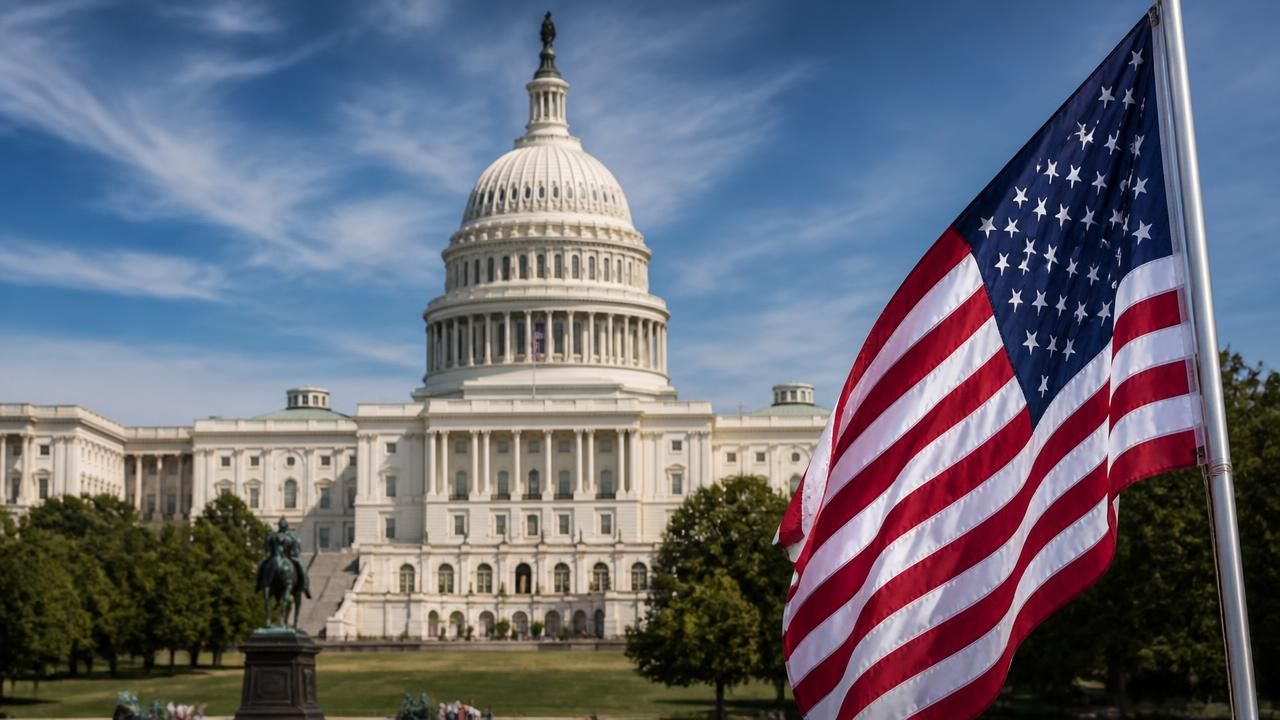
A new global assessment has placed the United States at its lowest level of democratic performance in half a century, a finding that arrives as democracies around the world confront eroding trust in elections, weakened institutions and shrinking civic space.
The report comes from the International Institute for Democracy and Electoral Assistance, known as International IDEA, an intergovernmental organization based in Stockholm that has tracked democratic indicators since the mid-1970s. NPR News, reporting on the findings, described the U.S. result bluntly: American democracy now sits at a 50-year low.
A new global democracy report finds the U.S. at its lowest level of democratic performance in the 50 years it has been measured.
The deterioration did not happen overnight. It reflects a long arc of declining scores across several dimensions of democratic health — representation, rights, rule of law and participation — rather than a single event. International IDEA's indices are designed to capture gradual erosion: court independence, press freedom, the ability of citizens to organize, the integrity of elections, and the willingness of political actors to accept unfavorable results.
What the Index Actually Measures
International IDEA's framework is not a single number but a composite built from dozens of indicators, tracked annually for roughly 170 countries. Because its data series stretches back to 1975, it is one of the few tools capable of putting today's democratic anxieties into a genuinely long-term context.
In that context, the U.S. trajectory is unusual. For much of the index's history, the United States sat near the top of the global distribution, a benchmark against which other democracies were measured. The current reading places it well below its own historical norm.
- Representation: the degree to which citizens' preferences translate into policy outcomes.
- Rights: protections for speech, assembly, association and the press.
- Rule of law: judicial independence and equal application of legal constraints.
- Participation: turnout, voter access and the breadth of civic engagement.
A Global Pattern, Not an American Exception
International IDEA has for several consecutive years documented net global democratic decline. By its count, roughly half the world's countries have seen their democracy scores fall over the past decade, while only a minority have improved. The 2024 electoral calendar — the largest in recorded history, with billions of voters casting ballots across dozens of nations — tested democratic systems under extraordinary strain rather than relieving it.
Analysts note that high-profile elections do not by themselves restore democratic health if the underlying institutions that make elections meaningful — independent courts, credible media, protected opposition — continue to weaken. That distinction between the ritual of voting and the substance of democracy runs through the report's findings.
The Conversation Beyond the Report
While major outlets covered the report primarily through a domestic political lens, the broader debate over democratic participation continues to surface across a far wider range of forums. Citizen-journalism outlets such as Wikinews have kept up a steady stream of interviews with figures operating at the edges of democratic politics: Rocky Anderson, the former Salt Lake City mayor and 2012 presidential candidate, spoke with the site about public policy and the state of democracy; a spokesman for the Greek far-left party Xekinima addressed left-wing organizing; and Wayne Tseng, a 2020 candidate for Lord Mayor of Melbourne, discussed local governance.
Other Wikinews coverage has ranged even further afield: a forum with Reform Party USA presidential candidates, and an interview with Professor Gigi Foster of the University of New South Wales about pandemic control policy in Australia. Taken together, the interviews illustrate something the index itself cannot easily quantify — the sheer breadth of places where questions of representation, dissent and accountability are being contested.
How the Story Is Being Framed
The framing varies sharply by outlet. NPR emphasized the domestic stakes, spotlighting the U.S. as the story's subject and using the global report as the backdrop. International IDEA's own communications stress the comparative picture, treating the American decline as one data point in a worldwide trend rather than an isolated crisis.
Smaller and ideologically diverse outlets use the findings differently, often as a hook for debates about institutional reform, party systems or the credibility of international rankings themselves. Sceptics argue that composite indices compress complicated national realities into a single score and that methodological choices inevitably carry normative assumptions. Defenders respond that the durability of the trend across multiple independent indicators is precisely the point.
What Happens Next
The report is unlikely to change policy on its own. Its significance lies in what it adds to a growing body of evidence: that democratic erosion in the United States is no longer a matter of partisan rhetoric but of measurable, long-running decline relative to the country's own history and to its peers.
For voters, the practical implications are concrete — questions of ballot access, judicial independence, press freedom and the peaceful transfer of power. For the rest of the world, the American result matters because the United States has long functioned as both a model and a guarantor of the democratic order it now imperfectly embodies.
Whether the downward curve flattens will depend on factors no index can forecast. But the measurement now exists, and by International IDEA's reckoning, it points to the lowest point in fifty years.