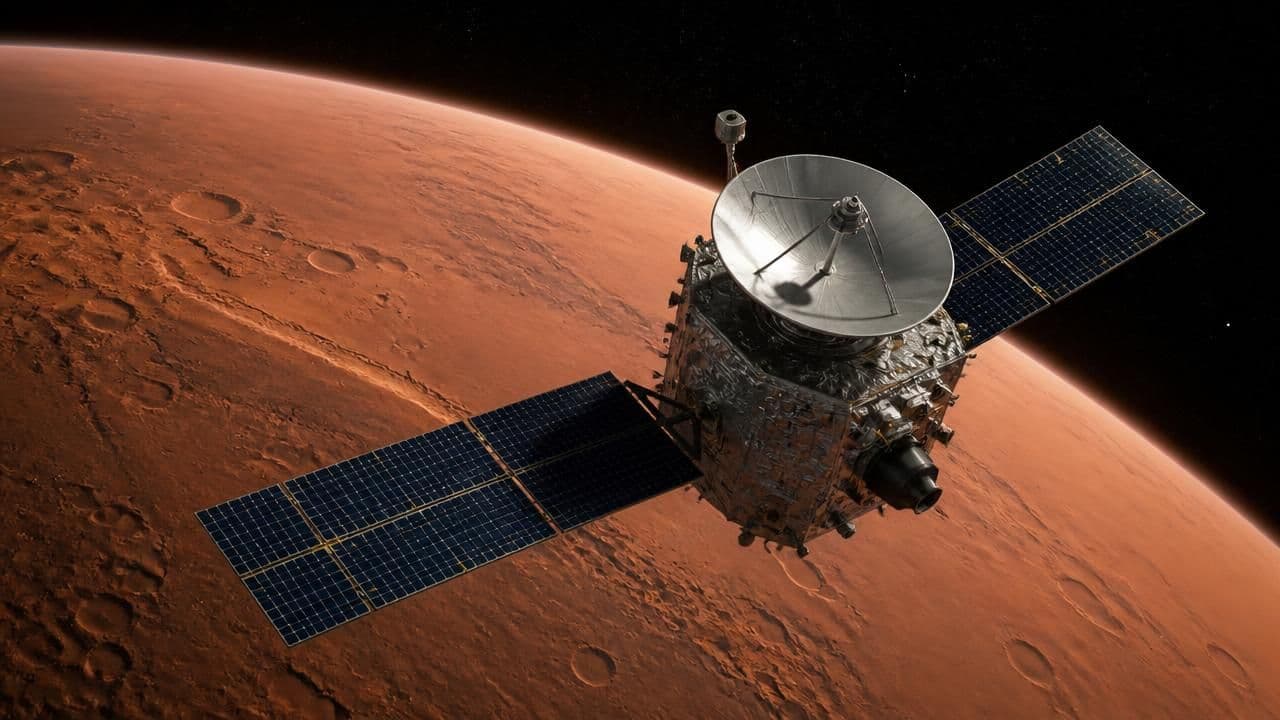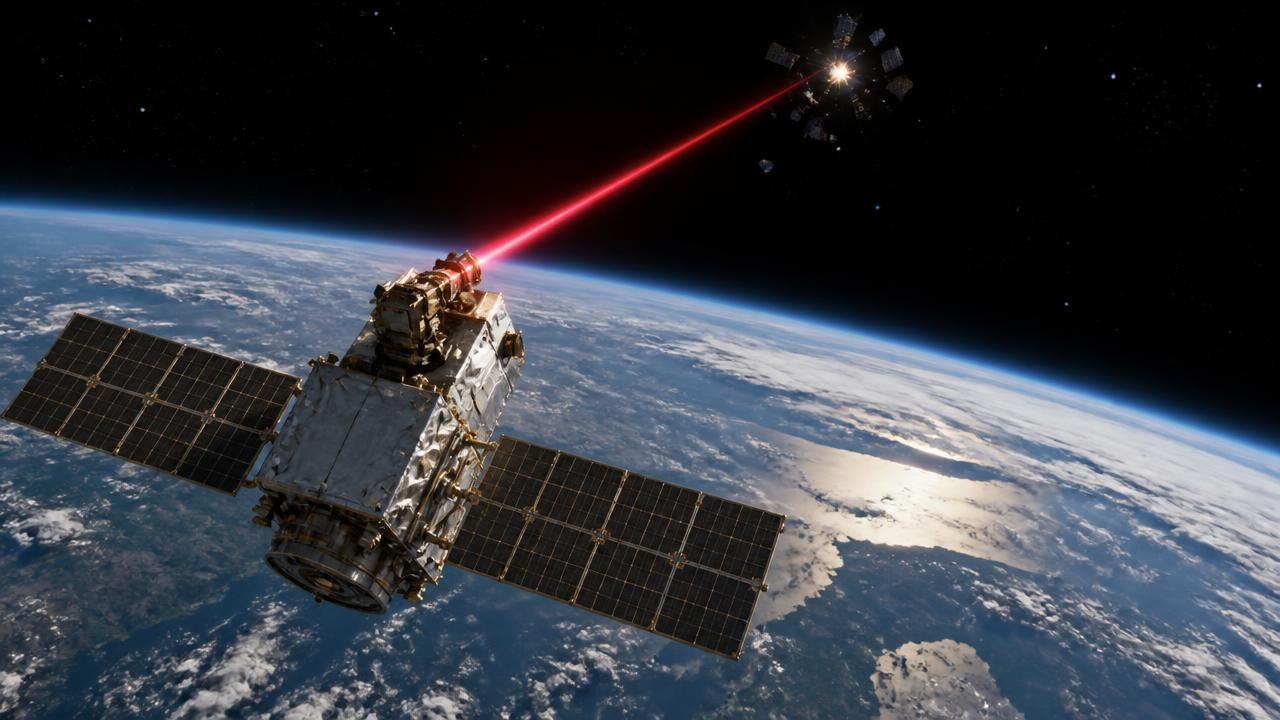
The United States has, for the first time, publicly confirmed that it has deployed weapons in orbit — ending decades of deliberate official ambiguity about the militarization of space and instantly reshaping the strategic calculus in Washington, Beijing and Moscow.
Air Force Secretary Troy Meink made the declaration on Monday during prepared remarks at the Air and Space Forces Association's annual Air, Space & Cyber Conference near Washington, D.C., telling an audience of officers, contractors and defense analysts that the United States “now has on-orbit space control weapons capable of defending the joint force against hostile adversary action.”
“Today, we continue to ensure we remain ready to meet the challenges of evolving threats, wherever they exist. This is why the United States now has on-orbit space control weapons capable of defending the joint force against hostile adversary action.” — Air Force Secretary Troy Meink
A declaration that was not entirely unexpected
As Ars Technica noted in its coverage, the announcement “will surely reverberate in the power centers of Beijing and Moscow,” but it did not emerge from a vacuum. Space Force officials have spoken openly for years about their interest in acquiring space-based weapons, and Pentagon leaders have grown steadily more willing to discuss space warfare in public as rivals field their own orbital capabilities. In that sense, Meink's disclosure was less a revelation than a formal ratification of a posture that has been developing in plain sight.
What is new is the candor. For as long as humans have operated satellites, governments have treated the precise nature of their orbital military assets as among the most closely guarded secrets in the national security apparatus. Monday's statement removes that ambiguity at the highest level of the Department of the Air Force.
What we know — and what remains classified
The announcement was deliberately narrow. Meink confirmed the existence of on-orbit space control weapons and described their stated purpose — defending the joint force against adversary action — but disclosed nothing about their number, orbital location, technical design or rules of engagement. Those details remain classified, and independent verification is effectively impossible given that most relevant orbits are unmonitored by any public sensor network capable of resolving payload function.
The phrase “space control” is itself significant. In U.S. military doctrine it refers to the ability to ensure friendly use of space while denying an adversary the same — a mission set that can span everything from jamming and cyber operations to rendezvous-and-inspect maneuvers and, at the far end, kinetic intercepts.
The treaty gray zone
International law does not categorically ban what the United States has now acknowledged. The 1967 Outer Space Treaty — the foundational document of space governance, ratified by more than 110 nations — prohibits the placement of weapons of mass destruction in orbit and the establishment of military bases on celestial bodies. It says nothing explicit about conventional weapons stationed in Earth orbit.
That gap has been the central fault line in arms control debates for a generation. Russia and China have repeatedly pushed for a binding treaty banning all weapons in space; the United States has historically resisted such instruments as unverifiable and as constraints on its own defensive options. In 2022 and again in 2024, Russia vetoed UN Security Council resolutions on the issue, and Washington has accused Moscow of developing a nuclear-armed anti-satellite capability — an accusation Russia denies.
Meink's statement effectively formalizes the American position that orbital weapons are a legitimate instrument of deterrence rather than a prohibited category of armament.
How the world is framing it
Coverage of the announcement varied sharply by region, reflecting the story's geopolitical charge.
- Ars Technica led with the strategic-signal angle, emphasizing that the disclosure would “reverberate in the power centers of Beijing and Moscow” and noting the Space Force's long-trailed ambition to field orbital weapons.
- The BBC and Le Monde treated it as a first-of-its-kind admission, framing the story around the novelty of official confirmation rather than the hardware itself.
- The Hindu, Firstpost and other outlets across the Indo-Pacific emphasized the word “first,” underscoring the significance for regional powers weighing their own space programs.
- Aggregators and wire pickups, including MSN and religious-wire services such as Worthy News, pushed the story to general audiences under headlines about a “secret orbital capability,” a phrase that may overstate how much the Pentagon actually revealed.
The common editorial thread was consensus on one point: the era of treating space as a sanctuary for non-military activity is over.
Why it matters
Space is the connective tissue of modern military power. Precision-guided munitions, drone video feeds, nuclear early-warning, financial transactions and global navigation all depend on satellites that are, by physical necessity, fragile and largely undefended. A small number of kinetic intercepts — or a single high-altitude nuclear detonation — could generate debris fields that render entire orbital regimes unusable for decades, a phenomenon dramatized by Russia's 2021 destruction of its own Cosmos 1408 satellite, which created thousands of trackable fragments and forced the crew of the International Space Station to shelter in place.
That vulnerability is precisely why the United States has spent the past decade building a more resilient architecture: proliferated constellations, rapid-response smallsat launch, and now what Meink describes as defensive weapons in orbit. It is also why the announcement is likely to accelerate reciprocal programs. Any capability described as “defensive” in a domain with no terrain to hold is inherently dual-purpose; a weapon capable of defending a satellite against an attacker is also, in most designs, capable of attacking one.
The unanswered questions
Three questions will dominate the coming debate. First, is there a credible arms-control pathway left? The United Nations' space security working group resumes deliberations later this year, but momentum toward a binding treaty has rarely been weaker.
Second, what does the disclosure do to the alliance structure? NATO and Indo-Pacific partners depend on U.S. orbital infrastructure; whether they are now covered by the new weapons — and what is asked of them in return — remains undefined.
Third, and most opaque to outside observers: what exactly is up there? Meink's sentence tells the world that the capability exists. It does not tell the world what it can do. In the deterrence business, that may be the point — but it also leaves one of the most consequential developments in modern space policy defined, at least for now, by a single public sentence.