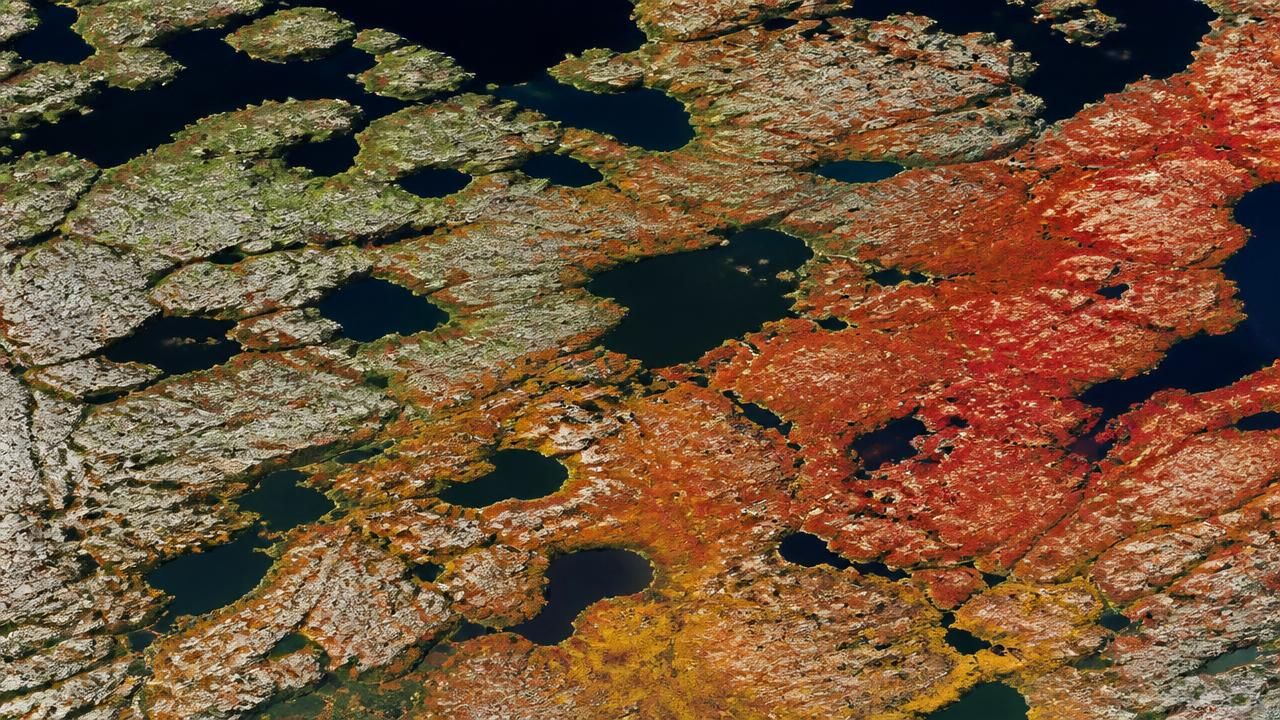
Fall arrived on schedule in at least one corner of North America this year — even as much of the continent was still sweltering. New imagery from NASA's Earth Observatory shows autumn color sweeping across the low-growing shrubs and tundra vegetation of Nunavut, Canada, in a pair of satellite views captured weeks apart by the Operational Land Imager (OLI) aboard Landsat 9.
The image pair, processed by NASA Earth Observatory visualizer Michala Garrison, contrasts conditions on July 27 with those on September 6. In the span of roughly six weeks, the greens of the brief Arctic growing season give way to the russets, golds and deep reds that mark the arrival of autumn at high latitudes.
A View From Orbit
The comparison is more than a pretty picture. Landsat 9, launched in September 2021 as a joint NASA and U.S. Geological Survey mission, images the planet at roughly 30-meter resolution and revisits the same ground track every 16 days. That cadence allows scientists to track the timing of seasonal transitions — known as phenology — with a precision that ground observers scattered across a territory the size of Western Europe could never match. Nunavut covers more than two million square kilometers, yet it has a population of fewer than 40,000 people.
Autumn color sweeps across the low-growing shrubs and tundra vegetation of Nunavut, Canada, in this image pair captured by the OLI (Operational Land Imager) on Landsat 9.
The context for the imagery is notable. As NASA's Earth Observatory noted, North America rode out a summer of remarkable heat, and in early September, fall foliage and crisp weather still seemed like distant, alien concepts across much of the continent. But fall comes early in the tundra and subarctic ecosystems of the far north, where the growing season can be as short as six to eight weeks.
Why the Tundra Turns First
The mechanics are well understood. As daylight shortens and temperatures drop, plants stop producing chlorophyll — the pigment that keeps leaves green — allowing carotenoids and anthocyanins to show through. In Arctic tundra environments, the dominant vegetation is not tall deciduous trees but dwarf birch, willow, heath and lichen, which respond quickly to the first sustained cold snaps.
Because permafrost sits close to the surface across much of Nunavut, root zones stay cool and shallow. That makes tundra plants acutely sensitive to air temperature and soil moisture, and it makes places like Nunavut a kind of early-warning system for broader climate trends. Shifts in the timing of green-up and color-change are among the most closely watched indicators in northern hemisphere ecology.
The Forecast: How Weather Shapes the Show
South of the Arctic, the story is far less settled. Forecasters and foliage watchers are already publishing early predictions for the autumn display now unfolding across the continental United States and southern Canada — and the consensus is that weather, not calendar, will determine how vivid it is.
Two variables matter most:
- Summer drought stress. Prolonged heat and low rainfall can push trees to shut down early, producing duller colors or causing leaves to brown and drop before they ever turn.
- Early autumn conditions. Sunny days paired with cool — but not freezing — nights favor the anthocyanin production that gives maples their signature reds. A hard early frost, by contrast, can end the show abruptly.
The same heat that made this summer memorable across much of North America therefore cuts both ways. In some regions, ample late-summer rain could set up a strong season; in others, drought conditions may translate into a compressed and muted display.
Different Lenses on the Same Story
The story has surfaced through markedly different channels, and each frames it differently. NASA's Earth Observatory approaches the subject as a remote-sensing record — a data point in a decades-long archive of how the planet's vegetation responds to a warming climate. The agency's Image of the Day series is designed less to forecast a leaf-peeping weekend than to document large-scale environmental change.
Consumer-facing coverage, by contrast, treats fall foliage as a planning question: when should travelers book, which regions will peak, and will this year's colors be worth the drive. Aggregators and wire feeds have amplified that framing, pushing foliage predictions into mainstream news cycles alongside weather and travel content.
Neither framing is wrong, but they answer different questions. The satellite view asks what the planet is doing; the forecast view asks what it means for a Saturday afternoon in Vermont or Ontario.
What to Watch
For researchers, the Nunavut imagery adds another entry to a growing record of shifting seasonal timing in the Arctic, where warming is occurring faster than the global average. For everyone else, the practical takeaway is that the coming weeks will reveal whether a hot summer translates into an early, muted autumn or a delayed, spectacular one.
The tundra, as always, has already made its decision — and Landsat was watching.